
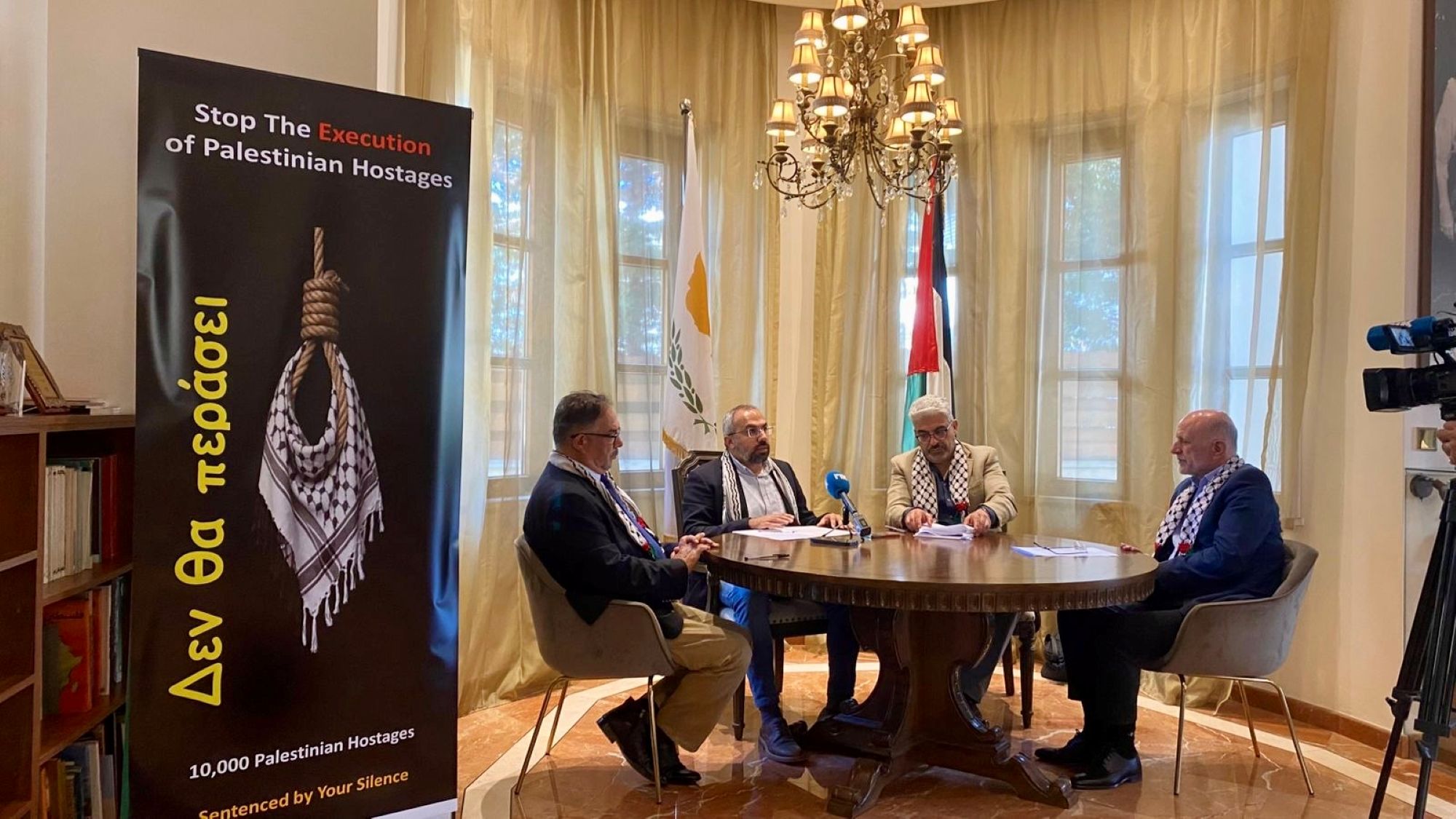
Speakers at an event held on Thursday at the Palestinian Embassy in Nicosia voiced strong opposition to recent Israeli legislation introducing the death penalty for those convicted of terrorism, warning it raises serious legal and human rights concerns.
The press conference brought together Palestinian ambassador Abdallah Attari alongside former Palestinian minister Shaddad Attili, University of Nicosia professor Nikos Trimikliniotis and Akel MP Giorgos Koukoumas, all of whom criticised the law, tabled by Israel’s national security minister Itamar Ben-Gvir as discriminatory and incompatible with international legal standards.
Attari said the measure causes “particular concern” and comes at a time when the Palestinian issue “has been largely sidelined from the centre of international attention”.
He described conditions in the West Bank as “tragic” with “settlements and ongoing attacks”, while in Gaza “the humanitarian crisis is intensifying and the massacre continues daily”.
Attili stated that he “comes from a place where genocide is still ongoing” and “I come from the West Bank, where annexation is taking place every minute”.
He argued the law extends beyond a domestic legal issue, saying “this is not a law that concerns Palestine alone” but one that challenges the foundations of international law.
He called for global intervention, warning the measure “constitutes a violation of the rules that govern the entire world”.
Trimikliniotis presented a legal analysis describing the legislation as “a flagrant violation of fundamental rights and a serious affront to international law”.
He argued that capital punishment in this context breaches the right to life, equality before the law and fair trial guarantees, particularly given that Palestinians are often tried in military courts.
“This is not an isolated penal reform. This is a legislative manifestation of an already established regime,” he said.
He further claimed the law is “racially targeted” and creates unequal legal status since “Israeli citizens and settlers are explicitly excluded”.
According to his assessment, “any death sentence in such a system would be arbitrary and illegal”, citing concerns over limited defence rights and the use of secret evidence.
He added that “the international community is not enough to condemn, it must act”, stressing that states have legal obligations not to support or legitimise violations where there are indications of war crimes.
Trimikliniotis also announced the creation of an international monitoring initiative focused on torture and detention conditions of Palestinian prisoners.
He said the effort would involve academics and human rights experts and aims to systematically document alleged abuses.
“We have a responsibility to stop the evil and to resist any participation or cover up of this unacceptable regime,” he said, with Attari expressing support for the initiative.
Koukoumas described the legislation as “a direct conflict with international law and human rights” and argued it reinforces “a dual legal system” in which Palestinians in the West Bank are subject to military rule while Israeli settlers are not.
He said “there is no concept of a fair trial under occupation” and cited figures indicating around 9,500 Palestinians are currently held in Israeli prisons, “thousands of whom are imprisoned without trial”.
He further characterised the measure as “racist legislation” that entrenches “racial and ethnic hierarchy” and called on the Cypriot government to take action at European level.
He urged authorities to advocate for repeal of the law and to raise the possibility of suspending the EU-Israel association agreement.
Israel’s ambassador to Cyprus, Oren Anolik, defended the policy in previous remarks to the Cyprus Mail, arguing that capital punishment is not incompatible with democratic systems.Bottom of Form
“It is not uncustomary for a liberal democracy to implement such a policy,” he insisted, citing a comparison with Japan and arguing that the “extremist fundamentalism” that is propagated by Hamas requires a stronger response.
He further criticised the Palestinian authority’s financial support programmes for prisoners and families of those killed in the conflict, which Anolik argues “incentivises violence via a pay-to-slay scheme”.





Click here to change your cookie preferences