
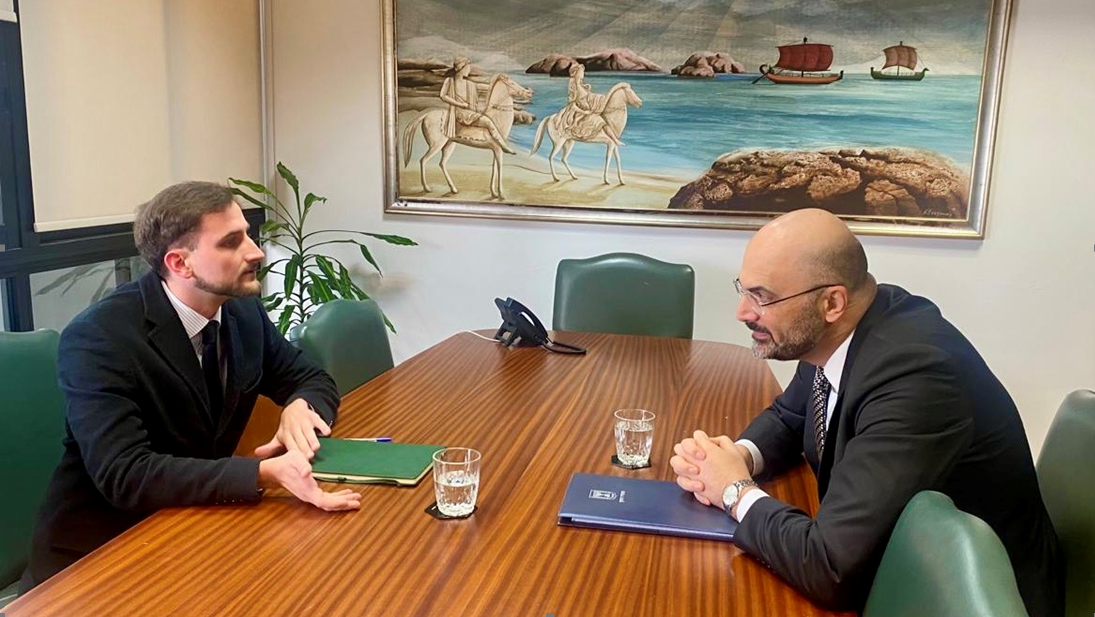
Israeli ambassador asserts Iran’s nuclear capability remains intact
Israel’s ambassador to Cyprus, Oren Anolik, has asserted that while Iran’s nuclear and ballistic capabilities have been significantly degraded by US-Israeli strikes they have not been entirely eliminated, as the conflict now spreads across multiple theatres in the region.
Speaking to the Cyprus Mail, the ambassador outlined three core objectives behind Israel’s campaign: the dismantling of Iran’s nuclear infrastructure, degrading its ballistic missile capabilities, and creating conditions in which “the Iranian people can decide their own fate.”
“We are not seeking to create regime change from air strikes,” he assured. “That has never been an explicit goal of Israel.”
American and Israeli strikes in June targeted key nuclear facilities, including at Natanz and Isfahan, in what the ambassador described as “a coordinated effort to disrupt Iran’s military nuclear programme”.
However, he said the issue of enriched uranium remains unresolved.
“The fissile material, which is in Iran’s case enriched uranium, has been a major bottleneck. This has changed in recent years for it is now a matter of a few days to produce weapons grade uranium, that being 90 per cent enriched, from a ready-made stockpile of say 60 per cent enriched uranium.”
Israel assesses that Iran’s overall nuclear capability has been delayed, “we believe they have been set back by at least a year,” he said. Yet he cautioned that “deeply buried stockpiles” with Iran’s mountainous terrain continue to pose a risk “dependent on the strategy that the regime intends to implement”.
Anolik affirmed Israeli and US intelligence assessments align, particularly over Iran’s efforts to move critical infrastructure underground.
He further alleged that since 2003 the regime has conducted clandestine nuclear testing under the ‘AMAD project’ masquerading as civilian energy purposes while pursuing military capabilities.
“It is Iran that chose this road, threatening their neighbours and exporting ideology and terrorism with proxies such as Hezbollah and Hamas.”
Israel is now engaged across what Prime Minister Benjamin Netanyahu has described as a multi-front conflict, including Lebanon, Iran and most recently the Red Sea, where Houthi forces have recently struck Israeli territory.
Despite concerns raised by opposition leader Yair Lapid in the Knesset, that the IDF is operating ‘near breaking point’, the ambassador insists Israel retains the capacity to sustain operations.
“The state of Israel is obviously not inexhaustible in its resources,” he admitted.
“However, the Israeli economy is remarkably resilient, and the army is still most certainly capable of carrying out its objectives.”
He rejected suggestions that Iran’s retaliatory capacity had been underestimated, following continued missile and drone attacks across the region.
“We were not taken by surprise,” Anolik stressed. “They threatened to enact these moves beforehand.”
He accused Iran of breaking international law with its deployment of cluster munitions against civilian areas and warned of the broader risks posed by strategic maritime chokepoints, including the Strait of Hormuz and the Bab al-Mandeb (Gate of Tears).
“The global economy should not be held hostage by the Iranian regime to these areas,” he said, pointing to alternative routes such as the India-Middle East-Europe Economic Corridor (IMEC) corridor linking the Gulf through Israel to Europe.
Regarding Israel’s establishment of a ‘security zone’ in south Lebanon, extending to the Litani river, the ambassador asserted that the deployment of troops is not permanent and primarily aimed at preventing Hezbollah from using the south as a launch pad for a possible invasion into northern Israel.
“Israel has no territorial claims over Lebanon,” he said. “This is purely a temporary positioning.”
His comments contradicted Defence Minister Israel Katz’s comments on Tuesday that the army will establish a “permanent security zone” after the current war ends.
He lambasted the Lebanese government for having failed to meet its obligations under a November 2024 ceasefire agreement to disarm Hezbollah, describing the group “as a regional abnormality, more powerful military than the supposed sovereign state itself, and operating with direction from Iran”.
The Lebanese campaign has displaced approximately one million people within the Lebanon and left more than 1,200 dead, including most recently reports of journalists and UN peacekeepers.
“The Israeli military does not deliberately target civilians,” the ambassador stressed.
“We instructed the Lebanese civilian population to withdraw from that combat zone for their own safety.”
Anolik inferred that “most casualties were likely Hezbollah terrorists” and acknowledged that “in war, accidents do happen” in reference to peacekeeper deaths, adding that the incidents would be investigated.
He also alleged that Hezbollah embeds military infrastructure within civilian areas, including tunnels and disguised convoys as ambulances in certain cases.
“The situation in south Lebanon emulates Hamas’ tactics in Gaza,” he said.
On Iran’s internal structure, the ambassador acknowledged its decentralised ‘mosaic’ system makes expediated political change unlikely, even under sustained pressure.
“This shall be up to the Iranian people to decide,” he said, adding that Israel ultimately seeks “an Iran, that does not seek to destroy the State of Israel, export terrorism abroad and is no longer a global threat.”
He also warned that Iran’s missile capabilities extend beyond the immediate region.
“They do indeed have the ability to strike European targets,” he said, refuting claims made earlier by the Iranian ambassador who dismissed the claim that Iran had the range to reach either Europe or the UK-US bases in Diego Garcia.
The United States has indicated it would target key Iranian energy infrastructure and potentially seize strategic islands in the Persian Gulf, should apparent negotiations between the two sides fail to produce meaningful terms.
The ambassador said coordination between Washington and Jerusalem remains close.
“Israel and the USA have excellent cooperation on all levels, whether that be political, bureaucratic or militaristic.”
Domestically, Israel’s Knesset has recently passed legislation, that was tabled by National Security Minister Itamar Ben-Gvir, making the death penalty the default sentence for Palestinians convicted of terrorism.
The ambassador framed the penalty as part of a deterrence strategy.
“It is not uncustomary for a liberal democracy to implement such a policy,” he insisted, citing a comparison with Japan and arguing that the “extremist fundamentalism” that is propagated by Hamas requires a stronger response.
He further criticised the Palestinian authority’s financial support programmes for prisoners and families of those killed in the conflict, which Anolik argues “incentivises violence via a pay-to-slay scheme”.
On the matter of Cyprus having been affected by the wider regional conflict, the ambassador said that he “doesn’t believe that Israel or any state for that matter considers the economic ramifications of a conflict on the wider region before initiating a military operation.”
“This was an existential threat facing our nation and must be seen through. In regard to Cyprus we will do all that is possible to help mitigate the impacts.”
He rejected concerns that Cyprus is being drawn into the conflict through its alignment with Israel.
“I believe that Cyprus is making the right choice in cooperation with Israel,” he said.
“We are sharing resources, information, we hold excellent economic relations, ultimately it will serve Cyprus’ interests and security well in the long run.”
The ambassador also addressed public discourse within Cyprus surrounding an apparently bolstered Israeli presence on the island, referring to comments made by Akel secretary-general Stephanos Stephanou regarding the impending ‘ghettoisation’ of the Jewish community in Cyprus.
“Those statements crossed a line, the singling out of Israelis and Jews stokes an irrational fear of only one group of people.”
He drew a distinction between criticism of Israeli policy and antisemitism, saying the latter involves targeting individuals or communities rather than state actions.
On the question of Turkey, the ambassador described Ankara’s role in the region as “a destructive force”, citing increasingly hostile rhetoric from President Recep Tayyip Erdogan’s ruling AKP and deteriorating relations since the October 7 attacks.
“It was Turkey’s decision to worsen relations with Israel,” he said, remarking upon Ankara’s lack of condemnation of Hamas and its ties to the group and the Muslim Brotherhood.
“We previously held strong relations with past Turkish administrations, yet it seems unlikely at present for a return to past pleasantries, it would certainly be preferable if they were to play a more constructive role.”


Click here to change your cookie preferences