
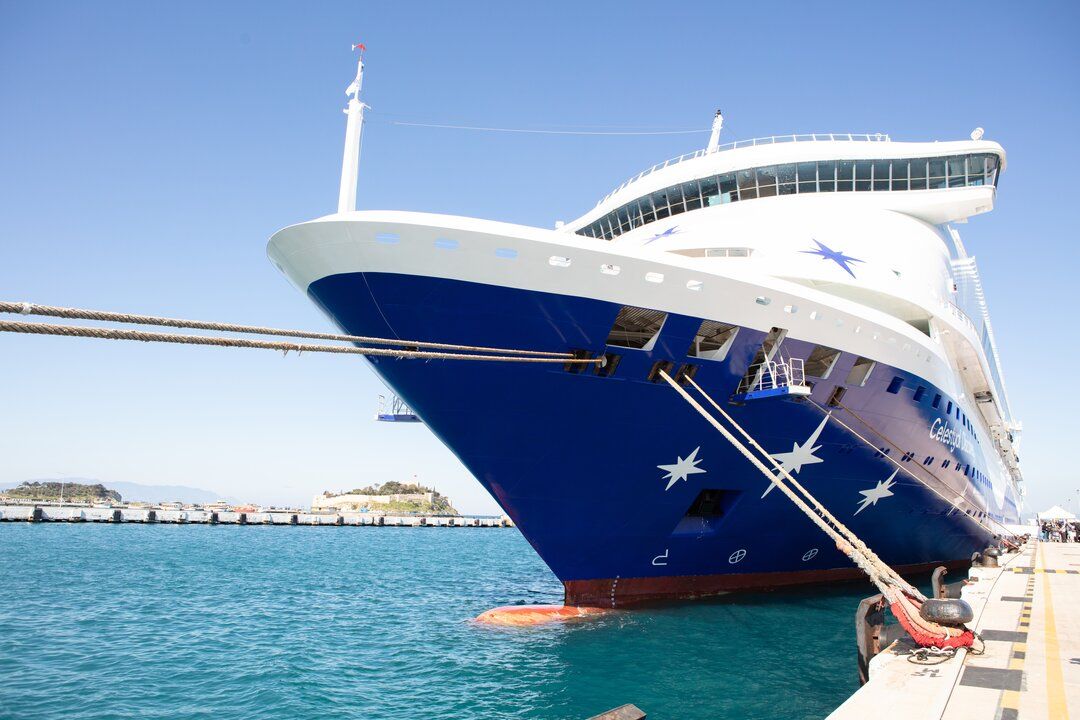
Celestyal’s two cruise ships have safely returned to the Mediterranean after transiting the Strait of Hormuz and the Suez Canal, clearing the way for the company to restart its summer sailings from Athens at the beginning of May.
The company confirmed that Celestyal Discovery and Celestyal Journey will now make their way to Athens, where they are expected to begin sailings on May 1 and May 2, respectively.
“We are delighted to share that Celestyal Discovery and Celestyal Journey have both safely arrived in the Mediterranean following their successful transit through the Strait of Hormuz and the Suez Canal,” the company said.
It added that the vessels’ progress had been closely followed in recent weeks, saying it was “pleased to confirm” that both ships would now return to Athens before resuming operations.
“We would like to extend our sincere thanks to our crew, guests and partners for their continued support throughout this journey,” Celestyal said.
The return of the two ships marks a major step for the cruise line, after both vessels had been stranded in the Persian Gulf since the outbreak of war on February 28.
Celestyal is now preparing promotional activity and offers to fill remaining gaps in its summer programme, as it looks to rebuild demand after weeks of disruption.
Lee Haslett, chief commercial officer at Celestyal, told a Travel Weekly webcast that the vessels made it safely through the Strait of Hormuz when a brief window of opportunity opened on April 17 and 18.
With the ships now heading back to Greece, he said the company’s attention had turned to restoring demand for the summer season, particularly for sailings in June, July and August.
“Our business has more than doubled week over week, we are starting to see people are now very much booking us because they’ve got some certainty,” Haslett said.
“We are planning some promotional activity, to drive both awareness and, show the value of a cruise versus a land stay,” he added.
“We will be taking some price action, from next week,” he added.
Haslett said Celestyal would also “re-engage and connect” with travel agents, adding that “there are some great opportunities for guests to get a really good deal for this summer in the Greek islands.”
Before the crisis, the cruise line had recorded a strong wave campaign and remained “quite well booked” for May.
Its next planned departures are a three-night Iconic Greek Islands sailing on Celestyal Discovery from May 1, followed by a seven-night Heavenly Greece, Italy and Croatia sailing on Celestyal Journey from May 2.
Even so, Haslett said the disruption had affected bookings for the peak summer period.
“We have seen a bit of a demand drop in the last seven weeks, which means that we’ve definitely got some work to do in the next few weeks to fill the final gaps in June, July and August,” Haslett said.
“September through to November look very good for us,” he added.
At the same time, he said that “there is some work for us to do to fill the summer months, there is some good availability in the summer, where we have seen a little bit of a slowdown.”
Despite the short-term pressure, Haslett said the company remained confident about its long-term plans.
He described the team as “strong” and “resilient”, saying Celestyal was “definitely back” and would be operating at 100 per cent from the start of May.
“We have great [agent] partnerships that have been growing, some of that slowed down in the last seven weeks and we need to get back to that,” he said.
Asked about the company’s future plans, Haslett said the crisis did not change Celestyal’s long-term outlook, which remained one of “continued growth”.
“We have got very supportive shareholders that have been very supportive through this period, and will continue to be,” he said, adding that “we are a very stable business.”
However, he acknowledged that the disruption had taken a financial toll on the cruise line.
“We have clearly taken quite a hit by not being able to operate for 49 days, and then another two weeks on top of that, while the vessels come back,” he said.
Asked whether measures such as a consultation over job losses remained in place, Haslett confirmed that they did.
Meanwhile, plans for Arabian Gulf itineraries scheduled for winter 2026-27 are also being reviewed, with an announcement expected in the coming weeks.
The situation with fuel costs is also under review, although Haslett said a decision on fuel surcharging would be “a last resort”.
Alongside the commercial impact, Haslett also pointed to the operational work behind the ships’ safe passage.
He praised Celestyal’s operations team and the leadership of Captain George Koumpenas, chief operating officer at Celestyal Cruises, who flew to Dubai to join Celestyal Discovery before it sailed through the Strait of Hormuz on April 17.
Haslett said a voyage plan had been prepared in advance, with the vessels sailing in daylight and close to Khasab, Oman, in order to avoid moving too far north towards Iran.
Celestyal also liaised with the Omani government, regional and local authorities, international security authorities and industry bodies over the plan, while the US Navy monitored the ships’ passage, providing “additional security and reassurance”.
According to Haslett, Discovery’s captain, Nikolaos Vasileiou, and Journey’s captain, Angelos Vasilakos, developed the voyage plans with the cruise line’s team in Piraeus, drawing on their knowledge and experience of the area.
“We gave every member of crew the option of staying in Dubai and not doing the voyage,” Haslett said, adding that “we would not put our crew in any danger. But they had to be comfortable that they wanted to operate it, which they were, and they had the option if they wanted to leave the vessel.”
There were around 70 to 80 crew members on each vessel, the minimum required to operate the sailings safely.
Celestyal Journey’s passage on April 18 was timed to reach the Strait of Hormuz at dawn, allowing the ship to transit in daylight alongside MSC Euribia and Tui Cruises’ Mein Schiff 4 and Mein Schiff 5.
Haslett said Celestyal had coordinated with other cruise lines ahead of the passage, agreeing to move in a convoy, with Celestyal Journey leading the group.
“It was a great collaboration,” he said.
He credited the safe passage mainly to Celestyal’s captains and operational teams, making clear that their work had been central to bringing the ships back safely.
“My role is kind of insignificant compared to what our captains and operational team have done,” Haslett said.
With the ships now returning to service, he said his own focus would shift back to the company’s commercial recovery.
“My role now is to ensure, when the ships are back, that we fill them, and hopefully we get all of that great support from the UK travel trade,” he said.





Click here to change your cookie preferences