
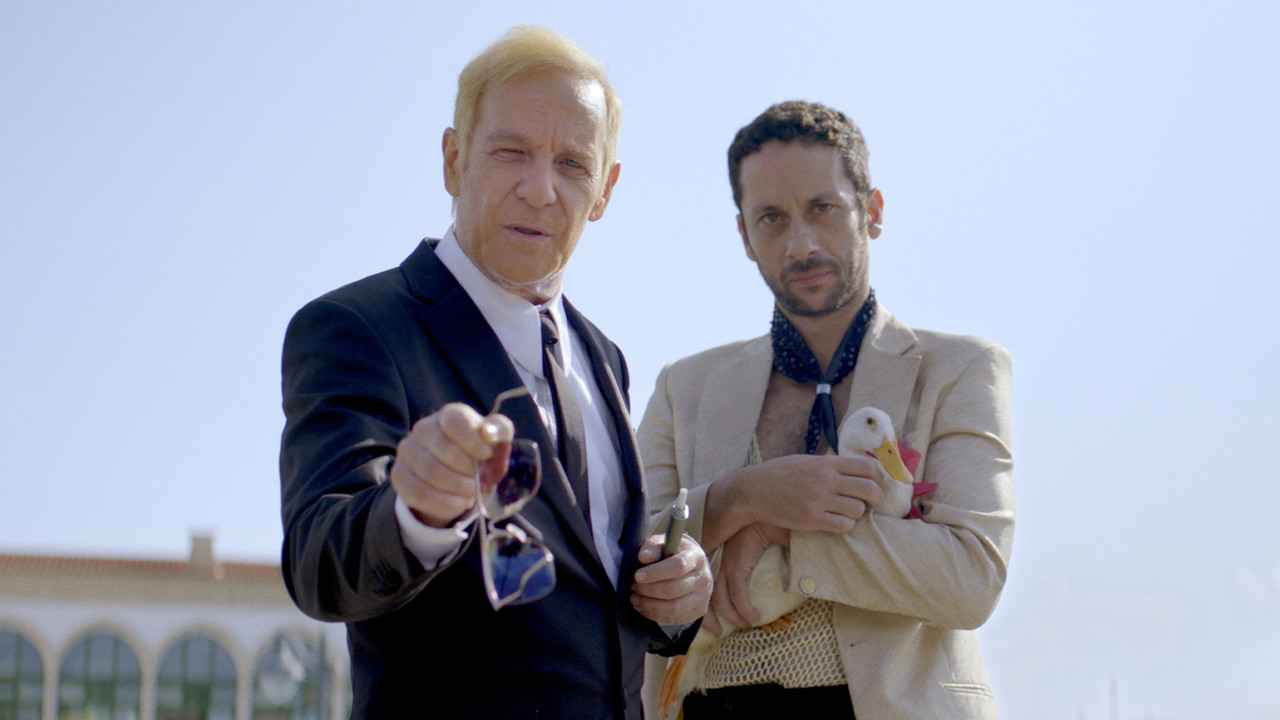
Film partly shot on the island looks at denial required to live in Israel now while ignoring the genocide
Does Yes have a Cyprus connection? In a word, yes. There are actually two obvious links.
The more obvious is that Yes – though made by an Israeli filmmaker, and set mostly in Israel – is a co-production with Cyprus, with around 40 per cent of the film being shot here. “Sometimes Cyprus was playing Cyprus [actually not Cyprus per se, but an unnamed Greek island],” explains writer-director Nadav Lapid, “and sometimes Cyprus was playing Tel Aviv”.
The second connection is that Yes is a film about denial, the denial needed to live in Israel now while ignoring the genocide – Lapid’s own word – in Gaza. It’s a theme that resonates with Cypriots (on both sides, but more in the Republic), who go about their daily lives while steadfastly ignoring the elephant across the Green Line.
Yes played at Cyprus Film Days in Nicosia and Limassol, and Lapid – the festival’s most high-profile guest, a world-class director who’s won major prizes at Cannes, Berlin and Locarno – sat down for a chat with artistic director Argyro Nicolaou a few hours before the Nicosia screening, also taking questions from the audience.
He began writing the film in 2022, he says, but rejigged it after the events of October 7, 2023, incorporating the shock of that day and its aftermath – and actually started filming exactly a year later, by which time Israeli society was consumed by what he calls a “morbid vivacity… The ecstasy of disaster and war, a terrible ecstatic state of mind of death and killing”.
That said, the screenplay he’d already written pre-Gaza remained very relevant.
That script, he believes, “describes Israeli society – and maybe not only Israeli – one second before the 7th of October…
“It’s about our world, the chaos of our world. It describes a society addicted to power and money, where vulgarity and hyper-nationalism walk hand in hand. A society despising any sense of tenderness – any complexity, any fragility, any sensitivity.”
After all, he adds, “when I speak about now, when I speak about Israel, I don’t care about Netanyahu… I think Netanyahu is a consequence – and all his ministers and all his government, they’re only a consequence of the collective soul of a place, of a collective psyche.
“And for me, I’m much more curious about – I dunno, how people eat their breakfasts in Tel Aviv than the latest speech of Netanyahu.” What intrigues him, he says, is above all the “melody” – the rhythm and cadence of Israel, the way people live and love and go to the beach, even with the hard (but hidden) truth of Gaza thrumming like an ominous backbeat.

As for the society itself, “I think that for many, many years I’ve felt that Israel is a sick society”.
Yoav, the hero of his 2019 Synonyms (winner of the Golden Bear at Berlin), heads to Paris on a one-way ticket, hoping to flee what he sees as the madness of his country. 51-year-old Lapid made that journey in real life, and has lived in Paris with his wife and son for several years now – though, responding to a question from the audience, he insisted he doesn’t see himself as an exile.
Actually, he added, “I feel myself not just 100 per cent, but 1,000 per cent Israeli. Living in Paris will not change that.
“So, when I talk about a sick Israeli soul, I talk about myself as well.”
That’s what gives the film its complexity – though it doesn’t endear it to everyone. Yes was among the most high-profile films at the festival – but opinions were mixed, judging by the post-screening crowd a few hours later.
“It’s like he’s trying to save Israel’s soul,” one audience member told me disapprovingly, the implication being that such a quest was unworthy and morally dubious. “It’s not easy to love you guys,” sighs the film’s protagonist at one point, doubtless speaking for Lapid himself – but most non-Israelis seem unmoved by the difficulty of ‘loving’ a nation in the grip of genocidal ecstasy.
Then again, the film (which explicitly states that Israelis have become like the Germans under Nazism) hasn’t exactly pleased the folks back home either – or the great and good of the cinema Establishment.
Some tried to dissuade him from even making it. “I can tell you that many people – people who I like – told me, ‘Maybe it would be more clever to wait five or six years, like Coppola [with the Vietnam war] in Apocalypse Now…
“Yes is a film that deals with cowardice. But while doing the film, I didn’t imagine how common and popular cowardice is, mainly among institutions,” he says acerbically.
“After this year’s experience, I wonder why people make so many films about heroes, when actually the most popular quality is cowardice. We should have thousands of films about cowards, because there are so many of them.
“Some of them direct the most important cinema institutions.”
In the end, like all true artists, Lapid isn’t interested in reflecting the audience’s politics back at them, nor shying away from the contradictions in his own psyche.
“Maybe the only interest I find in making films,” he admits, “is trying to express what I feel when I look around. And trying to connect with the present, this actual moment”. Is Yes a prickly time capsule that’ll stand the test of time? In a word, yes.





Click here to change your cookie preferences