
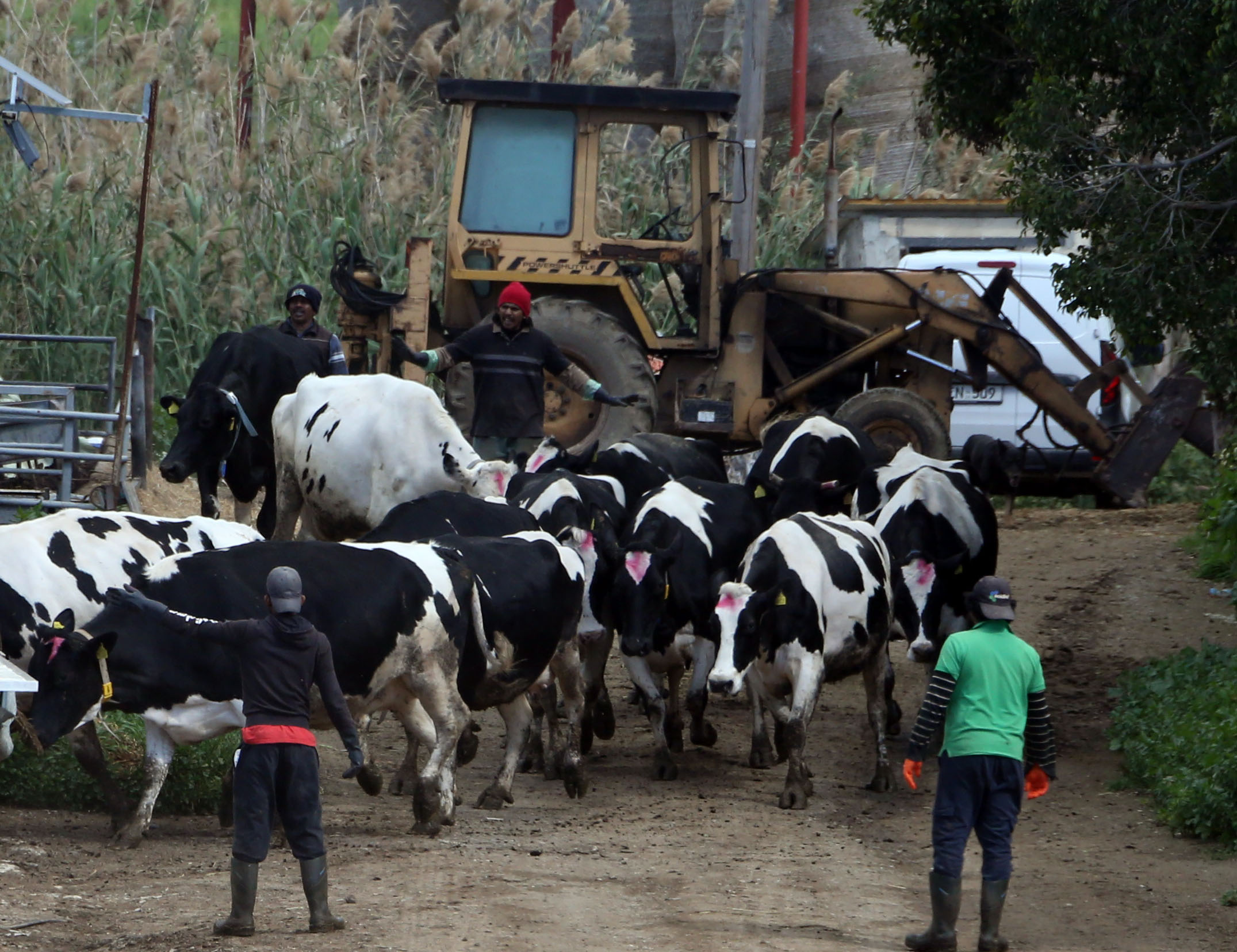
The ongoing foot and mouth disease (FMD) outbreak is reshaping the debate around Cyprus’ agricultural model with Employers and Industrialists Federation (OEV) President Giorgos Pantelides on Tuesday warning that food security and livestock resilience must now become national priorities.
Speaking at the federation’s AGM, Pantelides said “agricultural production must stop being approached solely in terms of cost,” stressing that in today’s unpredictable global environment, self-sufficiency in food is fundamentally a matter of national security.
“This is security we must safeguard in a timely manner,” he added, pointing to the need for Cyprus to ensure autonomous production capacity, “just as we managed to do with medicines through our domestic pharmaceutical industry.”
His warning comes as the FMD outbreak continues to deepen, placing unprecedented pressure on livestock farmers.
He underlined the urgent need to resolve the island’s long-standing water problem, adopt new agricultural technologies, and provide strong incentives to attract younger people into farming.
“The ageing of the professional farming population makes this an immediate priority,” he said.
Pantelides described the water issue as “an existential challenge”, arguing that Cyprus must decisively reduce its dependence on weather conditions.
“We were fortunate this year with beneficial rainfall, but we know our country is repeatedly hit by droughts and prolonged heatwaves,” he said, calling for full reliance on desalination for water supply, while reserving dams primarily for agricultural use.
Turning specifically to livestock, he said “the foot and mouth crisis must become an opportunity for the sector’s regeneration”, calling for a holistic plan to restart and restructure affected farming operations.
Meanwhile President Nikos Christodoulides arriving at the AGM said he was willing to engage directly with protesting farmers.
The outbreak, first confirmed in the Republic in February, has steadily escalated. By early April, infections had spread to 50 livestock units, primarily in Larnaca district, with authorities implementing culling and vaccination protocols.
However, the latest data shows more than 100 livestock units are now affected nationwide, alongside the culling of tens of thousands of animals .
Officials insist the spread remains geographically contained within designated zones, but acknowledge a “persistent presence” of the virus.
The outbreak has also sparked alarm over the survival of Cyprus’ rare indigenous breeds, which are particularly vulnerable to blanket culling measures. Experts have highlighted the risks facing traditional varieties such as the Cyprus fat-tailed sheep and the Red cattle, both of which have limited populations and significant genetic value.
Breeders and conservationists have warned that the loss of even a small number of these animals could have lasting consequences.
They stressed that beyond immediate economic losses, the disappearance of these breeds would represent an irreversible blow to Cyprus’ agricultural heritage and long-term biodiversity.
Authorities have intensified enforcement of emergency measures, issuing €45,000 of fines for illegal animal movements linked to the spread of the disease, while additional cases have been referred to police.
Experts increasingly point to poor biosafety practices and human movement between farms as key drivers of transmission, rather than animal movement alone.
The impact on the livestock sector is severe and potentially long-lasting.
More than 30,000 animals have already been culled, while industry representatives warn that up to half of livestock farmers may not restart operations after the crisis .
Compensation schemes are underway, but delays and uncertainty including the need for EU approval are adding to farmers’ concerns.
At the same time, protests and growing frustration among producers highlight the strain on rural communities.





Click here to change your cookie preferences