
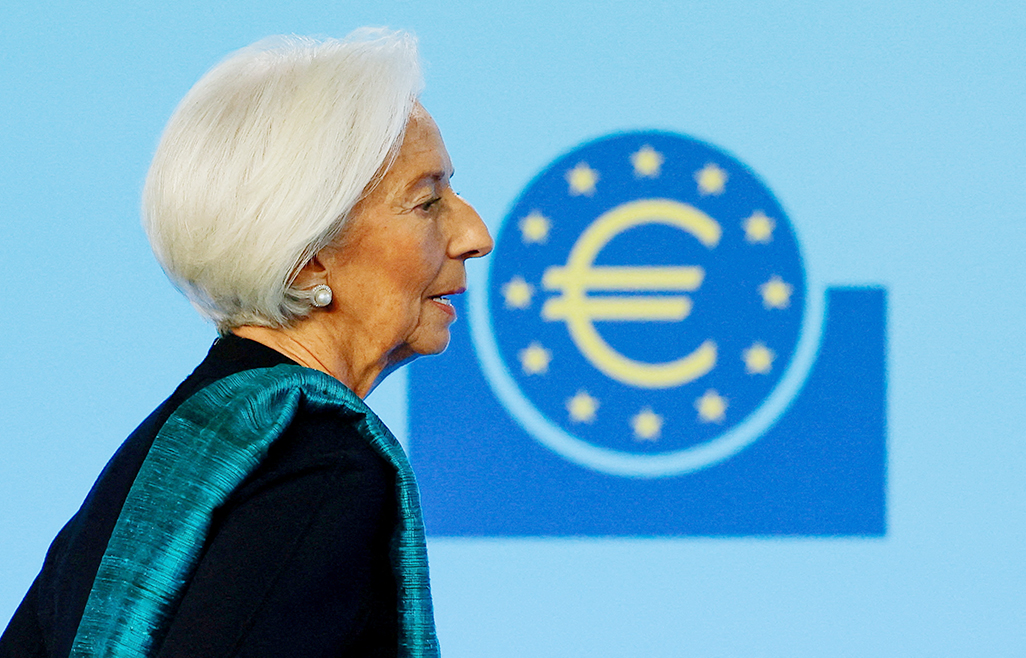
The European Central Bank left interest rates unchanged as expected on Thursday but signalled its rising concerns over soaring inflation, bolstering bets it would lift rates several times this year with an initial move in June.
Inflation jumped to 3% this month, well above the bank’s 2% target, and a further rise is expected as the Iran war has pushed oil prices to a four-year high, making it likely that the energy impact sets off a hard-to-break inflation spiral via second-round effects.
“The upside risks to inflation and the downside risks to growth have intensified,” the ECB said in a statement. “The longer the war continues and the longer energy prices remain high, the stronger is the likely impact on broader inflation and the economy.”
Financial markets now see hikes in June and July, followed by at least one more move in the autumn on the premise that the ECB will be keen to quash any inflation spiral quickly, not least because it was criticised for moving late in 2022.
“Longer-term inflation expectations remain well anchored, although inflation expectations over shorter horizons have moved up significantly,” the bank added. “The Governing Council is not pre-committing to a particular rate path.”
Still, any rate hike cycle is likely to be far more benign than in 2022, when the ECB had to lift its key rate by a combined 450 basis points in a span of a year to arrest runaway price growth.
Price pressures are far weaker now, the second-round inflation effects are not yet visible, the labour market is softer, rates are already higher to begin with, and economic growth is close to stalling.
Indeed, the euro zone economy barely grew in the first quarter, even before the war had any meaningful impact.
Meanwhile underlying or core inflation, a key component scrutinized to gauge the durability of price growth, actually slowed to 2.2% in April from 2.3%, suggesting that second-round effects are not taking hold in a meaningful way.
This means the ECB must tread carefully.
It will likely raise rates to signal to price and wage setters that it will not tolerate any sustained overshoot of its target, but it must move gently to avoid pushing the bloc into recession.
ENERGY SHOCK TO HURT GROWTH
Some economists think the energy shock itself could cut as much as 0.5 percentage point off economic growth, which is roughly half of the bloc’s projected expansion in the coming year.
The second quarter is already looking dismal due to the war, and Germany, the bloc’s biggest economy, could even see its economy contract.
Surveys this week showed business sentiment is plunging quicker than predicted, the services sector is deteriorating, corporate profits are dropping, exports are still reeling from tariffs, and banks plan to curtail firms’ access to credit.
But central bankers around the globe have argued that six weeks make little difference in rate hikes, so it is worth waiting a bit longer to gain more certainty over price trends.
The Bank of Japan, the U.S. Federal Reserve, the Bank of Canada and the Bank of England all also left rates unchanged this week, even while expressing concerns over price growth.
But the “memory effect” of having lived through rapid inflation just a few years ago may work against central banks.
It was the first big inflation shock in decades, so consumer may respond quicker this time, especially after workers took a large real-terms wage cut from the 2021/2022 episode.
“The experience of inflation is so recent that businesses will raise prices sooner than in 2022, and even workers will try to secure higher wages sooner, which will likely accelerate inflation developments,” said Lorenzo Codogno of LC Macro Advisors.




Click here to change your cookie preferences