
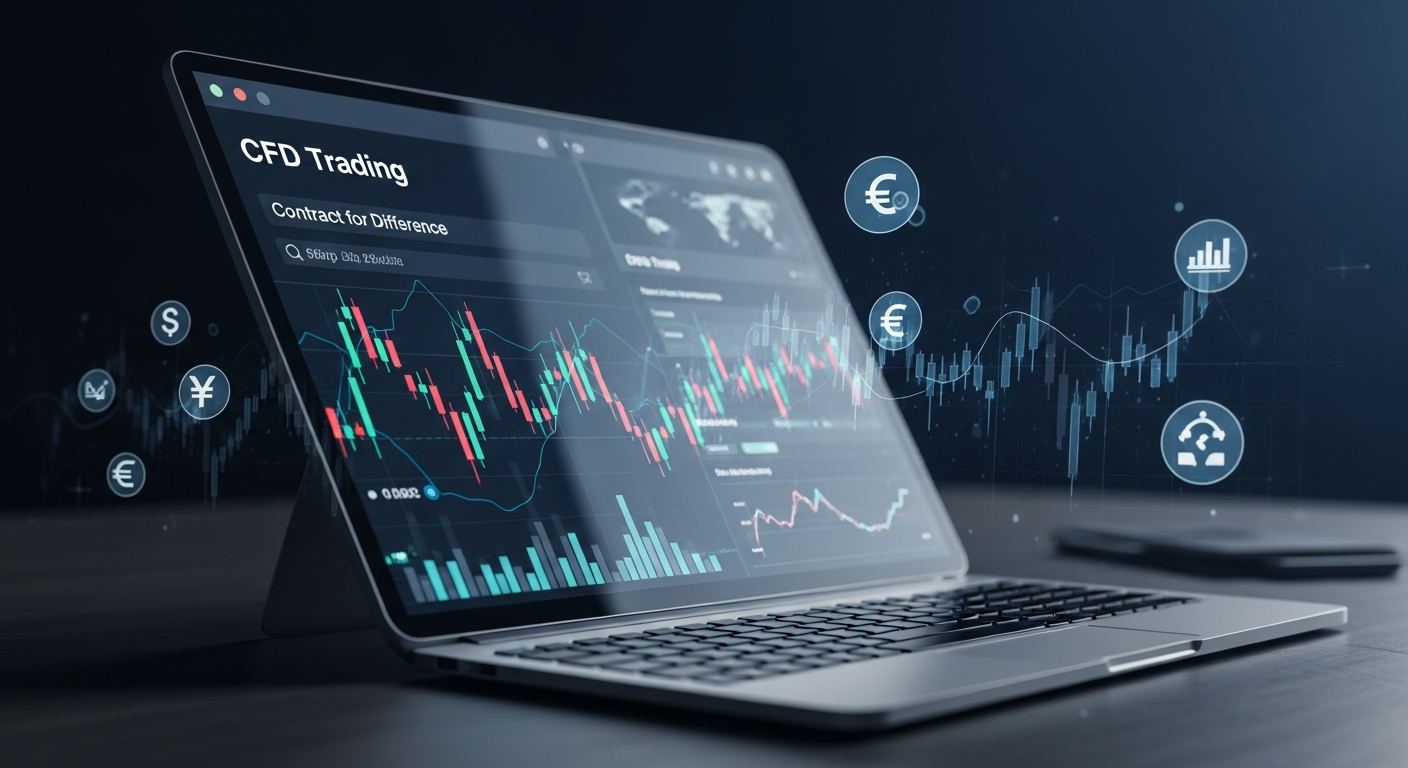
CFD trading has likely crossed your path if you’re a recent financial market entrant. It’s touted as an easy way to access a wide variety of global assets – but few people talk about how it works and the technology that makes it possible.
A Contract for Difference (CFD) is a derivative that allows you to trade the direction of the price of an asset without actually owning it. You take out a position with a broker, and when you close the position, the difference in price between opening and closing the position will be added or deducted from your account. What most “101” articles fail to mention is that there’s a platform between you and the markets you’re trading in and that there’s more to it than you might think.
This article is a down-to-earth rundown of what CFD trading platforms are, what they do, how they make money, and where the risks really lie.
The basics of CFD trading platforms
A CFD trading platform is the computer interface where the action is – price data, placing orders, tracking trades, managing accounts, and so on. It’s where you access the data and where your decisions are implemented in the market.
The majority of retail traders work with brokers’ platforms. Some of these use licensed third-party platforms; others develop their own. In either case, the platform is more than window dressing. It’s also where you see pricing transparency (or the opposite), how quickly your orders are filled, and how your margins are calculated.
The broker-platform relationship
Broker and platform are not the same. The broker is the regulated business – the company that you give your money to, that you withdraw it from, and that has a legal obligation towards you, the client. The platform is the software they offer for you to trade.
This is important because you’re really assessing two things: the legal status of the broker and the quality of the software platform itself. A great platform from an unregulated (or poorly regulated) broker is still no good. Confirming that your broker is regulated by an oversight body such as the FCA (UK), ASIC (Australia), or CySEC (Cyprus) is a minimum requirement.
What you can trade through CFD platforms
A key attraction of CFD platforms is the breadth of products available. Rather than open multiple accounts for different assets, the majority of platforms offer access to multiple asset classes. Common offerings include:
- Major, minor, and exotic currency pairs (Forex)
- Shares indices like the FTSE 100, DAX, and Nasdaq 100
- Share CFDs of listed companies
- Commodities such as oil, gas, gold, and silver
This varies between brokers. Not all will offer all of the above, and the degree of liquidity varies greatly, especially for less popular assets.
Getting started: The role of demo Ttrading
Most regulated CFD brokers offer a “demo account” to try before putting real money to work. Demo trading – the act of placing trades with virtual money in a virtual environment – is a good early step for beginners. The idea is not so much to work on trading strategies or strategies; it’s more about familiarization.
There are aspects of CFD trading that take some time to get used to: margin calculation, order types, and the impact of spreads on open positions. With a demo account, you can get that practice risk-free.
What demo accounts can do
A good demo environment is representative of the live environment in terms of layout, instruments and functionality. One can practice moving about the charting tools and placing market and limit orders and can see the costs in real-time action without any risk to real funds. The majority of demo accounts can be opened without charge and don’t require a funded account to open them (although this is not the case across all brokers).
For a complete novice to this type of trading, the familiarity period can help limit the number of “fat finger” mistakes made once a live account is opened.
Where demo trading falls short
In reality, it’s a bit more complex. It eliminates the financial risk aspect of decision-making, and this influences behavior. The psychological aspects of watching a real position go against you – the temptation to close too soon or to hold too long – cannot be removed from a live position. This effect is well-studied in financial psychology and is one of the main reasons why results achieved in a demo account often don’t translate to a real account.
Technical aspects are another consideration. It’s not always the case that demos represent slippage (the difference between the bid price and the price at which an order is executed), spread widening in volatile markets, or execution delays when there’s a lot of traffic.
These factors have an impact on real trading results, and a demo account environment may provide a more “polished” experience.
Key features of a CFD platform
CFD trading platforms come with a suite of analysis and trade-management tools. Knowing what those tools are and what they don’t always deliver will help more than viewing them simply as “good.”
Charting tools and technical indicators
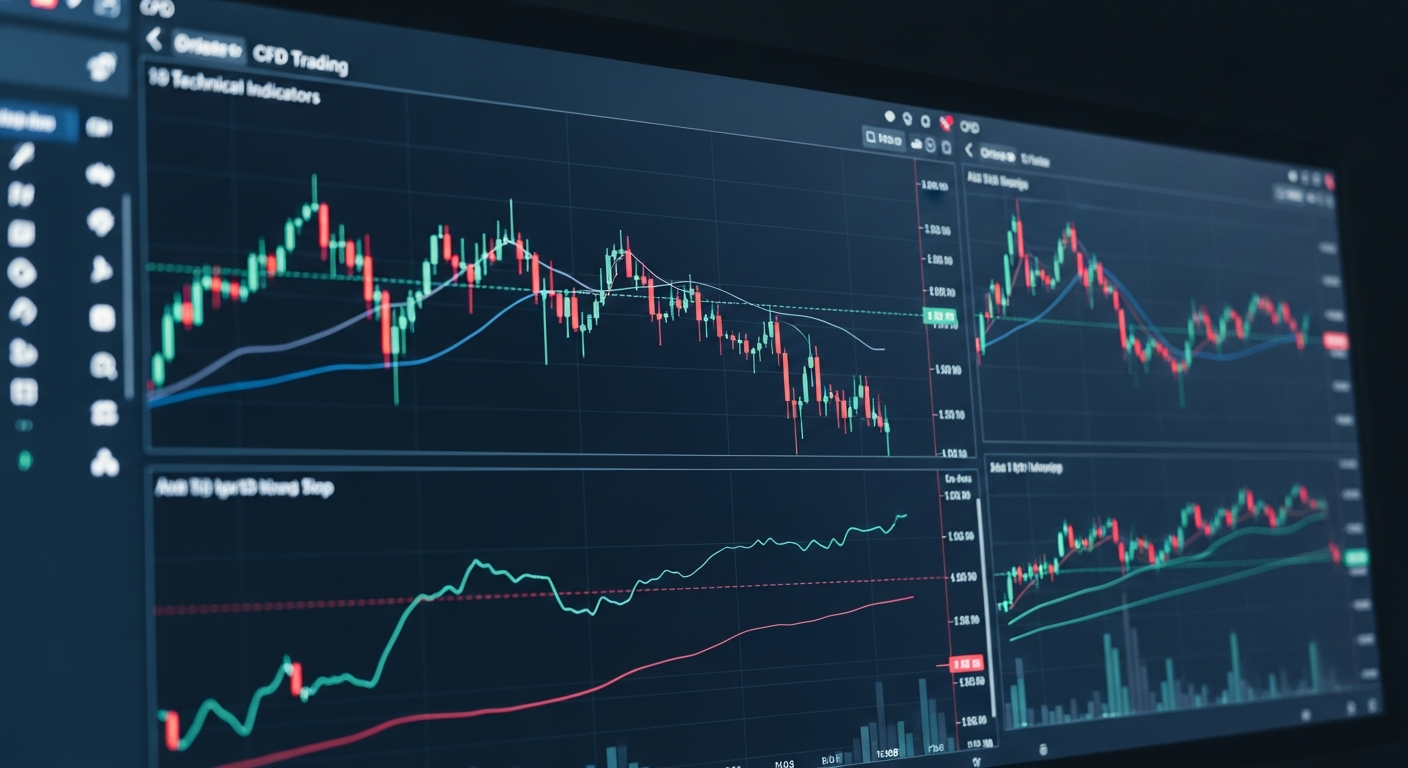
All CFD trading platforms have a charting tool with a set of technical indicators. Most will have moving averages, the Relative Strength Index (RSI), the MACD and Bollinger Bands. The indicators display visual cues based on past price movements.
What’s crucial to understand is that technical indicators reflect the past. They detect patterns in historical price data, but they don’t tell you what will happen next. The extent to which these patterns are likely to recur and the circumstances in which they are likely to repeat is the subject of much current debate in the field of market analysis, with results that differ significantly between instruments and market conditions.
Order types and how they function
CFDs allow traders to place orders other than a simple market order, and it is important to have a clear understanding of these differences. The most common are:
- Market orders – to open or close at the next available price
- Limit orders – to open or close at a price or better
- Stop-loss orders – automatically close out the position if the price falls below a certain level
- Trailing stop orders – set the stop at a distance from the current price as the price moves in the right direction
Both have shortcomings. Stop-loss orders, for example, can be affected by slippage in volatile markets – that is, the order can be filled at a price different from the price you set. This is a known feature of CFD trading, rather than an extraordinary occurrence, and should be considered when assessing risk.
Leverage and margin displays
Leverage and margin displays on CFD trading platforms provide information on your level of risk. Leverage is what allows you to trade a position larger than your deposited funds – a 20:1 leverage means a £500 deposit allows you to trade a £10,000 position.
Both profits and losses are magnified. Since 2018, there have been regulatory limits on retail leverage in the UK and the EU, with different limits for different financial instruments (30:1 for major forex pairs). Across the industry, on average, 70-80% of retail CFD accounts suffer losses with regulated brokers. This includes, in part, the impact of leverage on the results of the majority who lose money.
How CFD brokers generate revenue
Knowing how the business works can help you better understand the costs in every trade, which can be overlooked if you’re only looking at price action.
The spread is the most common way that brokers use CFDs: the spread is the difference between the bid price and the ask price for a particular instrument. This is factored into the cost of every trade and is an up-front cost at the time the trade is placed. Many will also charge a commission for each trade, although this is more likely to be found with equity CFDs than forex or index CFDs.
The third source of revenues is the overnight financing fee (also known as a swap fee). When you hold a CFD position over the daily settlement, you pay interest on the leveraged part of the position. It is usually based on interbank lending rates (plus a margin). With the sharp post-2022 increases in global central bank rates, these overnight costs have become much more significant than in the previous low-rate environment, especially if you hold a position for several days.
Regulated brokers are obliged to disclose all of these costs up front. It’s a simple but important step to consider all of the costs in the schedule before opening an account.
Types of CFD platforms available to retail traders
The retail CFD market can be broken down into two broad categories: third-party and proprietary broker platforms. Both types have their merits and neither should be considered a “one-size-fits-all” solution.
Third-party platforms: MetaTrader
MetaTrader 4 and MetaTrader 5 (MT4 and MT5) from MetaQuotes Software has been the leading third-party platforms in the retail CFD and forex markets for some 20 years. MT4, launched in 2005, is still popular today due to its stability, the huge range of custom indicators, and built-in support for automated trading scripts. MT5 added more order types and support for more asset classes. Interestingly, MT4’s survival – even with the availability of MT5 for over a decade – is testament to its integration with brokers’ systems and the trading habits of customers.
Proprietary and browser-based platforms
Many brokers also now provide their own proprietary platforms, often with more modern user interfaces, suitable for both desktop and mobile devices. These may be easier to navigate for beginners and tend to seamlessly include educational resources, economic calendars and account management. Web-based platforms, where there’s no need to download software, are becoming popular among day traders.
The downside is portability. Third-party platforms such as MetaTrader 4 (MT4) can be downloaded from a number of brokers, so the learning curve is minimal. A broker-specific platform defines the way you work with a particular broker.
What to consider when evaluating a platform
With the plethora of brokers and platforms operating in 2026, it’s important to have a methodology for evaluation. There are a number of factors that stand out:
- Broker’s regulatory status. Confirmation from a financial regulator is the first, not final, criterion.
- Order execution. Order processing during high-activity periods is more important than the color scheme.
- Transparency of fees. Spreads, commissions and overnight rates should be clearly set out pre-account opening.
- Technology. Downtime or delays in volatile trading conditions.
- Instrument offering. Does the broker offer the instruments you want to trade?
There’s no best of breed for all categories. A lower-spread environment might not be as easy to navigate; lower financing costs might be accompanied by a less appealing user interface. The trick is to figure out which compromises you can make in your particular circumstance, not to expect to find a product that performs at the top of every category, because there is none.
Disclaimer
This is a marketing communication and should not be construed as investment advice or investment research. The information in this article is for educational and informational purposes only. It does not provide financial advice, investment advice, or any specific advice for engaging in financial activities. CFDs are complex instruments and come with a high risk of losing money rapidly due to leverage. 74%-89% of retail investor accounts lose money when trading CFDs with this provider. You should consider whether you understand how CFDs work and whether you can afford to take the high risk of losing your money. Make sure you fully understand the risks involved and whether trading CFDs is right for your trading style and investment goals before you open an account. Read the complete risk disclosure document. Previous performance isn’t necessarily a guide to future performance. This article is not intended to be a recommendation for any particular financial action.





Click here to change your cookie preferences