
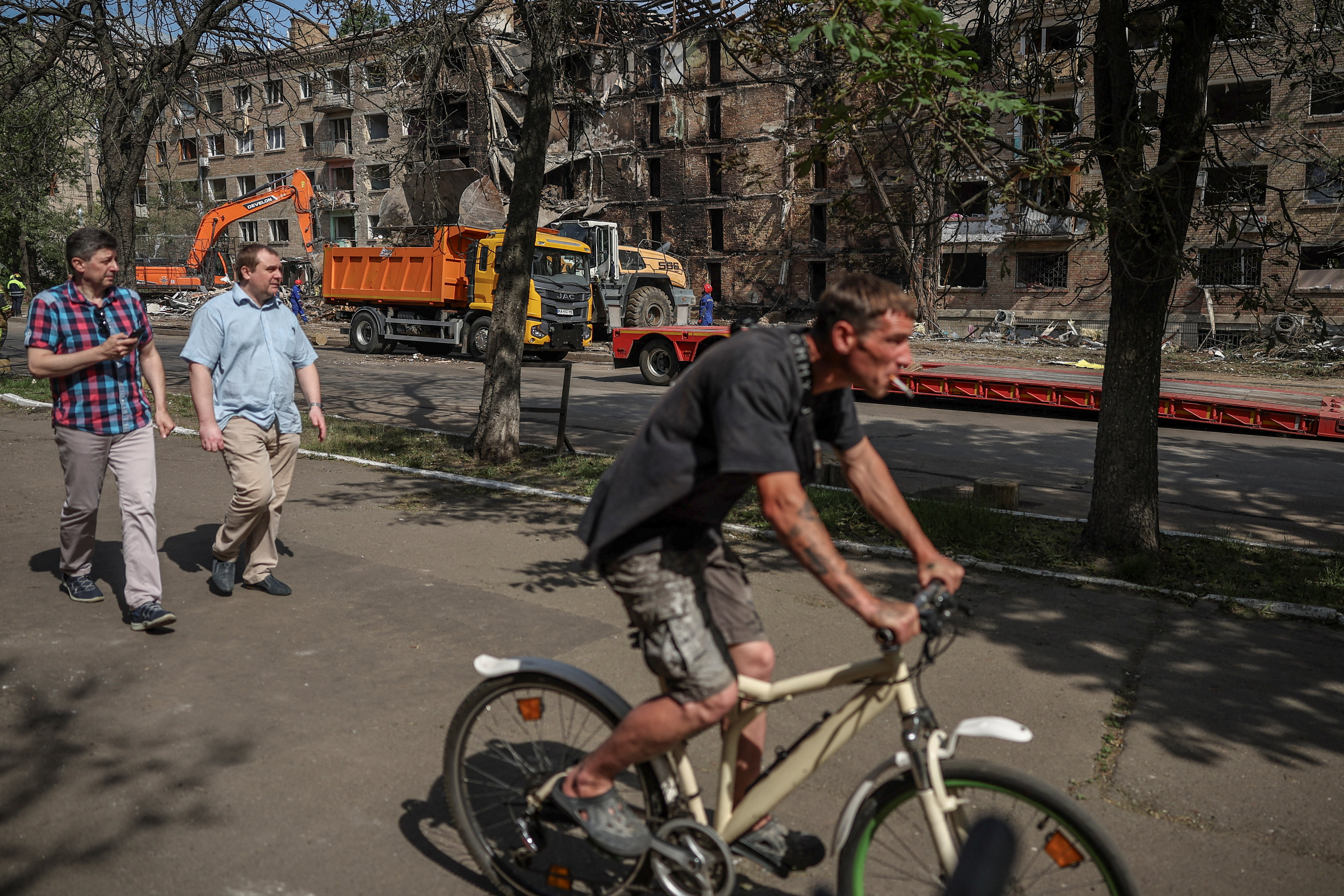
Kyiv residents and foreign embassies are shrugging off Moscow’s threat of a wave of heavy strikes on the Ukrainian capital as nothing new after years of war, displaying a defiant confidence in carrying on with their lives.
Russia, which has relentlessly attacked Ukrainian cities, including Kyiv, since launching its full-scale invasion in 2022, said on Monday it intended to launch “systematic strikes” on targets in Kyiv and urged foreigners and diplomats to leave.
But despite one of the war’s heaviest bombardments of the capital two days ago, residents interviewed by Reuters voiced their determination.
“I think that those threats are manipulation more aimed at sowing panic among the public,” Oleksandr Korzh, a former serviceman, 43, said.
“I will stay in Ukraine, and I will stay in Kyiv.”
Some of the diplomatic missions in the city, which Russia aggressively urged to leave, displayed no such plans. The EU’s ambassador to Ukraine, Katarina Mathernova, dismissed Russian threats as “a masterpiece of hypocrisy”.
The Netherlands, Germany and Norway were among the countries that summoned Russian diplomats over Moscow’s attacks on the capital and threats to envoys.
Dmitry Medvedev, the deputy chair of Russia’s Security Council, joked on X about the EU’s decision to stay in Kyiv.
“Well, apparently they’ve got diplomats to spare and need to trim the headcount,” he wrote.
U.N. Secretary-General Antonio Guterres expressed deep concern about the Russian threats.
A heavy missile and drone bombardment on Sunday killed three people in the city, injured more than 90 and damaged around 300 sites, Ukrainian authorities said. A strike on May 14 killed 24 civilians in Kyiv.
“Honestly, our people are tired of this, and I am also tired of this war,” said Viktoriia Paramonova, 21, a barista in a cafe damaged in Sunday’s strikes.
RETRIBUTION
Russia said Sunday’s attack and the announced new strikes were in retribution for a Ukrainian drone strike on Friday on a student dorm in the Russian-occupied Luhansk region of eastern Ukraine. Ukraine’s military said it hit a Russian drone unit.
Russia’s Foreign Minister Sergei Lavrov called his U.S. counterpart Marco Rubio on Monday to warn about upcoming strikes.
Mykola Bielieskov, from Ukraine’s National Institute for Strategic Studies, doubted Russia could sharply increase the tempo and scale of its air attacks.
“So for combined attacks at the scale of 13-14 May or 23-24 May they need to accumulate missiles as there is no spare capacity, people and money in Russia to produce much more than the rate of production of missiles attained in 2024-25,” he said.
Russian threats were “bluster,” Bielieskov said, to draw attention away from setbacks. On the battlefield, its advances have slowed in recent months, while Ukrainian attacks on Russia’s energy infrastructure have forced it to curb production.
Kyiv residents said they were tired but knew what to do during the next strikes.
“We take them (Russian threats) seriously because, basically, they are constantly bombing us. They bombed us all winter, and they are still bombing us now,” Kateryna Kozechenko, 38, told Reuters.
“Nothing new, everything’s as usual – we are ready. We always go to the shelter.”





Click here to change your cookie preferences