
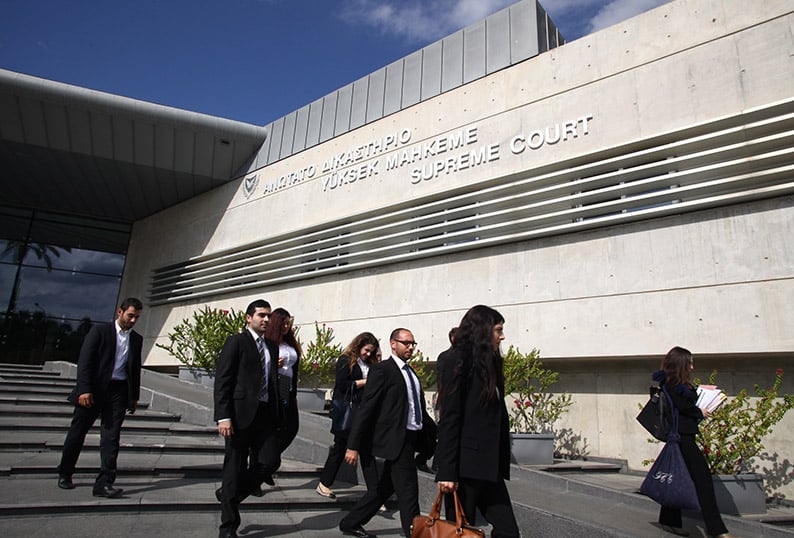
The Supreme Court on Thursday granted attorney Nikos Clerides permission to apply for the annulment of a search warrant on his premises, in connection with the ‘Sandy affair’.
The petition, filed as a ‘certiorari’ – an order or writ by which a higher court reviews a case tried in a lower court – seeks to have the warrant annulled, effectively rendering it void from the outset.
Clerides at one point – around late 2021 – had briefly been the attorney for ‘Sandy’, the woman at the centre of the affair who alleges to have been raped years ago by a former Supreme Court judge. In a trove of text messages – recently released by journalist Makarios Drousiotis – she also alleges the existence of a political-judicial cabal pulling the strings in Cyprus.
In early April, police had secured a warrant to search Clerides’ residence, office and car. The warrant had been signed off on by a Larnaca-based judge. It was issued at 12.45am.
Clerides claimed the warrant was illegally issued. It was based on the affidavit of one of the police officers investigating the ‘Sandy’ case. The attorney then applied to the Supreme Court to have the warrant annuled.
In its judgment on Thursday, the Supreme Court found fault with the issuance of the warrant.
The court cited four reasons. First, that there were no reasonable grounds that the affidavit was connected to the premises searched.
Second, that the description of the exhibits police were searching for was too general and vague – what Clerides calls a “fishing expedition” by the police.
Third, that there was no evidence whatsoever that Clerides was in any way connected with the creation of the fake text messages by ‘Sandy’ – as stated on the police warrant.
And fourth, that the search warrant was issued in contravention of attorney-client privilege – namely that Clerides’ seized mobile phones contained information pertaining to his communications with clients in general.
Speaking to the Cyprus Mail, Clerides said police had confiscated three mobile phones of his.
One of them he used as a computer, storing all his clients’ files on it.
The police subsequently – belatedly according to Clerides – returned the mobile with the clients’ files, but have held onto the two other phones.
They cloned the phone with the clients’ files before returning it to Clerides.
Meanwhile the police have secured separare court orders allowing them access to the telecoms data on the two phones they still hold.
Thursday’s Supreme Court decision does not mean the automatic annulment of the search warrant. Rather, it means the attorney-general will now have to decide whether to uphold the search warrant, or agree to have it annuled.
In the former case, Clerides would contest the AG’s decision and the matter would end up at the Supreme Court.
Were the search warrant to be declared null and void, any material contained on the seized devices would be inadmissible as evidence in a court of law.
Also on Thursday, Clerides opined that some of the text messages held by ‘Sandy’ are likely fake, while others are “100 per cent authentic”.





Click here to change your cookie preferences