
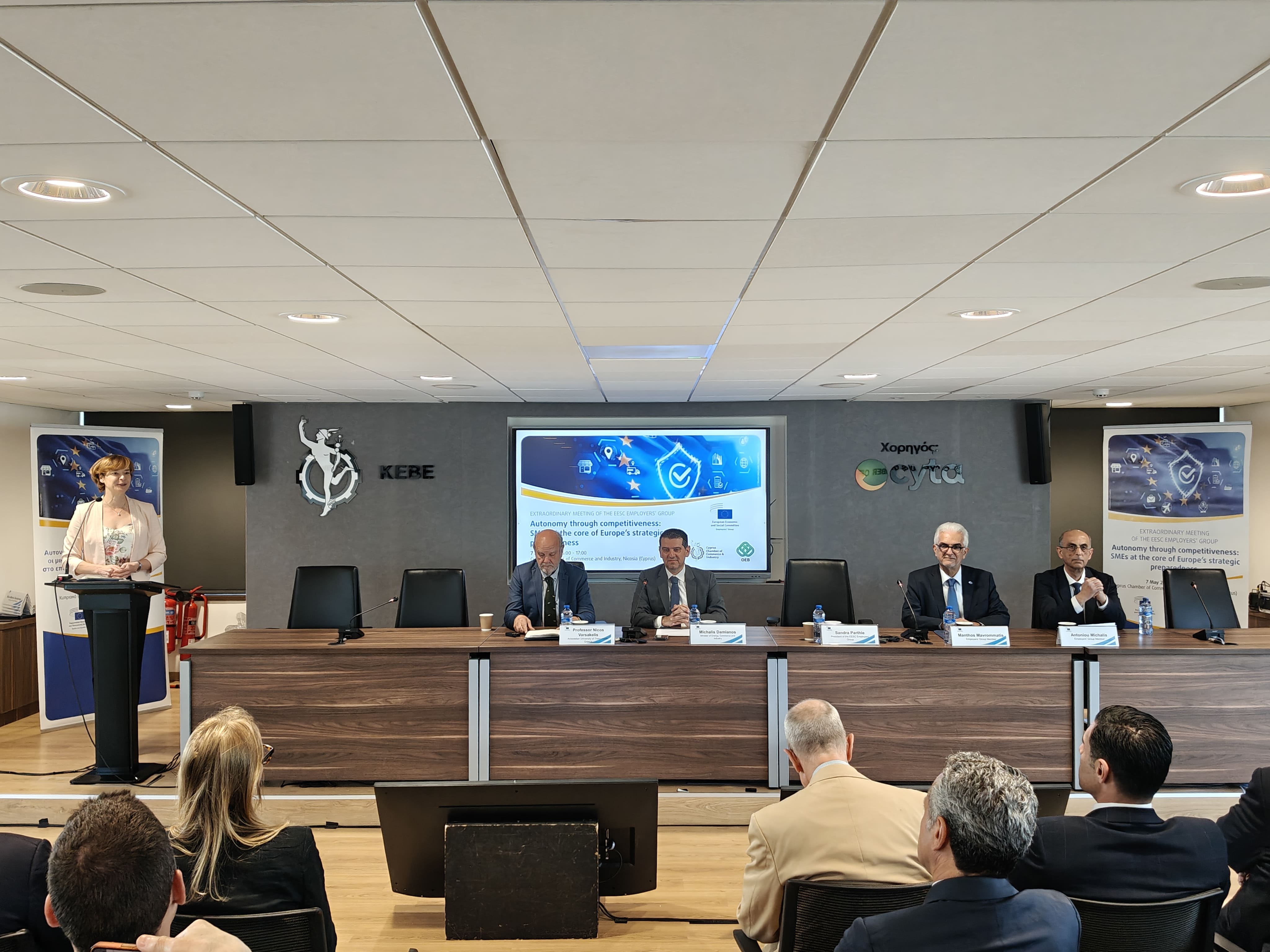
Small and medium-sized businesses must be placed at the centre of Europe’s competitiveness agenda if the EU is to strengthen its resilience, strategic autonomy and industrial base, according to Energy Minister Michalis Damianos.
Speaking at an extraordinary meeting of the Employers’ Group of the European Economic and Social Committee (EESC), hosted by the Cyprus chamber of commerce and industry (Keve), Damianos said Europe’s ability to respond to geopolitical uncertainty, technological change and the green transition will depend on whether SMEs are given the tools to grow.
The meeting, held in Cyprus as part of the country’s Presidency of the Council of the EU, focused on the theme “Autonomy through competitiveness: SMEs at the core of Europe’s strategic preparedness.”
Damianos said the title “perfectly captures the direction in which the European Union must move,” adding that “strategic autonomy is no longer an abstract ambition. It is a practical necessity, shaped by geopolitical uncertainty, technological disruption and the urgency of the green transition.”
For Cyprus, he said, the issue is especially pressing. Out of around 125,000 enterprises, about 99 per cent are SMEs, making them the backbone of employment, innovation and growth, as well as a key support for local communities and regional development.
These businesses, Damianos said, are also among the most exposed to Europe’s long-standing weaknesses, from regulatory complexity and high energy costs to limited access to finance and persistent skills gaps.
“If we are serious about strengthening Europe’s strategic preparedness, addressing these constraints must be at the heart of our policy approach,” he said.
At national level, Damianos said the ministry has placed SMEs at the centre of its policy framework, with measures aimed at improving competitiveness, productivity and adaptability.
These include support for entrepreneurship, better access to finance, industrial modernisation and efforts to reduce structural barriers, including production costs, skills mismatches and weak links between services and industry.
He said Cyprus has secured €227.3 million through Cohesion Policy Funds for the 2021-2027 period, alongside €124.5 million from the recovery and resilience fund and the new REPowerEU Plan, with the aim of channelling more resources into the real economy.
However, Damianos warned that national efforts alone cannot deliver the scale of change required.
That, he said, is why Cyprus is using its EU Council Presidency to help shape a more coherent European response, particularly on competitiveness, industrial policy and the Single Market.
Referring to the recent informal meeting of EU competitiveness ministers in Nicosia, Damianos said ministers had stressed that a stronger Single Market remains the foundation of European competitiveness.
“A deeper, more integrated Single Market is essential to enable SMEs to grow, innovate and compete globally,” he said.
He also said Europe must strengthen its industrial base, including strategic sectors such as defence, where more than 2,500 SMEs play an important role.
“Supporting these businesses requires not only financial tools, but also better coordination, standardization and de-fragmentation of markets,” Damianos said.
Europe, he added, already has “a strong industrial base, a highly skilled workforce, world-class research and a unique social model”.
What is now needed, he said, is closer alignment between European and national policies, as well as between ambition and implementation.
“SMEs are at the heart of this effort,” he said, adding that “If we manage to empower them, we will not only strengthen competitiveness, but also ensure Europe’s autonomy, strengthen its preparedness and ensure sustainable prosperity for all.”
The event was also attended by Competitiveness Council president Demetris Georgiades, Fiscal Council president Michalis Persianis, and Maria Irakleous, former representative of the International Monetary Fund in Cyprus and former member of the Central Bank’s board of directors.
Manthos Mavrommatis, on behalf of the Keve, and Michalis Antoniou, on behalf of the Employers and Industrialists Federation (Oev), also took part as members of the EESC representing Cypriot businesses.
During the discussion, speakers said SMEs remain central to Europe’s ability to compete internationally and to reduce strategic dependencies.
Nikos Varsakelis, Professor of Industrial Policy at the Aristotle University of Thessaloniki, also outlined the main challenges facing European SMEs in an increasingly uncertain and competitive global environment.
The discussion also focused on Europe’s productivity gap, the slow pace of reform and the need for targeted policies to complete the Single Market and support growth.
Participants agreed that delays in strengthening EU competitiveness are weakening Europe’s position compared with other major economies, particularly the US and China.



Click here to change your cookie preferences