
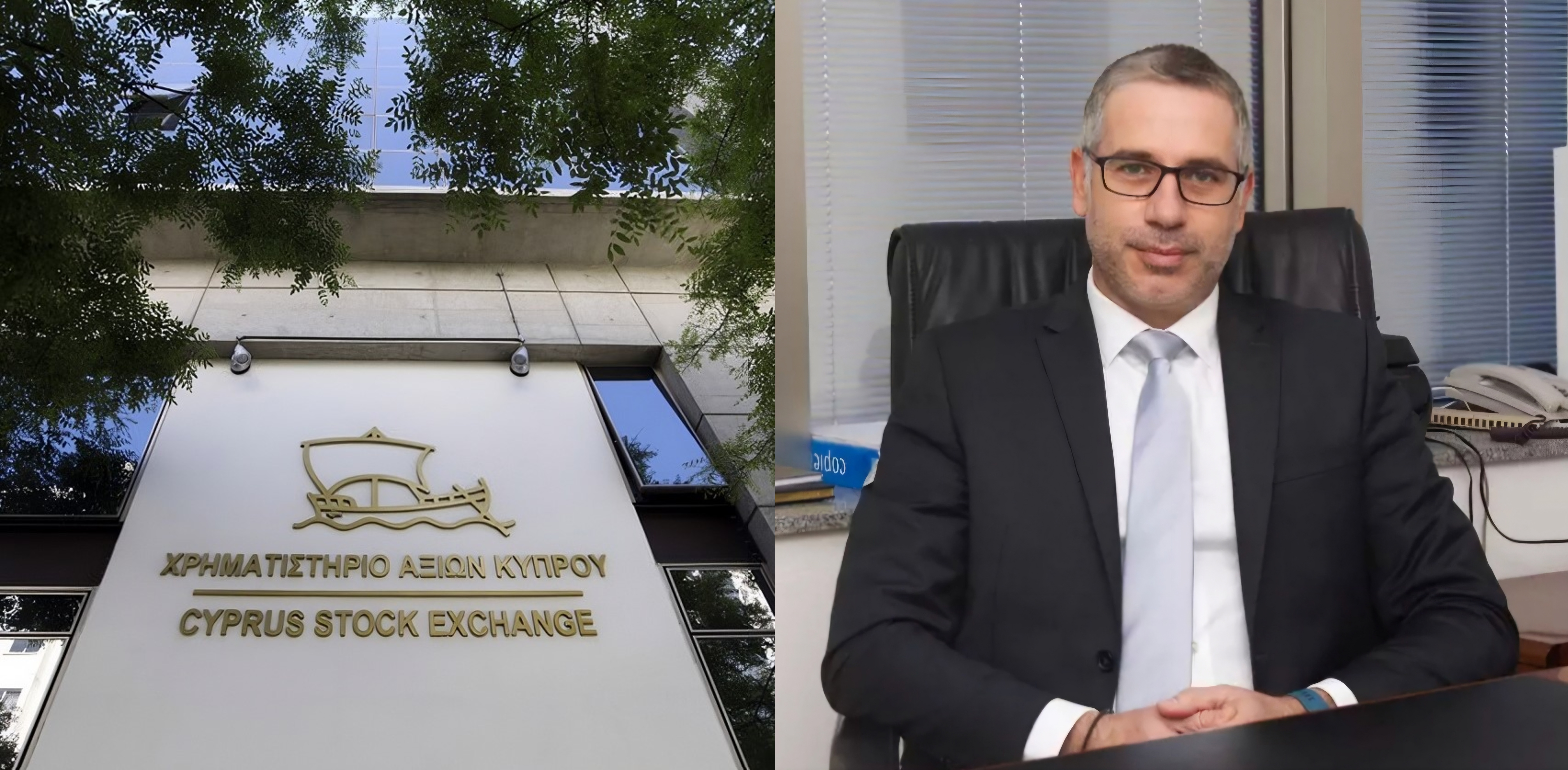
CSE chairman outlines post-privatisation vision
Cyprus Stock Exchange (CSE) chairman Marinos Christodoulides on Monday said that the institution is preparing for a new phase of privatisation, international expansion and technological modernisation.
Speaking during an event for the exchange’s 30 year anniversary at the Landmark hotel in Nicosia, Christodoulides described the exchange’s three-decade history as a journey shaped by challenges, transformation, modernisation and important lessons for the country’s capital market.
“It is with particular joy that we welcome you to today’s anniversary event marking 30 years since the establishment of the Cyprus Stock Exchange,” said Christodoulides.
Christodoulides said the CSE, since beginning operations in March 1996, had served as a key institution for the organisation and development of Cyprus’ capital market, with the primary aim of supporting businesses and the broader economy.
“Three decades are not simply a chronological milestone, but a course filled with challenges, transformations, modernisation and significant lessons,” he said.
The chairman also referred to the role played by the Cyprus Chamber of Commerce and Industry (Keve), explaining that it laid the foundations for organised stock market activity in Cyprus long before the formal establishment of the exchange.
He said the earlier informal market created the groundwork upon which today’s institution was built.
“We are pleased that both current and former officials of the chamber are with us today, because their presence reminds us that the history of the stock exchange began well before 1996,” Christodoulides said.
The chairman referred repeatedly to the Kyrenia ship emblem, describing it as a symbol of endurance and forward vision that reflects both the history of the exchange and Cyprus itself.
“With the Kyrenia ship as its emblem, symbolising resilience in adversity and a constant forward outlook, the Cyprus Stock Exchange completes 30 years of operation,” he said.
Christodoulides stated that over the years the exchange enabled companies to raise capital, modernise, grow and innovate, while also providing investors with a reliable framework for participating in the country’s economic development.
At the same time, he acknowledged that the institution’s path had been marked by major crises and periods of uncertainty.
He described the speculative bubble at the end of the 1990s as perhaps the most painful test faced by the exchange, saying it led to a collapse in share prices and heavy losses for thousands of Cypriot investors.
According to Christodoulides, the experience ultimately shaped the institution’s regulatory and supervisory maturity.
He also referred to the 2013 financial crisis, Cyprus’ entry into a bailout programme, the Covid-19 pandemic, Russia’s invasion of Ukraine and wider geopolitical developments in the region.
“With hard work, methodical planning and vision, we managed to overcome adversity and evolve,” he said.
The chairman highlighted a series of strategic partnerships developed by the exchange over the years to improve its markets, products and services.
Particular emphasis was placed on the common platform partnership with Euronext Athens, formerly known as the Athens Stock Exchange (ATHEX).
Christodoulides described the cooperation as a major institutional partnership that delivered benefits to both exchanges in infrastructure, investment activity and trading operations.
“We are especially pleased that chief executive Yiannos Kontopoulos and executives of Euronext Athens are with us today,” he said.
“Their presence honours our event and reflects the excellent cooperation we have built together,” Christodoulides added.
The chairman also stressed the exchange’s growing role in the energy sector. He explained that since 2018 the CSE has been a founding shareholder in the Hellenic Energy Exchange, describing the initiative as particularly important for Cyprus’ energy landscape.
Christodoulides welcomed Hellenic Energy Exchange chairman Athanasios Savvakis and chief executive Alexandros Papageorgiou, saying the partnership had evolved into a substantial CSE presence in the energy market.
He further revealed that from October 2, 2025, the CSE began providing cash settlement services and acting as a collateral coverage body for the Cyprus Transmission System Operator in relation to the competitive electricity market.
The chairman also referred to a recent partnership with the National Stock Exchange of India, saying the cooperation was already being put into practical use by market participants.
Christodoulides stated that the exchange had also introduced substantial reforms to its institutional and regulatory framework in order to align fully with European standards and better serve listed companies, investors and other market participants.
He added that the creation of the CSE New Market had already attracted a significant number of dynamic businesses.
Looking ahead, the chairman said the exchange’s future would be shaped by three defining pillars, namely technology, sustainability and internationalisation.
“Today, 30 years later, we are not here only to look back,” he said.
“We are here to design the future,” Christodoulides added.
What is more, he connected the CSE’s strategy with the European Union’s broader push towards capital markets integration through the Savings and Investments Union initiative.
According to Christodoulides, the initiative underscores the central role of stock exchanges in strengthening the competitiveness of European companies.
The chairman said technological developments are radically changing the way markets operate through digitalisation, automation and new forms of financing.
“Our vision is for the Cyprus Stock Exchange to stand at the forefront of this transition,” he said.
He explained that the exchange aims to improve the speed, security and accessibility of transactions while becoming a more modern and flexible financial institution.
Christodoulides also stressed the growing importance of sustainability and the green transition.
“Sustainability is no longer an option, it is a necessity,” he said.
He added that the green transition requires major investments and argued that the CSE can act as a catalyst by promoting green bonds, sustainable investment products and greater ESG transparency.
According to the chairman, this would contribute not only to economic growth but also to creating a better future for coming generations.
Internationalisation, he said, represents the third strategic pillar for the exchange.
“In a world where capital moves without borders, the Cyprus Stock Exchange must strengthen its footprint,” Christodoulides said.
Within that framework, he confirmed that plans for the exchange’s privatisation are intended to integrate it into a larger stock market environment with new growth prospects.
Under the umbrella of a credible strategic investor with international and regional reach, Christodoulides said the CSE would be able to attract more companies from Cyprus and abroad, increase investor participation and establish new strategic partnerships.
He argued that this could position Cyprus more prominently on the map of regional capital markets.
“There are examples of stock exchanges in other countries that have achieved a significant regional or international role,” he said.
“We are convinced that Cyprus can achieve something similar,” Christodoulides added.
The chairman revealed that an official tender process for expressions of interest from strategic investors is expected to be launched during 2026, marking the start of procedures for the definitive privatisation of the exchange.
He said the CSE council is working closely with the Ministry of Finance of Cyprus to advance all necessary procedures for the transition.
Christodoulides also thanked Finance Minister Makis Keravnos, the ministry’s director-general and officials for their continued support of the institution.
In addition, he thanked the House of Representatives and parliamentary parties for supporting the privatisation effort.
The chairman disclosed that around 40 per cent of the CSE’s market capitalisation is already held by foreign investors.
He called on sectors including large project companies, private hospitals, universities, shipping companies, investment firms and pharmaceutical companies to make greater use of the stock exchange as a development tool.
According to Christodoulides, this would also broaden investment choices for both domestic and international investors.
He further stressed the importance of supporting small and medium-sized enterprises, which he described as the backbone of the Cypriot economy.
“The Cyprus Stock Exchange, under its new framework, can perform precisely this role by allowing them to grow, expand and compete internationally,” he said.
Christodoulides also emphasised the need to strengthen financial literacy and cultivate a stronger investment culture among citizens.
“We want a Cyprus Stock Exchange that is more accessible, more understandable and more useful for every citizen,” he said.
The chairman thanked the management and staff of the exchange for supporting the organisation’s modernisation and development efforts over the years.
He also thanked former council members and executives who had previously served the organisation.
Towards the conclusion of his speech, Christodoulides returned to the symbolism of the Kyrenia ship.
“The Kyrenia ship does not wait for the wind, it takes advantage of it,” he said.
“That is exactly what we are called to do today by making use of the technological, geopolitical and investment conditions taking shape around us,” Christodoulides added.
He said the first 30 years of the exchange demonstrated its ability to adapt, evolve and deliver results.
According to the chairman, the next phase centred on privatisation, modernisation and international integration represents the natural continuation of that course.
“We have the strategy and we have the conditions,” he said.
“What is required is collective commitment to implement it,” Christodoulides concluded.





Click here to change your cookie preferences