
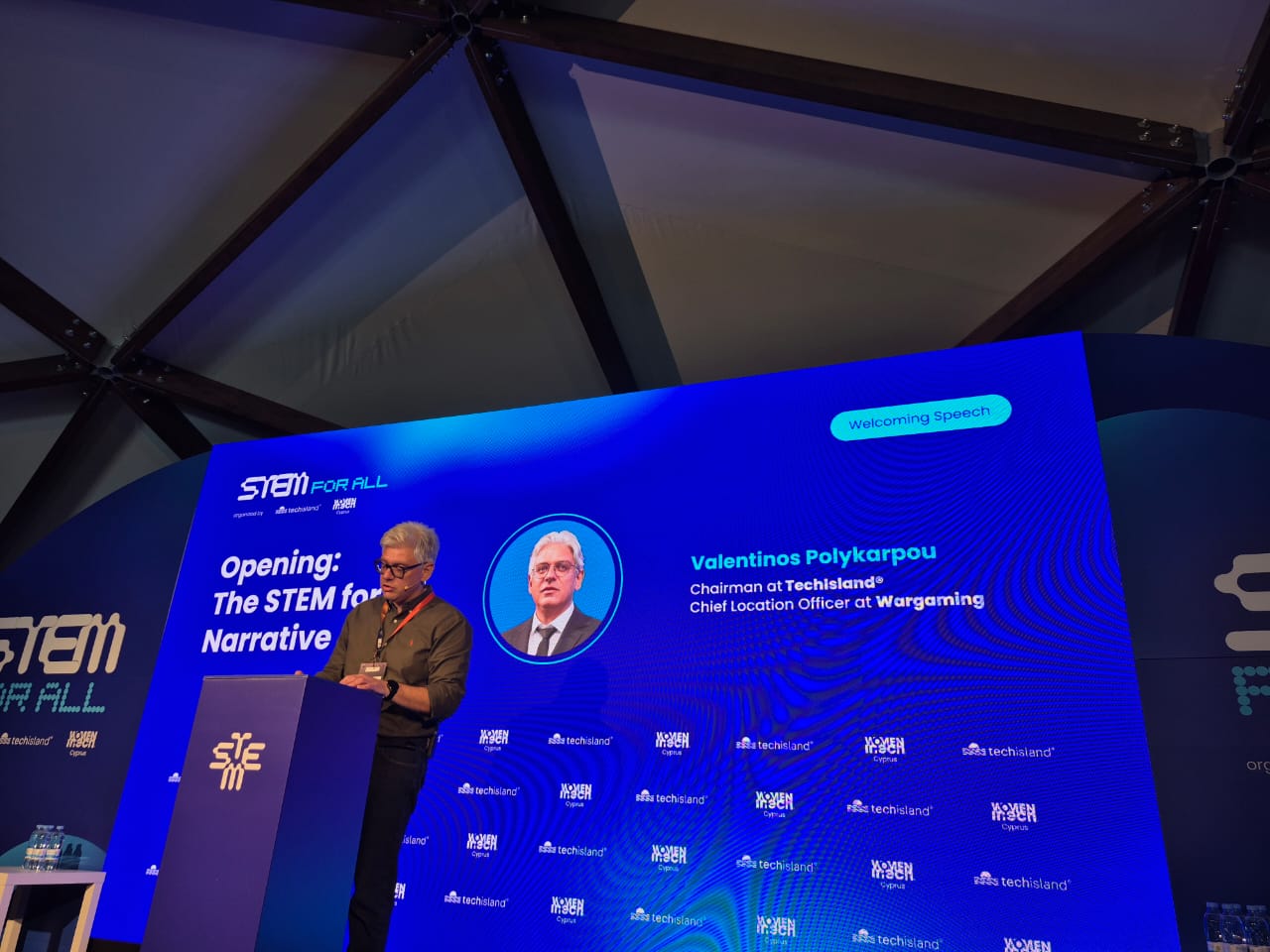
TechIsland chairman Valentinos Polykarpou said Cyprus’ transformation into a technology hub is no longer an aspiration but “a fact”, as he called for a broader investment in people to ensure the country does not leave parts of society behind in the AI era.
During his opening address at the TechIsland Summit in Limassol, Polykarpou linked Cyprus’ progress as a tech destination with the challenge of making science, technology, engineering and mathematics accessible beyond the traditional boundaries of the sector.
“A decade ago, if you told someone that Cyprus would become a global technology hub, a place where international companies come to build, where top talent chooses to relocate, where the ICT sector would drive national growth, many would have smiled politely,” he said.
Today, however, he said that “the vision of a tech island is no longer a vision. It is a fact”. For TechIsland, he added, “this is a major achievement”.
Polykarpou said the association was founded in 2021 by people from the private sector who shared the ambition of helping turn Cyprus into a tech island. Five years later, he said, TechIsland has grown into an organisation of more than 400 companies, with 52 per cent local Cypriot firms and 48 per cent international businesses, ranging from startups and SMEs to multinational corporations.
He also referred to the IN Business Editors’ Choice Award, which he received on behalf of the association at the IN Business Awards 2026 for TechIsland’s contribution to Cyprus’ tech ecosystem.
“We are not just a business association. We are a think tank. A connector. A platform for society, not just for industry,” he said.
For Polykarpou, this shift explains why initiatives that bring together policy, industry, education, research and the next generation are no longer optional. They are part of the same discussion about Cyprus’ future.
It was from this need, he said, that the idea of STEM for All emerged, he explained.
Addressing the audience, Polykarpou said not everyone in the room was an engineer, coder or data scientist. There were also educators, policymakers, entrepreneurs, parents and young people still trying to decide what they wanted to become.
“And yet, every single one of you is already living inside an AI-powered world,” he said. That, he said, is why the discussion around STEM can no longer be treated as a narrow conversation for specialists.
For most of history, he said, technology was seen as something separate from everyday life, something that existed “in labs, in server rooms, in the vocabulary of a select few”.
The rest of the world, he said, consumed technology but rarely shaped it. “AI changed that bargain, permanently,” he said.
Polykarpou said “AI is no longer something that engineers build and hand over to the world”.
“AI is the world, it is inside the tools we use to teach our children, the algorithms that surface the news we read, the models that help diagnose our health,” he said.
Because AI now touches every profession, age group and country, he said STEM can no longer be reserved for engineers or IT specialists.
“STEM is not a career path. It is a literacy,” he said. “And like every literacy before it, reading, writing, arithmetic, the moment it becomes essential to navigate the world, it must become accessible to all,” he added.
Polykarpou said the challenge is not only technological but deeply human. As AI becomes more capable, he said, the harder question is whether people are growing alongside it.
He asked whether people are expanding their potential, or quietly becoming passive within systems they themselves have built.
“That is the question this day is designed to confront,” he said.
Explaining the meaning of STEM for All, Polykarpou said it does not mean that every person must become a software engineer. “We do not mean that everyone must code,” he said.
Instead, he said, the idea is more fundamental and more democratising.
It means that a teacher should be able to understand how AI tools entering the classroom actually work, so they can guide students rather than simply use a product.
It also means that a nurse should understand what a predictive algorithm is saying when it flags a risk, so they can apply judgment rather than simply follow an instruction.
The same applies, he said, to a journalist, a lawyer, a farmer and a public servant, all of whom should have access to the understanding, skills and confidence needed to engage with technology “as active participants rather than passive recipients”.
“STEM for All means ensuring that no one, regardless of gender, age, background, region, or profession, is left behind as this transformation accelerates,” he said.
Polykarpou warned that exclusion from technological understanding carries wider consequences.
When people are shut out from understanding the technology that increasingly shapes their lives, he said, they do not gain freedom. “They lose it,” he said.
He added that every major transformation in human history has required a choice between waiting for the future to happen and trying to shape it. “The AI era is not asking for our permission. It is already here,” he said.
The question, he said, is no longer whether technology will transform education, healthcare, business, government and daily life, because it is already doing so.
Instead, the real question is whether every person in Cyprus, every student, every professional and every community, will have the understanding, skills and agency to be part of that transformation.
“That is what STEM for All means to us,” Polykarpou said.
He described it as “a commitment, to rethink education, to redesign pathways, to remove barriers, to open doors that may be closed to many people”.
Concluding his remarks, Polykarpou said Cyprus is at a remarkable moment. “We have the economy, the ecosystem, the momentum, and now we need the will to make the human investment that matches it,” he said.




Click here to change your cookie preferences