
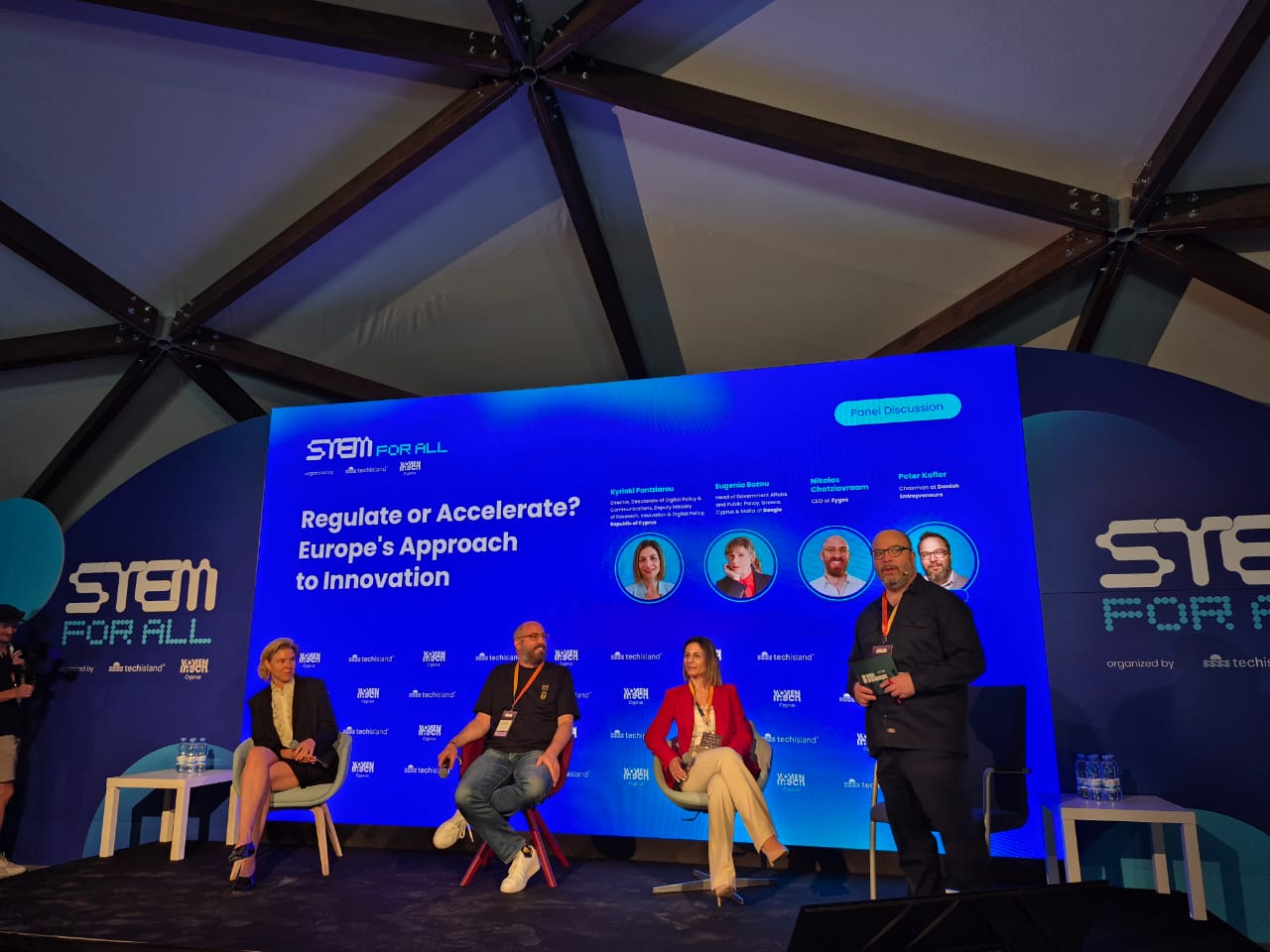
Europe’s regulatory approach to technology came under scrutiny in Limassol this week, as policymakers and industry figures warned that the bloc risks falling further behind the United States and Asia unless it simplifies rules and helps companies scale faster.
The discussion took place during the panel ‘Regulate or Accelerate? Europe’s Approach to Innovation’, held as part of STEM for All by TechIsland and Women in Tech Cyprus at the Pentagon Stage of the Doers Summit at Kolla Culture Factory.
Moderated by Peter Kofler, chairman of Danish Entrepreneurs, the panel brought together Kyriaki Pantziarou, director of the Directorate of Digital Policy and Communications at the Deputy Ministry of Research, Innovation and Digital Policy, Eugenia Bozou, head of government affairs and public policy for Greece, Cyprus and Malta at Google, and Nikolas Chatziavraam, CEO of Zygos.
Opening the discussion, Kofler said Europe was at a critical point, with around 80 per cent of digital regulation affecting countries such as Denmark and Cyprus coming from Brussels. For the past decade, he said, Europe had operated under the belief that regulation would create a safe and predictable environment for innovation.
However, he questioned whether that approach has delivered the intended results.
“Can we accelerate and can we regulate at the same time?” he asked, pointing to the growing gap between Europe and its global competitors.
Kofler also referred to the Draghi report, saying it had echoed what startup organisations across Europe had been saying for years: that growth is increasingly taking place outside the EU. He added that the message from a recent meeting of startup organisations in Lisbon was blunt: “slow is the new stupid.”
Pantziarou said there had been a visible shift in Brussels since the Draghi report, with policymakers now moving away from a “regulate first” mindset towards competitiveness and investment.
“There is a shift also from the Commission, the realisation that we have to move from the regulate first to competitiveness and to accelerate investment in Europe,” she said, “otherwise, we will stay behind.”
She said Cyprus, through its EU Presidency, had been able to open important discussions on digital files that affect the wider economy, rather than regulation for its own sake.
These include the Digital Networks Act, which is linked to infrastructure, 6G investment and fibre-to-the-home, as well as the Business Wallet Act, designed to simplify transactions between SMEs and between businesses and government.
Pantziarou also referred to the Digital Omnibus package, which includes simplification linked to the AI Act and other data-related rules. Cyprus, she said, had made progress in taking the AI proposal to the European Parliament for a vote in June, while other parts of the package remain under discussion.
The conversation then moved to the barriers facing founders and SMEs trying to scale across Europe.
Chatziavraam said the single market remains a major opportunity, but that Europe has still not removed the friction that makes expansion difficult for smaller companies.
“I think the single market is a great opportunity for removing tariffs, but still we have a long way to go from removing friction itself,” he said.
He explained that a Cypriot founder entering a market such as Germany may still need a German counsel, a German entity and a German compliance officer, while expanding to the US can often feel easier because the market is more unified culturally and commercially.
At the same time, he said, although Europe has umbrella regulations such as GDPR and the AI Act, implementation remains fragmented from one member state to another.
“The Commission has to equip states with the implementation tools as well, rather than just the regulation as a whole,” he said.
He added that this sequencing is particularly important for SMEs, which do not have the budgets to absorb complex compliance requirements or the indirect effects of rules that may not formally apply to them.
For Bozou, the wider issue is whether Europe is truly absorbing the message coming from industry.
She said the ambition and intention to improve competitiveness are present, but Europe is still not seeing the results needed to close the gap with the US.
Referring to Draghi’s latest intervention, she said the investment needed for Europe’s competitiveness had risen from €800 billion to €1.2 trillion, precisely because the gap is widening.
“Yes, the ambition is there, the intention is there, but it looks like Europe is missing something,” she said, adding thet “we’re not there, there is something we’re not doing right.”
Bozou pointed to Google’s recent product announcements in California, saying teams in Europe were already wondering how many of those products would actually be launched in the EU before being overtaken by newer technologies.
She cited AI Overviews, Google’s AI-powered search feature, as one example of a product available elsewhere but not in some European countries because of regulatory barriers.
“For citizens, the end users, but also for companies, it’s very, very hard to compete when there are barriers all the time in adopting the US technology,” she said.
The second part of the panel focused on the Digital Omnibus and the gap between simplification in principle and complexity in practice.
Bozou said the Digital Omnibus had a clear goal: to simplify regulation and reduce overlapping layers of rules so that SMEs can operate and innovate more easily in Europe. However, she warned that reopening several files at once had made the process more complicated.
On cookie consent and so-called cookie fatigue, she said the issue should not be rushed without a clearer impact assessment.
She warned that some proposals could have a major effect on personalised advertising, digital businesses, publishers and access to free quality content online.
“What we are suggesting is that it needs more time because we don’t have tangible impact assessment on what we are trying to solve and how we can solve it in an effective way,” she said.
She added that if businesses lose access to personalised advertising tools, publishers and websites may be forced to gate more content, introduce more subscriptions or create new pop-ups to persuade users to consent again.
“So again, we will have this experience for the end user of many banners and many pop-ups,” she said.
For Chatziavraam, the issue is especially serious for SMEs, which rely heavily on retargeting because they do not have the marketing budgets of larger companies.
He said the Digital Omnibus may be a good initiative in principle, but questioned how many SMEs in Cyprus even know what it is.
“This amplifies the gap between the EU and the actual market, the SMEs,” he said.
He added that cookies remain critical for smaller businesses trying to reach customers, particularly those who have already visited their websites.
“I don’t see how this could help SMEs,” he said, referring to proposals that would move certain consent controls to browsers.
He argued that removing cookie pop-ups through regulation may not remove the problem in practice, because businesses will likely seek other ways to convince users to accept personalised advertising.
Pantziarou said the cookie issue is a priority because it affects consumers, SMEs and companies at the same time. However, she made clear that Cyprus does not expect to close the relevant data proposal during its Presidency, with the file likely to continue under the Irish Presidency.
She said the challenge is to simplify rules while maintaining trust and consumer protection.
“We should find the right balance in order to keep the protection, not weaken the protection of the consumers and the trust that they have on the online services and their data,” she said, “at the same time, we don’t want to make things more complicated for SMEs.”
As the discussion drew to a close, Bozou said Cyprus’ progress in digital investment and ICT growth had been impressive, adding that the government’s ambition now needs to be reflected both in Brussels and at home.
She said Google had seen a strong willingness from Cyprus to engage in frank discussions, even on difficult regulatory issues.
“I think this is the most important thing, that we can sit on the table and talk,” she said.
The broader message of the panel was that Europe’s challenge is no longer simply whether it should regulate technology. Rather, it is whether it can create rules that protect citizens without slowing down the companies, founders and investors it wants to support.
For Cyprus, the issue is particularly relevant. As the island works to strengthen its position as a technology and innovation hub, the question is whether European regulation can offer clarity and trust without becoming another barrier for startups and SMEs trying to scale.





Click here to change your cookie preferences