
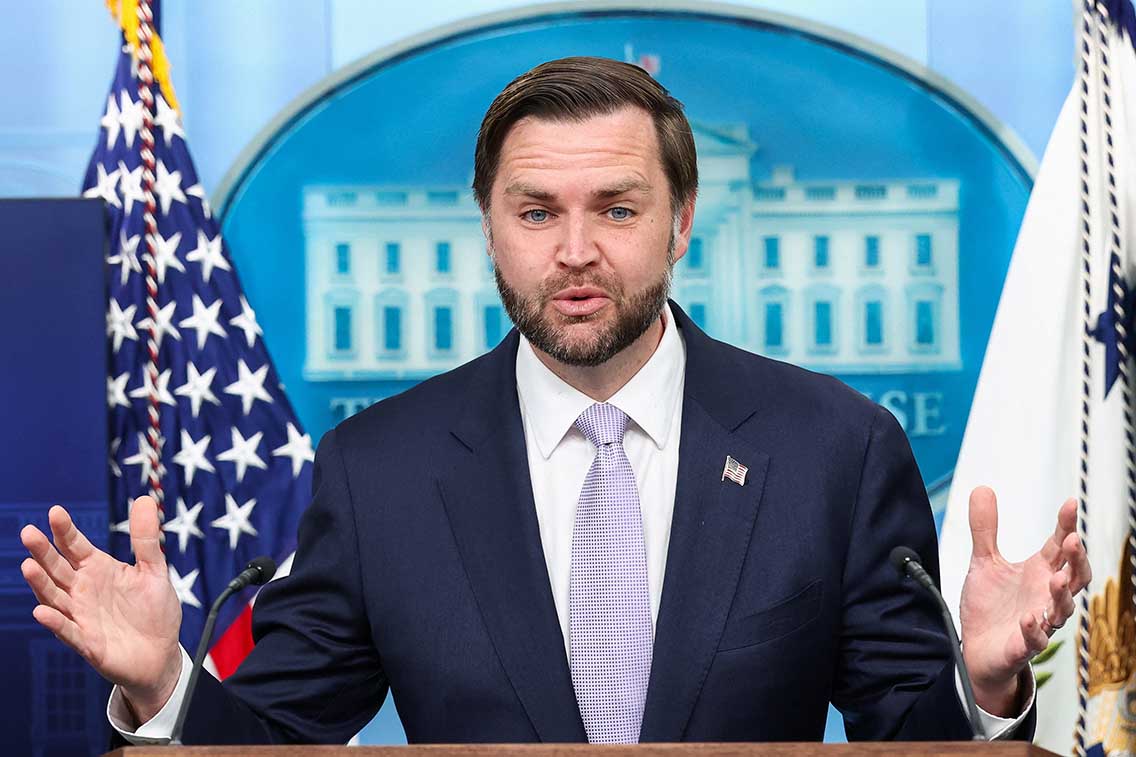
Thursday, February 26. Around 5pm, the final Situation Room meeting got underway. The positions of everyone in the room were already known before they sat down.
Trump went around the table.
General Daniel Caine, the chairman of the Joint Chiefs, outlined the risks meticulously – munitions depletion, the difficulty of securing the Strait of Hormuz, the question of what came next – and offered no opinion. JD Vance, who for weeks had been the most vocal opponent, told the president: “You know I think this is a bad idea, but if you want to do it, I’ll support you.” Marco Rubio, privately ambivalent, gave a narrow technical answer; once the war began, he would deliver the administration’s justification with full conviction. Susie Wiles, the chief of staff, had told colleagues she worried about another Middle East war, but did not view it as her role to weigh in on a military decision in front of others.
So why didn’t they push harder when it mattered?
Before we judge them, ask yourself: when was the last time you sat in a meeting, watched a decision being made that you disagreed with, and said something – but not the thing you were actually thinking? Maybe you flagged a technical concern instead of the strategic one. Maybe you told yourself someone more senior would say what needed saying, and walked out telling yourself you had done your part.
When we hold back, three forces are usually at work, and they reinforce each other.
The first is the most direct: fear of consequence. Everyone in the room had watched what happened to senior figures in the first Trump administration who had pushed back too hard. Most were fired or pushed out.
This is not unique to the White House. It happens in any organisation where leadership signals – sometimes loudly, sometimes through a single well-placed dismissal – that dissent is unwelcome. Researchers call the missing ingredient psychological safety: the sense that you can raise a concern without it costing you. And it turns out to be one of the strongest predictors of how well teams actually perform. Google’s Project Aristotle, a study of hundreds of its teams, found that psychological safety mattered more than talent, experience, or seniority – that the teams that got things right were the ones where people felt safe to disagree.
The second reason is subtler and harder to spot. Trump had defied expectations before, and his associates had seen him make bold decisions, take on unfathomable risks, and somehow come out ahead. At that point, you start questioning yourself: does he know something I don’t? This is known as informational influence – we treat the views and track records of others as evidence about reality. Often that is sensible. If you go to a fancy dinner and aren’t sure which fork to use, you might watch the person next to you, assuming they know the proper etiquette. But the same instinct can talk us out of a judgement that was actually correct, simply because we assumed someone else knew more than we did.
The third mechanism may be the most important. It is called the diffusion of responsibility: when many people share responsibility for an outcome, each individual feels less of it. The classic illustration is the bystander effect. Someone collapses on a busy street, and precisely because dozens of people are present, nobody steps in. Each one assumes someone else will. When everybody is responsible, nobody is.
The same logic operates in a meeting. Caine, by colleagues’ accounts, privately thought the war was a terrible idea. He never said so directly. He confined himself to listing risks – that was his job. Someone else, surely, would say the larger thing. Wiles deferred to the experts. The experts deferred to the president. Each one assumed the necessary words would be spoken by someone better placed to speak them. Nobody was.
When the group finally agrees, something quietly dangerous happens. People leave more confident than when they walked in – because the discussion has surfaced reasons for the chosen course but almost none against it. Those who agreed heard their position echoed back. Those who disagreed kept quiet.
What looks like consensus is really the silence of everyone who held back. The room did not test the decision. It signed off on one.
On February 28, the war began. Within days it became clear that several of the assumptions baked into the plan were wrong. The regime did not collapse. The popular uprising did not materialise. The Straits of Hormuz remain closed.
At which point a new question takes over. When the evidence starts to suggest a decision was wrong, why is it so much harder to reverse it than it was to make it in the first place? That is the question we turn to next.
Pantelis Solomou is a Cyprus-based behavioral scientist

Click here to change your cookie preferences