
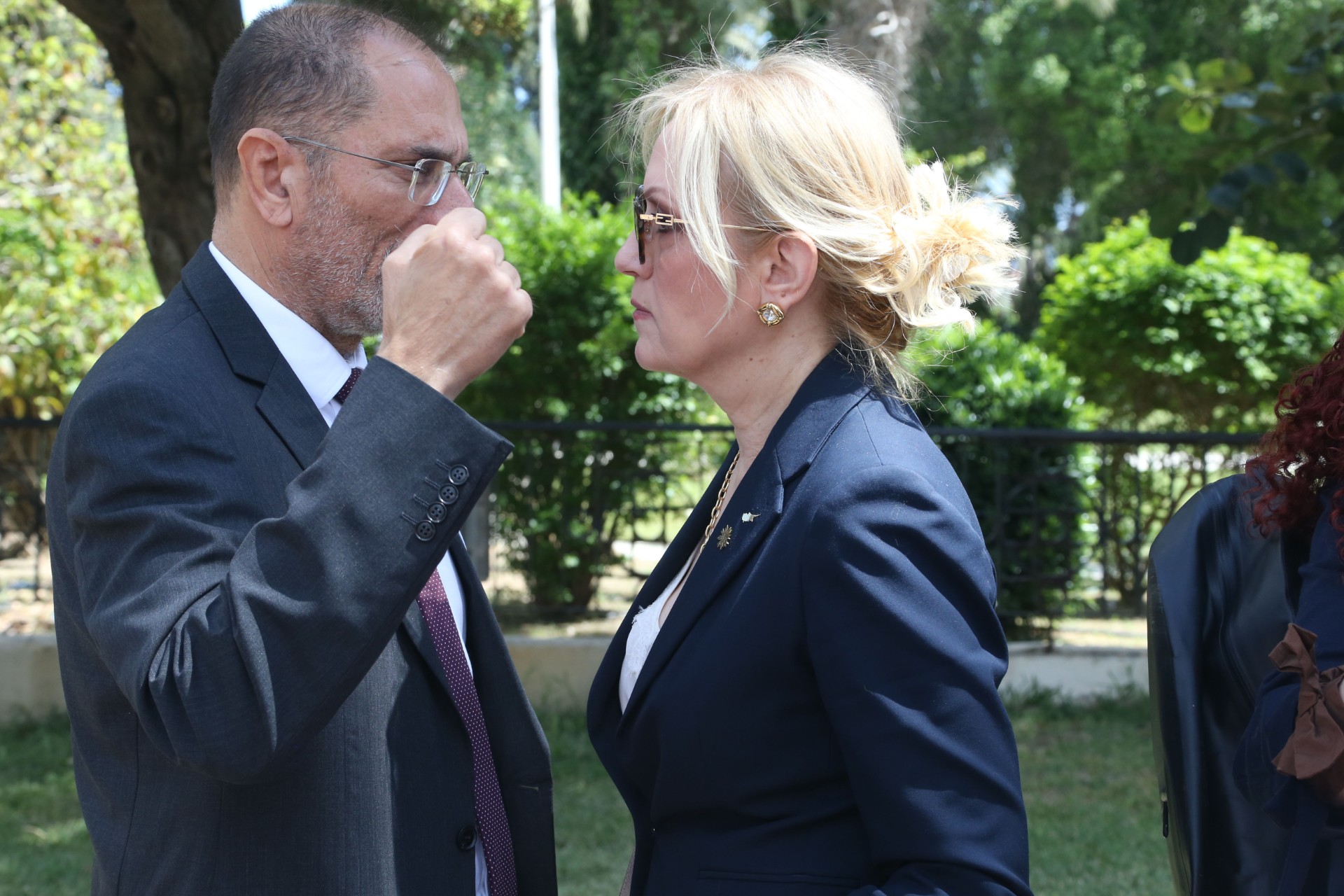
Alma leader Odysseas Michaelides ruled out supporting Diko leader Nikolas Papadopoulos for House president on Thursday, while floating a potential alternative coalition involving Akel, Elam and the party’s most recent convert MP Irene Charalambides.
On the same day, Disy formally nominated its leader Annita Demetriou for House president. According to a statement, the decision rests on Demetriou’s “successful term” as House president for the past five years, as well as on the result of the recent legislative elections which gave their party “a strong mandate”.
Speaking to Ant1, Michaelides said Alma could not support Papadopoulos because he leads a party participating in the government, reiterating that his movement’s preference is for a candidate from the opposition.
He also dismissed any prospect of backing Disy’s Demetriou.
Michaelides revealed he had already met Papadopoulos and was due to meet Akel secretary-general Stefanos Stefanou later on Thursday.
He is also expected to hold talks with Elam to explore whether a consensus candidate could emerge.
According to Michaelides, one option he intends to discuss is support for a figure from Alma who could potentially attract backing from both Akel and Elam.
He suggested that MP Irene Charalambides, who recently left Akel and joined his own political movement, could be such a candidate, while acknowledging that he did not know whether her name would be acceptable to Akel.
“I would like to at the very least hear their position,” he said.
Michaelides added that Alma had not ruled out abstaining if none of the eventual candidates reflected its political priorities.
At the same time, he appeared open to supporting a possible candidacy by Stefanou should Akel decide to enter the race.
The intervention came as Papadopoulos completed a first round of meetings with parliamentary party leaders in an effort to gauge support for his own bid for House speaker ahead of the vote next Thursday.
Papadopoulos met Stefanou on Wednesday before holding talks with Michaelides and Elam leader Christos Christou on Thursday.
He had also met Direct Democracy leader Fidias Panayiotou, who shall not be standing as an MP in the House but continue in his present capacity as an MEP, earlier in the week.
While no agreements have emerged from the discussions, the meetings have reinforced the central role Akel is expected to play in determining the outcome.
Sources from both Akel and Diko indicated that discussions between Stefanou and Papadopoulos were conducted in a positive atmosphere and focused primarily on Papadopoulos’ candidacy, with no alternative names formally proposed.
Akel has yet to make a final decision and is expected to discuss the matter collectively at a politburo meeting early next week.
Stefanou has publicly stated that the party remains open to dialogue with all parliamentary parties except Disy and Elam.
The arithmetic of the new House has left several possible scenarios in play.
Akel’s 15 seats combined with Diko’s eight would give a joint candidate 23 votes, enough to comfortably progress to a second round and potentially secure election.
By contrast, Disy’s 17 MPs would leave Demetriou dependent on support from smaller parties.
Elam has maintained that it will not support either Demetriou or any candidate proposed by Akel.
Party officials have nevertheless left open the possibility of supporting a Diko candidate, arguing that such a move would not contradict their position because the nominee would not come from Akel itself.
Back in April, parliament decided to simplify the procedure for electing a House president. The old rules been in place since 1985, and had provided for up to four rounds of voting.
Under the current procedure, a vote will take place, with the winner being the candidate securing an absolute majority – meaning 29 out of the 56 MPs.
If no candidate secures an absolute majority, a second round of voting will be held between the two candidates that secured the most votes in the first round. Here, a simple majority will decide the issue – the candidate receiving more votes than the other.
In the event of a tie, a runoff vote will take place among the top two candidates – with the winner being the one securing a simple majority.
If again the voting results in a tie, a simple drawing of lots will take place to decide the matter.
In each round of voting, only affirmative votes will be counted. An affirmative vote is a formal ‘yes’ signifying support for a candidate. Negative votes or abstentions will not be counted.




Click here to change your cookie preferences