
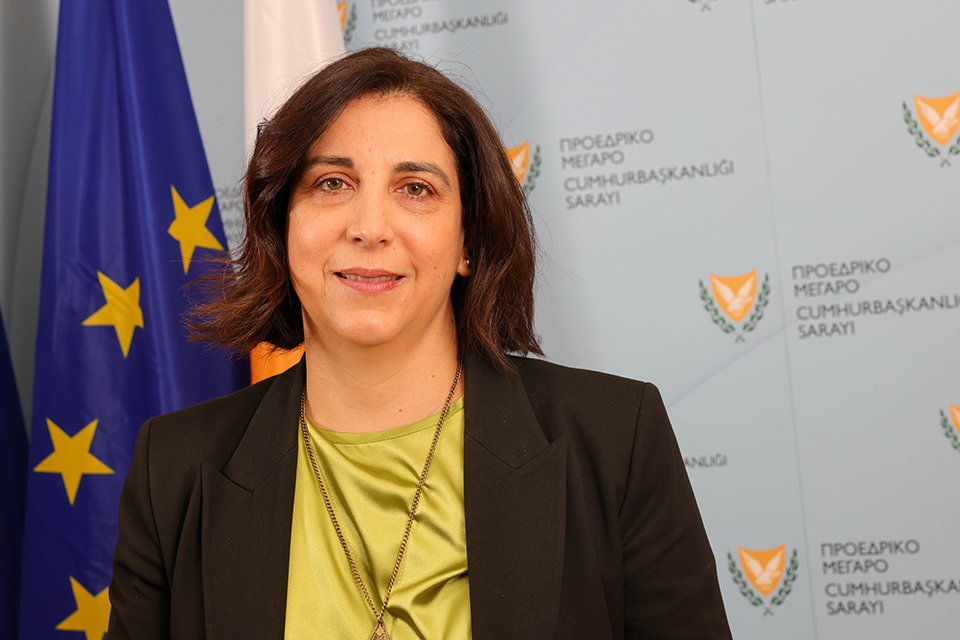
Deputy Minister to the President Irene Piki this week said Cyprus and Italy can act as bridges of stability and economic interconnection between Europe, the Middle East and North Africa, as the two countries seek to deepen their cooperation in trade, energy, technology and regional connectivity.
Speaking at the Italy – Cyprus Round Table with the business community, held at the Limassol Chamber of Commerce and Industry (Evel), Piki said the current geopolitical environment has given new importance to the role of Mediterranean EU member states.
She said there is a clear common understanding between Cyprus and Italy on the main challenges and opportunities shaping the future of Europe and the wider Mediterranean.
In this context, she added, the decision taken by the leaders of the two countries during the recent visit of President Nikos Christodoulides to Rome to prepare a joint Cyprus – Italy Action Plan is of particular importance.
As two European Union member states with a strong Mediterranean and outward-looking orientation, Piki said Cyprus and Italy share the need for a more competitive, more resilient and better connected Europe.
Referring to economic ties between the two countries, she said cooperation has developed strong momentum, with total bilateral trade in goods and services exceeding €1.5 billion in 2025.
This, she said, reflects both the breadth and the potential of the economic relationship.
“Italy is the second most important trading partner of Cyprus in terms of imports within the European Union. Nevertheless, there is still significant scope for balancing the trade balance,” she stressed.
Energy, Piki said, remains one of the most important areas of cooperation, with Italy acting as a strategic partner for Cyprus, mainly through the activities of ENI and, in particular, the ENI-Total consortium in Block 6 of the Cypriot Exclusive Economic Zone.
She said the latest developments surrounding the Kronos gasfield are especially important, recalling that last week the Council of Ministers approved the development and production plan for the field.
The decision, she said, marks a substantial next step towards the commercial exploitation of Cypriot natural gas.
“This development confirms that our energy cooperation in the Eastern Mediterranean is now entering the implementation phase, strengthening both regional cooperation and European energy security,” she said.
At the same time, Piki said new regional interconnection initiatives are creating further opportunities for economic cooperation.
She referred to the BlueMed digital cable system, with the participation of Italian company Sparkle and its connection to Cyprus through Cyta, describing it as an important development for the strategic interconnection of the region.
“In combination with the dynamics of the IMEC economic corridor, it strengthens the role of the Eastern Mediterranean as a space for trade, data, investment and strategic interconnection between Europe, the Middle East and India,” she added.
Piki said Cyprus is increasingly emerging as a regional hub for digital interconnection, logistics and business services, creating new opportunities for investment and regional business activity.
She also said the strengthening of European strategic autonomy is opening new prospects for cooperation in the defence industry, a sector which is becoming increasingly important at the European level.
“Cyprus is gradually developing a dynamic ecosystem of defense and technological innovation, with increasing participation of Cypriot companies and research institutions in European programs and collaborations with major European industries,” she said.
Moreover, Piki said there are also significant prospects for cooperation in traditionally strong sectors of the Cypriot economy, including shipping and business services, while financial services and technology are also gaining momentum.
In recent years, she added, Cyprus has been attracting more international technology companies, which are using the country as a European base with regional access, contributing approximately 14 per cent to GDP.
She also recalled that in the first quarter of 2026, Cyprus recorded the highest growth rate in the European Union, at 3 per cent of GDP, saying this confirmed the stability and competitiveness of the Cypriot economy in a particularly demanding international environment.
“Cyprus, therefore, combines the institutional stability of the European Union with real operational access to the wider region,” she said.
In a period of heightened geopolitical uncertainty, Piki added, this is an important advantage for businesses and investors seeking stability, reliability and a strategic perspective.
Referring to the round table, she said the event sends a clear message that Cyprus and Italy are choosing to invest further in cooperation, interconnection and the common opportunities created by the new economic and geopolitical reality of the Mediterranean.





Click here to change your cookie preferences