
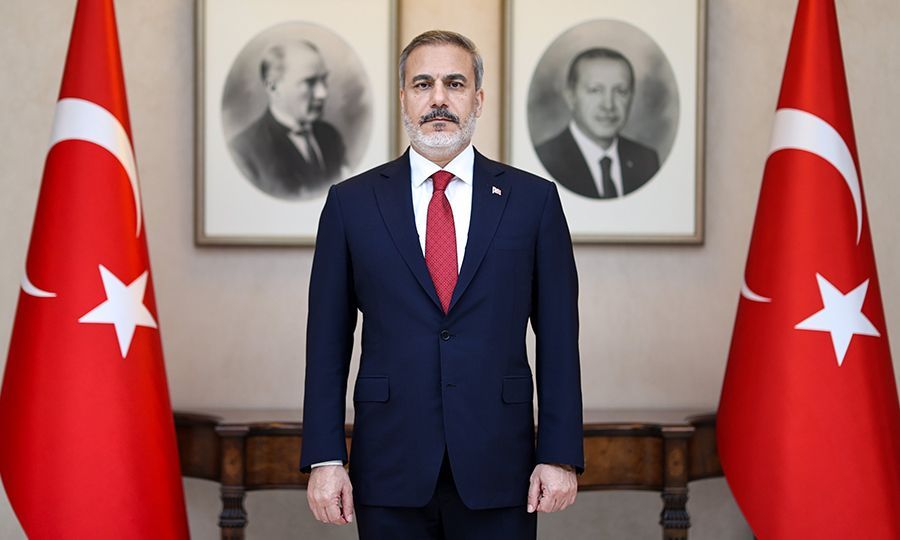
President Nikos Christodoulides said on Monday that he “does not downplay or underestimate” recent statements by Turkish Foreign Minister Hakan Fidan on the Cyprus problem.
Speaking to journalists in Limassol, Christodoulides was asked about Fidan’s comments following his meeting with the UN secretary-general’s personal envoy, Maria Angela Holguin, during which the Turkish foreign minister reportedly reiterated support for a two-state solution as a more ‘realistic option’.
Christodoulides said he had been briefed on developments through the UN envoy and had exchanged messages regarding recent contacts, adding that he would not disclose further details.
He added that the United Nations continues to operate within a defined framework and would not undertake initiatives outside the UN Charter, particularly at a time when international law and the post-1945 system were being questioned.
The president said the UN secretary-general, Antonio Guterres, has set a clear direction for the process, and that efforts to move forward on the Cyprus issue remain aligned with that framework.
“The UN initiative is moving in a specific direction, a direction that the secretary-general himself has given and we are continuing this effort,” he said.
Fidan is reported to have remarked during his meeting with Holguin in Ankara, that the “most realistic solution” to the Cyprus problem would be the status-quo, that being two separate states on the island.
According to Turkish foreign ministry sources cited in local media, he said approaches that do not recognise what Turkey describes as the “sovereign equality” and “equal international status” of Turkish Cypriots would not lead to progress, stressing that any process must reflect “realities on the ground”.
Holguin’s meetings in Turkey form part of a wider round of contacts ahead of a possible enlarged conference on the Cyprus issue involving the two Cypriot sides, the three guarantor powers, Greece, Turkey, the United Kingdom as well as the United Nations.
The proposed meeting is expected to take place by early August.
Christodoulides said he remains in contact with the UN envoy regarding her discussions with all parties, including Turkish Cypriot leader Tufan Erhürman, and other regional actors.
He said he would not publicise the content of those exchanges but stressed the importance of continuing diplomatic engagement under UN auspices.
“I will repeat what I have said before,” he said.
“At the end of the day, we will all be judged by our positions and the final outcome.”
Holguin has recently completed meetings in Cyprus and Turkey and is expected to continue consultations in Brussels and with Greek Foreign Minister Giorgos Gerapetritis before returning to the island for further contacts later this month.
UN officials have indicated that preparations continue for an enlarged meeting aimed at assessing conditions for the possible resumption of formal negotiations on the Cyprus problem.





Click here to change your cookie preferences