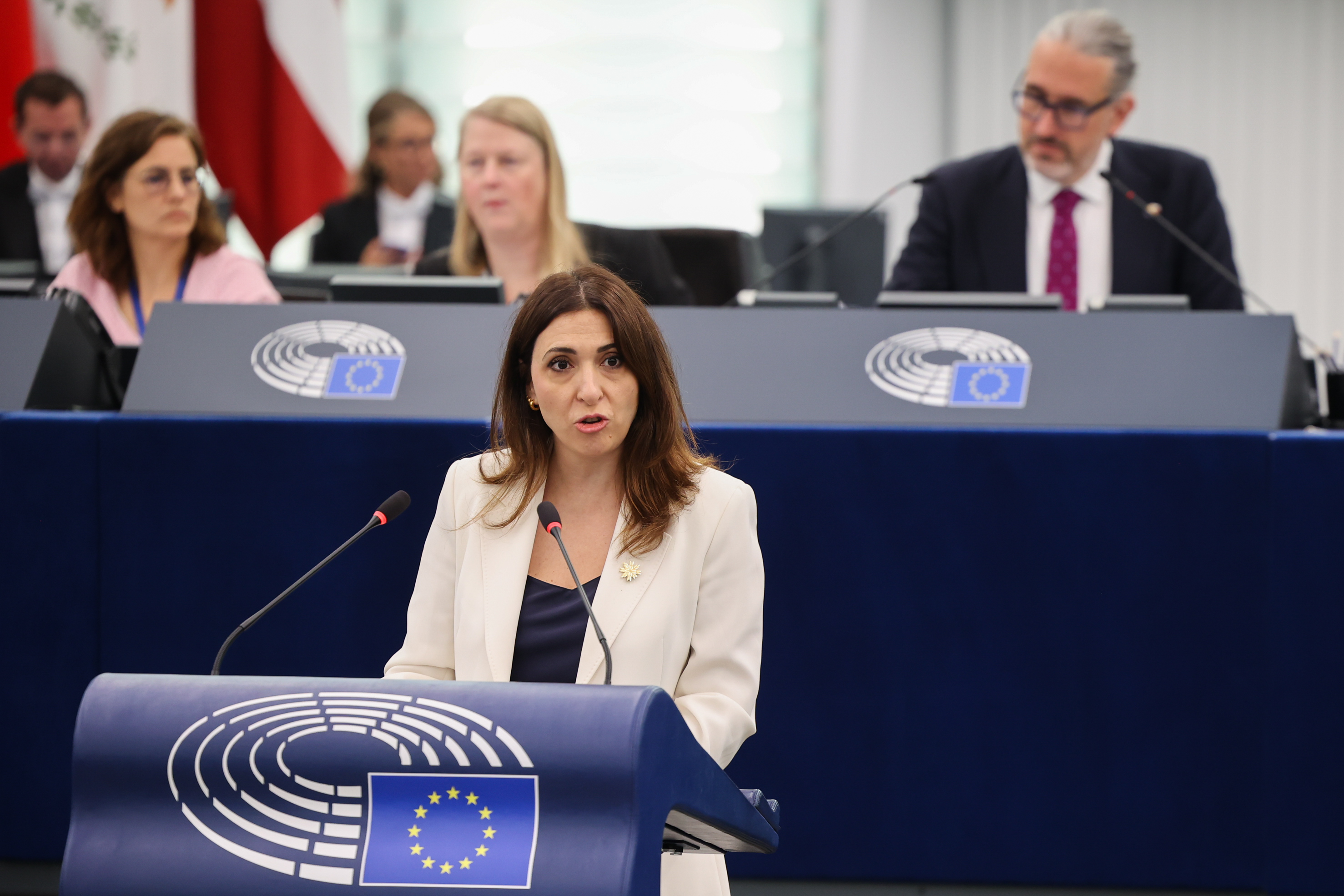
European Affairs Deputy Minister Marilena Raouna on Wednesday said she expects for a “strong message of unity and determination” in support of Ukraine to be sent from this week’s European Council summit, as she addressed the day’s European Parliament plenary session in Strasbourg.
“The European Council will send a strong message of unity and determination in support of Ukraine. Leaders will first hear from President [Volodymyr] Zelenskiy on the situation on the ground and the latest developments,” she said.
She added that the leaders of the European Union’s 27 member states are “expected to discuss Russia’s continued escalation and ongoing diplomatic efforts” being undertaken with the aim of bringing the war, which has now been ongoing for almost four and a half years, to an end.
“Recent developments demonstrate both Ukraine’s resilience and the growing pressures facing Russia’s war effort. This reinforces the need for the European Union to remain steadfast in its support for Ukraine and united in maintaining pressure on Russia,” she said.
Zelenskiy will be in Brussels alongside the EU’s 27 leaders, having already travelled to France this week to attend the G7 summit in the lakeside town of Evian-les-Bains.
European Council President Antonio Costa had said in his invitation letter to the week’s summit that “Ukraine remains high on our agenda”, and that the country has “demonstrated renewed success on the battlefield, while Russia is failing to achieve its military and strategic objectives”.
“Russia’s increasingly reckless and irresponsible behaviour towards EU member states is unacceptable and signals the opposite approach. Our two-pronged approach – supporting Ukraine and increasing pressure on Russia – is working,” he said.
Costa’s mention of incidents involving EU member states come with two Russian drones having fallen in Romania in recent weeks, with Raouna also making reference to those incidents.
“Recent months have seen repeated drone incursions in EU airspace, including two serious incidents in Romania. These developments further underscore the urgency of advancing Europe’s defence readiness agenda and strengthening our collective capacity to address emerging threats,” she said.
She also made reference to the opening of negotiations for both Ukraine and neighbouring Moldova to accede to the EU on Monday, saying that EU leaders are expected to “welcome” this.
Cyprus, she said, in its capacity as the holder of the Council of the EU’s rotating presidency, has “worked intensively since day one of its presidency and is very proud to have delivered this milestone moment in Ukraine’s accession path and in Moldova’s accession path”.
Both Ukraine and Moldova opened ‘cluster one’ of the six thematic clusters of accession negotiations, which focuses on “fundamentals”.
Negotiations are divided into six thematic clusters – “fundamentals”, “internal market”, “competitiveness and inclusive growth”, “green agenda and sustainable connectivity”, “resources, agriculture, and cohesion”, and “external relations”.
Per EU law, ‘fundamentals’ is the last negotiating cluster to be closed, despite being the first to be opened.



Click here to change your cookie preferences