
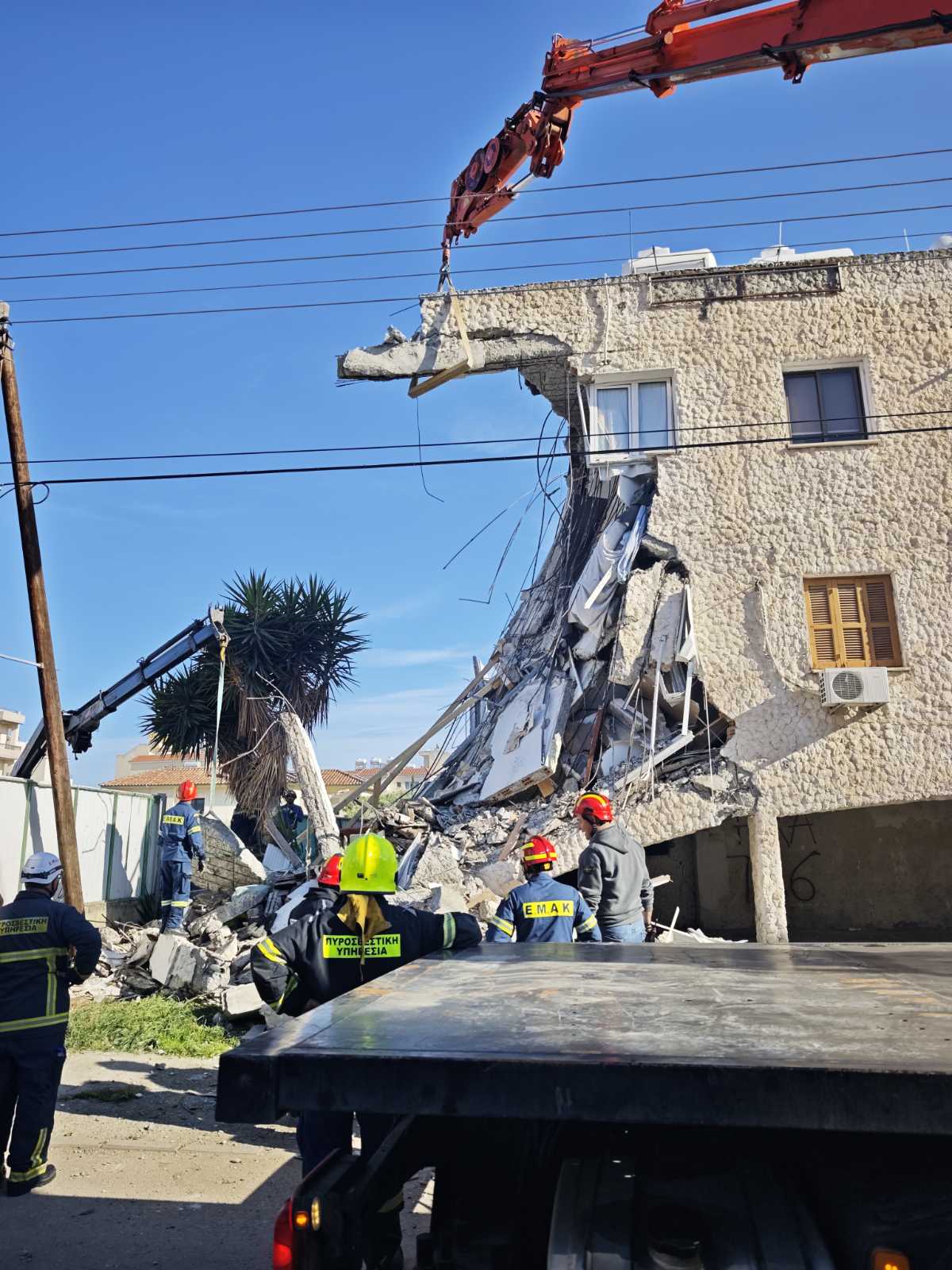
Nearly a month after the Limassol district local government organisation (EOA) applied for a court order to evacuate the unsafe Seagate apartment complex in the Yermasoyia tourist area, no decision has yet been issued, exposing what its president described as the shortcomings of the current legal framework.
The building partially collapsed on April 11, leaving two people dead.
Speaking to CNA, Limassol EOA president Yiannis Tsouloftas said the delay demonstrates that while legal mechanisms exist, they are “time-consuming and ineffective” and do not allow authorities to address dangerous buildings swiftly.
The organisation filed its application for an evacuation order on May 20. During a hearing before the Limassol district court on Thursday, directions were issued regarding the next steps in the proceedings.
Tsouloftas explained that, as the legal process moves forward, owners of the building have lodged an appeal against the EOA’s request, which is currently being examined by the interior ministry.
If the court grants the order, the owners will be required to vacate the complex, which houses around 60 families. Failure to comply would leave them liable before the courts, while the police would be responsible for ensuring the order is enforced, he said.
“Legal tools may exist, but they are slow and ineffective and do not provide the organisation with the ability to offer an immediate solution to a problem involving a dangerous structure,” Tsouloftas said.
He called for legislative amendments that would give district organisations the authority to deal with unsafe buildings “quickly and effectively”.
Tsouloftas also raised concerns over the financial burden placed on EOAs, which are funded through water supply, sewerage and licensing services.
“These organisations have been given a responsibility that generates no income,” he said, questioning how repairs or interventions should be financed when owners fail to maintain their properties.
“Should someone’s water bill increase to subsidise the negligence of a neighbour with a dangerous building? Should building permit fees be doubled to finance dangerous structures?” he asked.
Such an approach, he added, would be unfair to residents and contrary to European regulations, which treat the three services provided by EOAs as separate entities and prohibit cross-subsidisation.
He also pointed to the social dimension of the issue, noting that residents forced to leave unsafe buildings may not have the financial means to secure alternative accommodation.
Referring to the housing crisis and soaring rents in Limassol, Tsouloftas said some people were compelled to live in unsafe properties because they offered lower rents.
“It is a social problem that the state must address comprehensively,” he said, adding that EOAs alone could not solve the issue.
“There needs to be cooperation between local authorities and the central government, which has access to revenues from general taxation and the flexibility to allocate resources where needed,” he added.
According to Tsouloftas, the Limassol EOA has records of around 1,000 potentially dangerous buildings across the district.
Of these, 262 have undergone visual inspections by civil engineers from the Cyprus Scientific and Technical Chamber (Etek), following an agreement with the organisation.
Reports have already been submitted for 220 properties and are currently being assessed by EOA engineers to determine whether the buildings require immediate evacuation or whether repairs and maintenance would be sufficient.
Where buildings are classified as highly dangerous, owners will be given a deadline to remedy the situation. If they fail to do so, the organisation will initiate legal proceedings to enforce the removal of the risk.
Tsouloftas said 96 buildings in Limassol have already been officially declared dangerous, including 70 designated by the EOA and 26 inherited from previous planning authorities.





Click here to change your cookie preferences