
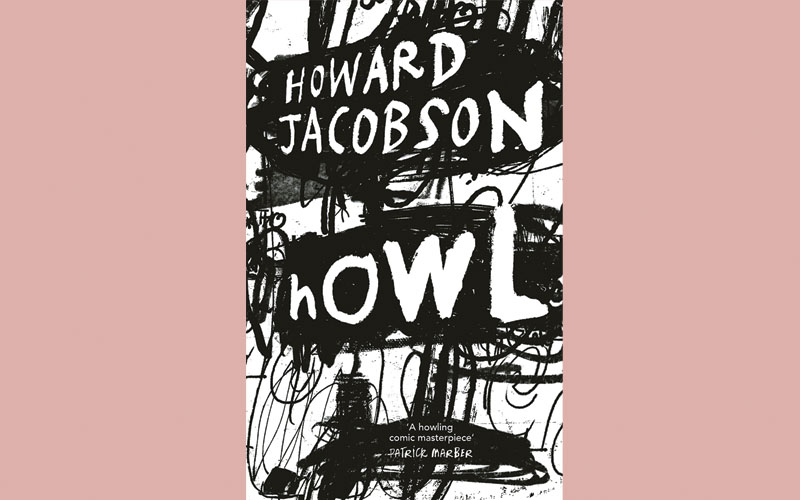
Book review: Howl by Howard Jacobson
By Philippa Tracy
Howard Jacobson won the Booker Prize in 2010 for The Finkler Question, a book about philosophy, culture, friendship, love, humanity and what it means to be Jewish. In his latest novel Howl the humour is darker, exploring what it means to be Jewish in a post October 7 world. In a piece he wrote for a UK national newspaper, Jacobson calls the novel’s response, “exploratory and uncertain” rather than political, because “no good novelist was ever an ideologue.”
Dr Ferdinand Draxler MBE, FRSA, (Ferdie to his wife and close friends), an English Jew, is the headmaster of Strawberry Fields, a non-denominational primary school in South London. The day after the October 2023 massacre of Israeli Jews, the moral clarity in Ferdie’s world is gone. He struggles to comprehend the response in the media and on the streets of London. The rules on hate no longer apply. He wonders, “in the history of hate, had there ever been anything like this rush of clerks and scholars to embrace savagery?” In this he sees a “crime still more iniquitous” than Holocaust Denial. And so begins his slow unravelling, as he grapples with the “existentially absurd.”
As his world falls apart, Ferdie reflects on what it means to be Jewish. He is being undermined in the staffroom by his deputy, Max Axelberg, a convert to Judaism who clearly doesn’t like Ferdie, or Ferdie speculates, any other Jews that were born Jewish. Axelberg will not acknowledge the crimes of October 7 and, instead, seems to be calling on Ferdie to make a statement of solidarity with the murderers. The school janitor, Hasheen, is “running wild, radicalising toddlers.” Ferdie’s own daughter, Zoe, a student at Oxford, refuses to believe any “Zionist propaganda” and is now regularly attending what he calls the “peace marches”; she is spotted on TV ripping down and defacing a poster of an Israeli hostage, laughing.
As Zoe moves into the “Liberation squat” across the road, waving a Palestinian flag, Ferdie’s wife, Charmian, normally so good at diffusing family tensions, struggles to deal with the fall out. At one point she has to throw a sheet over the television, after Ferdie stays up all night arguing with it. Ferdie is shocked to find that his brother, Isak, the sort of religious Jew that Ferdie has very little time for, and whom he hasn’t seen for 20 years, has returned from Israel, and plans to join the marches too. Meanwhile, Ferdie’s mother, Mutti, as he calls her, a Belsen survivor, is having her house daubed with antisemitic graffiti.
Having escaped school for a day, Ferdie encounters a parent protester at the National Gallery, where activists have glued themselves to a Rubens painting because, “they confused Rubens the painter with Reubens the delicatessen in Golders Green.” Humour is the basic structure of a novel that keeps you reading and allows Jacobson to play with any such absurdities of response to the Hamas atrocities. Ferdie, a grammar obsessive, hates the “dogma,” “vindictive groupthink” and “hand-me-down language” of the protesters.
Jacobson recognises the novel contains “an undercurrent of nostalgia” for a possibly idealised and vanishing England. But this is not a novel of absolutes. Ferdie sees antisemitism everywhere. But, as a narrator, he also has his doubts and, at times, his own behaviour is questionable. There are some wonderfully comic moments. It is thought-provoking but never preaches.



Click here to change your cookie preferences