
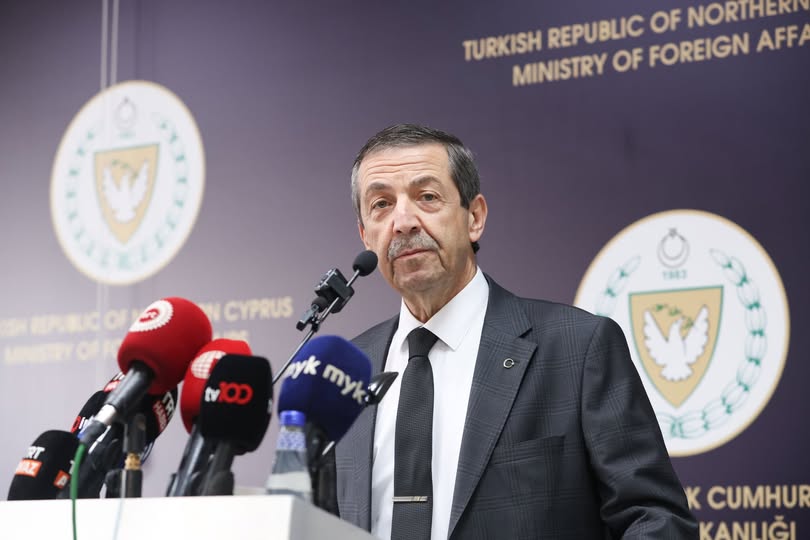
The Turkish Cypriot ‘foreign ministry’ has described the resolution passed by the European Parliament earlier this week on the sexual violence suffered by Cypriot women during Turkey’s invasion in 1974 as “a manifestation of the European parliament’s biased, prejudiced, and politically motivated approach to the Cyprus issue”.
“We strongly condemn this resolution, which distorts the 1974 Turkish military intervention and targets the Turkish Cypriot people and Turkey,” it said.
It then added that “following the bloody coup d’état carried out by Greece and its Greek Cypriot collaborators on July 15, 1974, with the aim of annexing the island to Greece and eliminating the Turkish Cypriots, the Republic of Turkey legitimately intervened on the island on July 20, 1974, in accordance with its rights and obligations”.
Those obligations, it said, stem from Turkey’s role as a guarantor power.
It went on to say that its military action in Cyprus in 1974 “ended the systematic attacks, massacres, and grave human rights violations perpetrated by the Greek Cypriot side against the Turkish Cypriot people between 1963 and 1974”.
“This operation … not only ensured the safety of the Turkish Cypriot people, but also prevented a potential mass slaughter on the island, guaranteeing the existence and freedom of our people,” it said.
It added that “instead of addressing the atrocities and crimes against humanity committed by the Greek Cypriots against the Turkish Cypriot people during this period, the European Parliament has once again overstepped its bounds by making baseless accusations against the heroic Turkish armed forces”.
“This unacceptable decision … which targets Turkey, will only serve to contribute to Greek Cypriot propaganda aimed at deceiving the world,” it said.
Prior to the resolution’s passing through the European Parliament, it said, the 11 female members of the Turkish Cypriot legislature sent letters to the European Parliament’s gender equality committee (Femm), Spanish MEP Lina Galvez, “responding to claims which do not reflect the truth and making intensive efforts to present the realities on the island accurately and transparency”.
However, it added, “despite all these efforts, the adoption of the resolution once again reveals that the European Union and its institutions have long since lost their neutrality on the Cyprus issue and are acting entirely as spokespeople for the Greek Cypriot side”.
“Such decisions, which disregard the will of the Turkish Cypriot people, ignore their inherent rights, and deliberately distort the realities on the island, are null and void from our perspective and have no legitimacy whatsoever,” it said.
As such, it said, “we invite the European Parliament to abandon its unilateral approaches, to cease using the Cyprus issue as a tool for political propaganda, and to respect historical facts and the current reality on the island”.
The resolution was passed on Wednesday with 575 votes in its favour, 33 votes against and 43 abstentions, and was written following a factfinding mission to Cyprus carried out by a delegation from the European Parliament last year.
While the resolution itself made no reference to violence suffered by the Turkish Cypriot community, a number of MEPs did raise the issue during Tuesday’s debate.
Akel MEP Giorgos Georgiou said that “in 1974, the Turkish armed forces in Cyprus systematically organised sexual violence against Greek Cypriot women and men of all ages”, and that this constitutes “another heinous crime [committed] by Turkey which remains unpunished”.
“However, we must be honest. Barbarities were also committed by Greek Cypriot paramilitary groups against Turkish Cypriot women. Rape has no colour, race, or religion. Wounds are difficult to heal,” he said.
He added that “Cyprus and the European Union have an obligation to ensure the rights, dignity and historical memory of all women in Cyprus” and called for “the common pain [to] become a driving force for bicommunal cooperation and peace on our island”.
Likewise, Italian MEP Cecilia Strada said that while “Turkish forces systematically gang raped and assaulted Greek Cypriot women aged 12 to 70”, the “fascist paramilitary forces of Eoka-B raped and massacred the female population of entire Turkish Cypriot villages”.
“As in too many war zones, the perpetrators went unpunished and the victims, in most cases, lacked access to adequate health and social care,” she said.
All six Cypriot MEPs voted in favour of the report, though the parliament’s rapporteur on Turkey, Nacho Sanchez Amor, was among the abstainers.





Click here to change your cookie preferences