
When President Nikos Christodoulides persuaded the European Union to make EU-Turkey relations dependent on progress on the Cyprus problem, this was presented as great achievement. The linking of the two was seen as an effective way of persuading Ankara to adopt a more constructive approach to the Cyprus problem and abandon its insistence on a two-state solution.
As a theory it sounded rather convincing, but as a strategy that would lead to a breakthrough in the Cyprus problem and possibly a resumption of talks it has not been very effective. It was part of a broader scheme of the government which had made EU involvement in the Cyprus issue its main priority, the president seeking the appointment of a Cyprus envoy by Brussels. He claimed to have made the Cyprus problem a European problem. As a slogan this too sounded impressive, but it has had no discernible practical benefits.
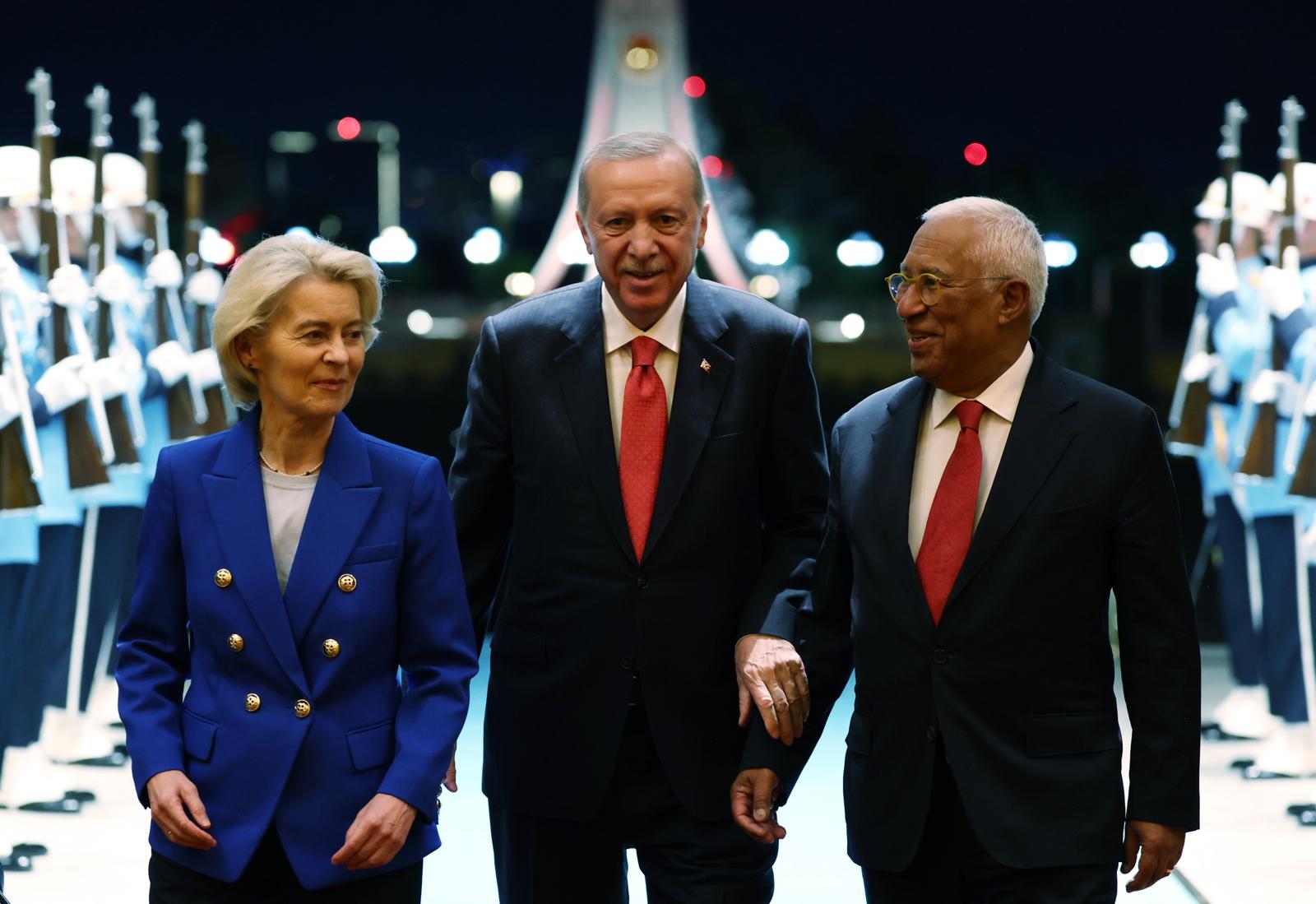
The ineffectiveness of this strategy was highlighted on Wednesday in Ankara, when President Recep Tayyip Erdogan hosted a dinner for the European Commission president Ursula von der Leyen and the president of the European Council Antonio Costa. In the run-up to the dinner, the presidential palace said it expected a positive message from Erdogan as regards the Cyprus issue, while Christodoulides a few hours before the meeting said there would be a move by Turkey on Cyprus followed by a move on EU-Turkey relations.
The dinner did not go according to plan. Press reports suggested that Erdogan told his EU guests that he wanted tangible commitments from Brussels on Turkey-EU relations before there could be any steps on the Cyprus issue. This leads to something of a deadlock considering Christodoulides had made it clear that without any move on the Cyprus issue, giving his consent to EU-Turkey issues to progress was out of the question.
Where does this leave us? The latest initiative by the UN secretary-general seems to have reached an impasse, which we suspect suits Ankara as it has not shown any great desire for a resumption of the talks more than Nicosia. Christodoulides’ scheme appears not to have worked, if the objective was the calling of a 5+1 conference by the UNSG. In fact, by linking the Cyprus issue to EU-Turkey relations the government, instead of facilitating the start of peace process, has placed another obstacle in the way.
The idea it could bring Erdogan to the negotiating table through an ultimatum involving the EU was a big miscalculation, although it went down well with Greek Cypriot public opinion, which enjoys scoring points against Turkey, even if these achieve nothing. What is the probability that the autocratic Erdogan would bow to pressure from Nicosia? A more likely scenario is that Brussels, for which progress on EU-Turkey relations is considered of vital importance, will be looking for some face-saving compromise that will satisfy Erdogan and Nicosia would be forced to accept.
The government in Nicosia was certain there would be no backtracking by Brussels. Spokesman Konstantinos Letymbiotis insisted that for there to be progress on the EU-related issues that Turkey was interested in, Ankara had to show “the constructive will, the decisive will for progress on the Cyprus issue”. He defiantly stated: “this is the position that the 27 member-states and of course the institutions of the European Union convey and support from the first moment.”
We should take this assertion with a pinch of salt, because it will not be long before some of the member states that enjoy close ties with Turkey will seek a watering down of this policy or find some way of getting round it. If Nicosia succeeds in blocking any progress in EU-Turkey relations because its condition had not been met, it will also be blocking any progress on the Cyprus issue, in spite of the UN effort to get things going.




Click here to change your cookie preferences