
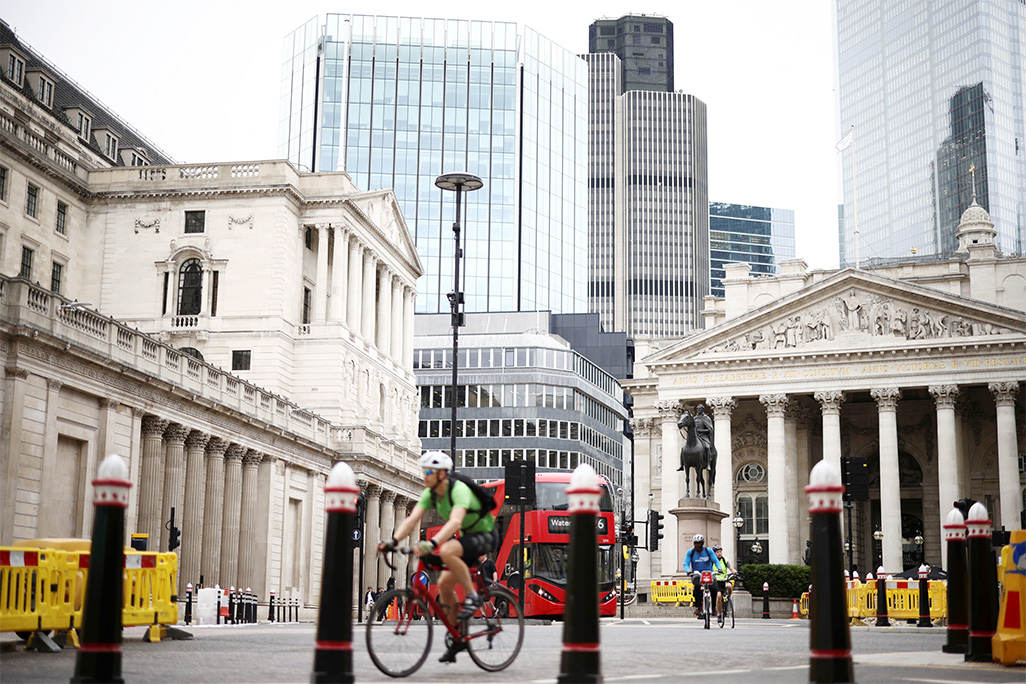
The Bank of England kept interest rates on hold as expected on Thursday, but a third policymaker backed a rate hike due to renewed conflict between the United States and Iran.
The Monetary Policy Committee voted 6-3 to keep rates at 3.75 per cent rather than the 7-2 split most economists polled by Reuters had expected.
Catherine Mann – who expressed reservations about the stance of policy earlier this month – joined Megan Greene and Chief Economist Huw Pill in voting for a rise to 4 per cent.
The rest of the MPC appeared in no rush to raise rates, however, sticking with the wait-and-see approach of Governor Andrew Bailey which he hopes will ensure inflation does not overshoot its 2 per cent target by too much this year.
“Holding Bank Rate is appropriate as global conditions look to be more uncertain and inflationary, while domestic conditions are on balance more benign as regards the prospects for inflation,” Bailey said.
NEW UK GOVERNMENT SEEKS TO LOWER COST OF LIVING
If the BoE continues to keep rates on hold, it will be a relief for new Prime Minister Andy Burnham who has prioritised cost-of-living measures, including scrapping a tax on household electricity bills which the BoE said would help lower inflation by a tenth of a percentage point.
In forecasts published on Thursday, the BoE’s central projection – which assumes energy prices move broadly as markets expect and there are only limited spillovers from high energy costs into pay and price-setting – showed inflation rising to 3.2 per cent later this year from a 15-month low of 2.6 per cent in June and staying above target until early 2028 when it would dip below 2 per cent.
This is a softer inflation outlook than in the BoE’s last full quarterly forecasts in April, but similar to what it predicted in June.
However, this scenario is based on financial market expectations that the BoE will raise rates in the final quarter of 2026 and again in 2027, in contrast to the expectation among most economists polled by Reuters that the BoE will be able to avoid further tightening.
While the European Central Bank raised interest rates in June, Bailey has said the BoE can afford to keep rates on hold as it cut rates by less before the outbreak of the US-Iran conflict at the end of February closed the Strait of Hormuz to most oil exports.
The US Federal Reserve kept interest rates unchanged on Wednesday but three members of the Federal Open Market Committee said they would have preferred a quarter-point rise. Chair Kevin Warsh said he had “no tolerance” for inflation.
WIDENING MIDDLE EAST CONFLICT CAUSED MANN TO VOTE FOR HIKE
The BoE’s Mann cited a breakdown of a tentative truce between the United States and Iran and a broadening of the conflict this month as the main trigger for her change of view.
“This ‘sporadic continuance’ of the conflict that I hypothesised last month appears to be the state of play,” she said.
Although British inflation is, unusually, below rates in the euro zone and the United States, that largely reflects how regulated household energy bills in Britain lag behind market prices.
For the MPC members who backed a rate hike, the fact that inflation has been above the BoE’s 2 per cent target for almost all of the past five years increases the chance of damaging second-round effects.
Others saw no evidence that these risks were materialising and focused more on a weaker labour market, where private-sector pay is now growing at the slowest pace since 2020.
However, Deputy Governor Clare Lombardelli said the absence of second-round effects so far was “informative but not conclusive”.
Separately, the BoE raised its estimate of the market impact from the reduction on its balance sheet of hundreds of billions of pounds worth of government bonds, judging it had added a “modest” 0.2-0.3 percentage points to gilt yields since 2022, up from 0.15-0.25 percentage points in a similar assessment last year.
This assessment comes ahead of an annual vote by the MPC in September on the pace of the quantitative tightening programme. In 2025, the BoE slowed the pace at which it reduces its bond holdings to £70 billion ($93 billion) a year from £100 billion. Financial market participants polled by the BoE see a further slowdown by the MPC in September to £50 billion.




Click here to change your cookie preferences