
Driven by escalating sovereign debt, domestic fiscal constraints, and a strategic pivot toward peer competition in East Asia, the United States has transitioned to an offshore balancing posture across the Middle East.
This structural retrenchment – accelerated by the collapse of negotiated diplomatic frameworks and the physical destruction inflicted across the Gulf during the Iran war – has systematically eroded local confidence in Western security guarantees.
Consequently, the traditional post-Cold War security architecture, historically anchored by forward-deployed American naval power, centralised air defence networks, and Israeli escalation dominance, has fractured.
The structural imperative of American retrenchment
For over three decades, Middle Eastern security was tied to American military primacy. That framework collapsed under the strain of global overextension and an expanding mismatch between worldwide defence commitments and domestic industrial output.
Confronting severe capacity limits, Washington has prioritised the containment of China in the Indo-Pacific, resulting in a deliberate rationing of American conventional forces across secondary theatres.
This military recalibration reflects acute economic realities. Soaring debt-servicing burdens and debt-refinancing walls have constrained Washington’s capacity to finance permanent forward expeditionary garrisons.
In a shifting international landscape where tangible industrial mass and resource-backed endurance outweigh financialised power projection, the United States can no longer sustain high-intensity deployments across multiple non-contiguous fronts simultaneously.
To adapt, Washington has stepped back from routine maritime policing and continuous carrier escort missions, transferring the primary burden of local deterrence onto regional partners.
The institutional collapse of diplomatic credibility
The decision of regional middle powers to transition away from Western security reliance stems directly from an institutional collapse of trust in American diplomatic enforcement. Washington is increasingly perceived as an erratic actor whose domestic political volatility and unconditional alignment with Israel undermine the sovereign interests of regional partners.
This unreliability manifested across multiple initiatives. The June Memorandum of Understanding between Washington and Tehran collapsed when the United States failed to halt Israeli military incursions in Southern Lebanon.
In bilateral civil nuclear cooperation talks, trust between Washington and Riyadh broke down after the United States unilaterally introduced an unnegotiated prerequisite requiring Saudi Arabia to immediately normalise diplomatic relations with Israel.
Similarly, the Gaza Board of Peace framework was derailed when an agreed phased disarmament mechanism was rewritten into an unconditional prerequisite prior to troop withdrawals, culminating in Israel’s total repudiation of the framework.
The Mecca Joint Defence Agreement: an asymmetric realist barter
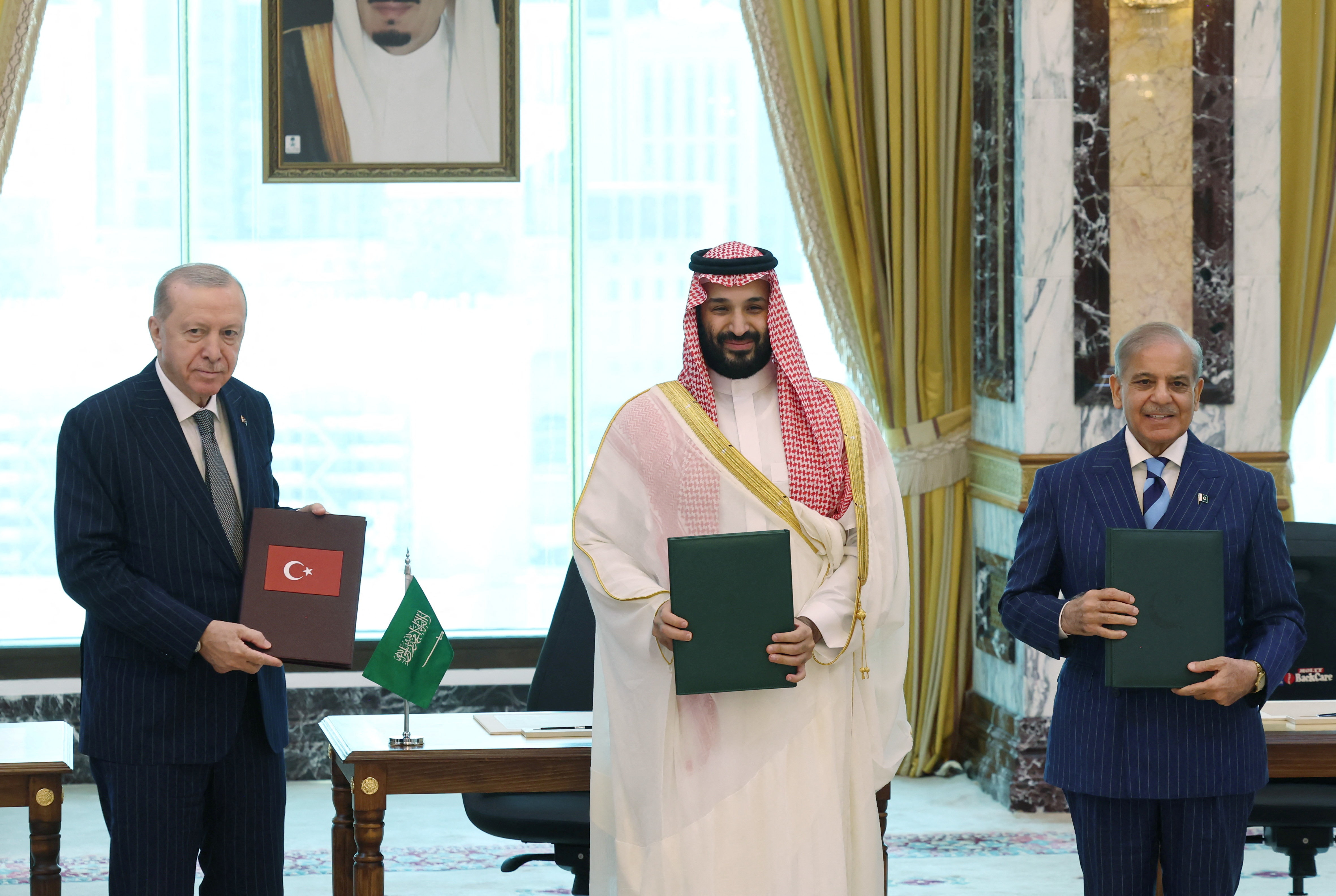
To fill the institutional void left by Western retrenchment, Saudi Arabia, Turkey, and Pakistan moved decisively to construct an autonomous, self-funded alliance. Signed on August 7, 2026, the Mecca Joint Defence Agreement marks a definitive break from external defence dependencies.
Born out of pragmatic necessity and structural exhaustion with external security guarantees, this partnership is rooted in structural realism rather than pan-Islamic sentiment or shared ideology.
The pact consolidates the three largest indigenous military and economic establishments in the region, operating as an asymmetric barter system built on structural complementarity.
Saudi Arabia provides sovereign liquidity, central bank deposits, and subsidised crude oil baselines to underwrite joint industrial programs and stabilise allied economies, compensating for its own combat-conversion deficits.
Turkey contributes an advanced defence-industrial base, supplying unmanned combat aerial systems, electronic warfare suites, and aerospace platforms, while securing captive export markets free from Western restrictions.
Pakistan supplies strategic combat manpower, solid-fuel ballistic missile systems, and an operational nuclear delivery triad, establishing an extended deterrent backstop across the Gulf in exchange for critical capital inflows.
Strategic dual-balancing: insulating the Gulf and constraining Tel Aviv
The operational core of the Mecca entente constructs an autonomous dual-balancing perimeter designed to insulate the Arabian Peninsula from Iranian asymmetric disruption while placing hard structural limits on Israeli military unilateralism.
Against Tehran, the pact establishes a multi-axis containment perimeter along Iran’s immediate borders, capitalising on the collapse of the Syrian transit corridor to raise the operational costs of proxy interdictions.
Simultaneously, the entente establishes firm structural boundaries against Israeli operational reach. Incorporating Pakistan into Gulf security introduces extended strategic nuclear ambiguity, counterbalancing Israel’s undeclared regional nuclear monopoly and challenging the assumption of uncontested escalation dominance in the Levant and the Gulf.
Institutional mechanics and structural limitations
Despite its demographic scale and defence-industrial base, the alliance operates under strict institutional and operational constraints. Established as an intergovernmental consultation framework under UN Charter Article 51, the pact lacks an automatic collective defence mechanism analogous to Nato’s Article 5.
Any coordinated military mobilisation requires independent political consensus and separate constitutional authorisations from Riyadh, Ankara, and Islamabad.
The mutual defence mandate applies strictly to future state-on-state wars, deliberately excluding ongoing regional hostilities such as the kinetic campaigns in Lebanon and Houthi maritime interdictions in the Red Sea.
Spanning three non-contiguous operating theatres across West Asia, the Levant, and South Asia, the pact lacks a unified central command, standardized tactical datalinks, and integrated operational doctrine.
Hardware interoperability remains constrained by disparate inventories, dividing Saudi Arabia’s Western airframes, Turkey’s Nato-standard systems, and Pakistan’s hybrid Sino-indigenous platforms.
Consequently, the alliance functions primarily as a distributed strategic deterrent and political counterweight rather than an integrated expeditionary force.
The post-hegemonic order and the peripheral buffer shift
The global security architecture is undergoing a structural transformation driven by the fiscal exhaustion of the Western debt-based financial model. As Western powers contend with soaring interest obligations and mounting refinancing barriers, their capacity to finance permanent forward expeditionary forces is shrinking.
This systemic strain has accelerated the American transition toward an offshore balancing posture, compelling regional middle powers to construct independent defence architectures.
By establishing an autonomous balance of power outside Western oversight, the Mecca Alliance dismantles traditional containment geometries, directly disrupting Western-backed initiatives like the India–Middle East–Europe Economic Corridor (IMEC).
However, rather than eliminating geopolitical conflict, this systemic realignment alters where friction is absorbed. When major powers establish high-level conventional deterrence and nuclear ambiguity among themselves, the projected cost of direct, state-on-state confrontation becomes prohibitively high.
Consequently, structural competition is channeled away from direct conflict and toward the lowest-risk, least-defended geographic pressure points: peripheral buffer states.
This dynamic transfers acute geopolitical friction directly onto unhedged buffer zones, with the Republic of Cyprus emerging as an exposed theatre in the unfolding Eastern Mediterranean order.
This article is also available in the author’s substack https://ioannistirkides.substack.com/publish/posts/published – The essay was based on sources on Geopolitical Futures, Middle East Eye, and open-source website podcasts





Click here to change your cookie preferences