
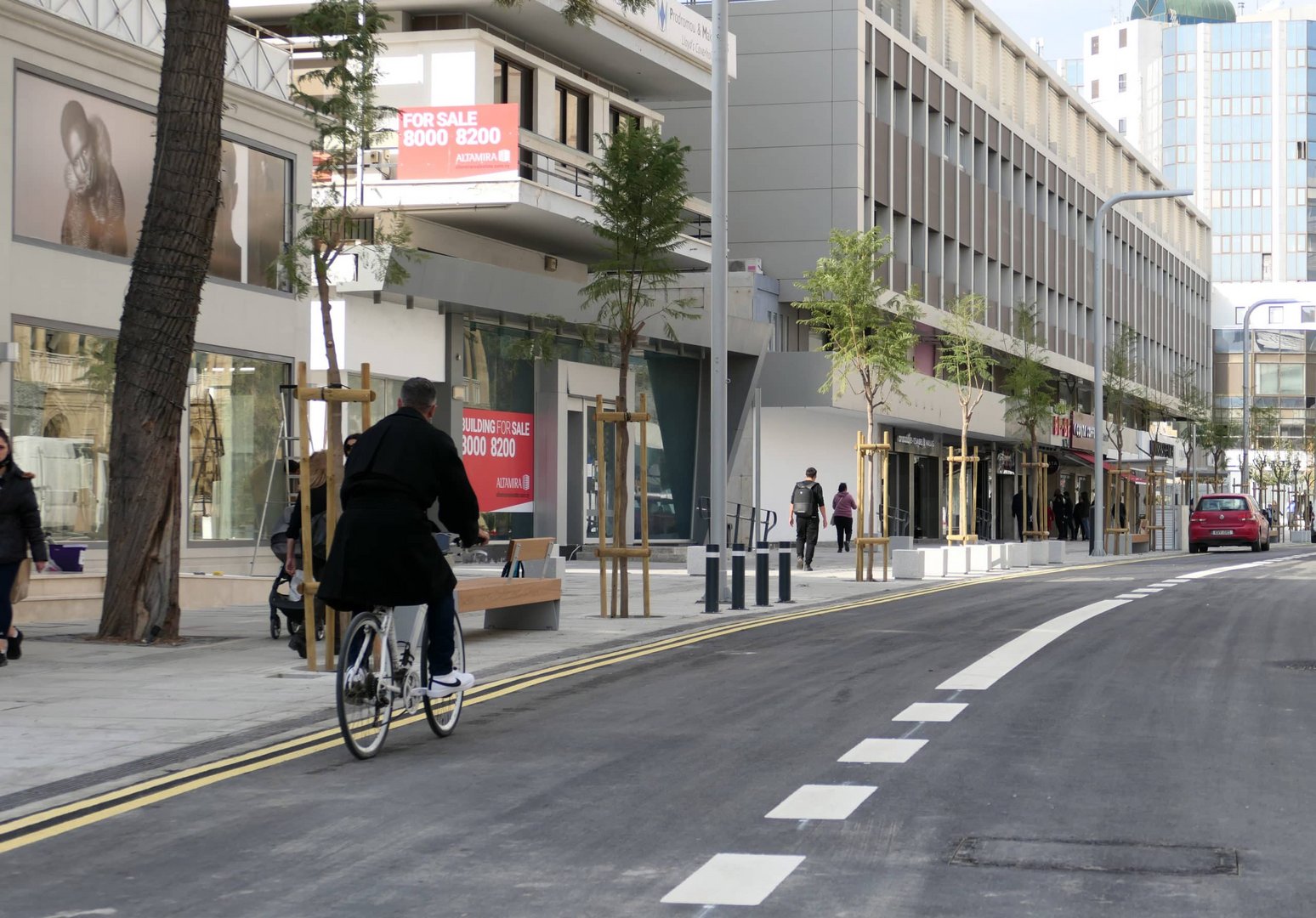
A pressure group calling itself the Joint Platform for the Revitalisation of the Urban Commercial Core of Every City, has been demanding the re-opening of the lower part of Makarios avenue in Nicosia to all traffic. Private cars are not allowed to enter the part of the road from Lykavitos police station towards the old town, the restrictions imposed as part of the Sustainable Urban Mobility Plan, which was funded by the EU.
The Platform wants the road re-opened to all cars and to two-way, in the belief that it would restore the past glory of the capital’s busiest shopping street. Until 20 years ago, business people were prepared to pay six-figure amounts (‘air’ it was called) to acquire a rental contract for a shop on lower part of Makarios avenue, but it is unlikely these days will return by opening the road to all cars moving in both directions.
Speaking to the Cyprus Mail, Nicosia mayor Charalambos Prountzos, quite rightly, pointed out that it was simplistic to suggest that “closing the area to traffic is the main issue at stake.” He explained that conditions had changed and “we cannot look back to the 1990s, regarding the high street – there are shopping malls, there is online shopping, we live in an entirely different reality now.”
It is very difficult to disagree with the mayor. Makarios avenue was not attracting people long before the traffic restrictions were introduced. Most shops people visit can be found in malls and this is not exclusive to Nicosia. Shopkeepers in the old shopping centre of Larnaca have also been complaining that the town’s mall was taking away their business, but there is nothing that can be done, short of closing the malls, which will never happen.
Consumers are behaving differently, but it is not the traffic restrictions that are to blame. The parallel road to Makariou, Stassikratous street, is thriving and it is not because cars can drive up it. It is because there are shops that people want to shop in, there are restaurants and cafes. Have the shop owners on the high street considered the possibility that they are selling things that people can also buy in the mall? The mayor hinted at this, telling the Mail that to bring customers back the “authenticity of shops” was key. Lower rents would also help, and the municipality plans to propose taxation of empty shops.
When the lower part of Makarios avenue was closed to private cars, it was predicted that big traffic jams would be created on adjoining roads, but this did not happen. Changing this now could cause the European Commission to demand we pay back the money it gave for the capital’s mobility plan, estimated to be in the region of €20 million. The mayor has ruled out burdening the taxpayer with this cost. And it would be an extortionate price to pay to prove to shop owners that the problems their shops face are not cause by the lack of cars.





Click here to change your cookie preferences