
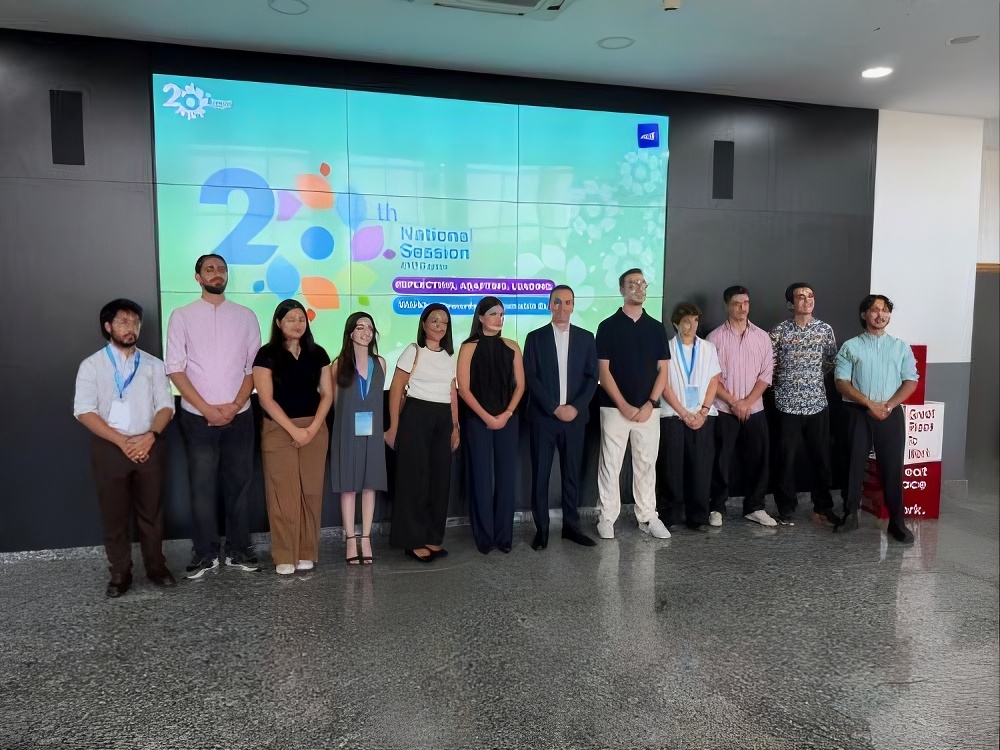
Young people must be included in decisions on technology that will shape their jobs, education and safety online, Deputy Minister of Research, Innovation and Digital Policy Nicodemos Damianou said during an open discussion in Larnaca.
Damianou met students at UCLan Cyprus as part of the 20th National Session of the European Youth Parliament Cyprus (EYP Cyprus), with the discussion covering the digitalisation of the state, employment opportunities in technology and innovation, and the protection of minors online.
“As much as young people want to listen to me, I also want to listen to them,” Damianou said, acknowledging that policymakers sometimes unintentionally leave the younger generation out of discussions that directly concern them.
He added that technology, digitalisation and innovation were no longer subjects confined to specialists, but had become part of everyday life and the country’s economic future.
The discussion came shortly after a new EU assessment found that Cyprus has built a strong foundation for its digital transition, supported by extensive gigabit connectivity and full 5G coverage.
Around three quarters of Cypriot small and medium-sized businesses have reached at least a basic level of digital readiness, while companies are making relatively strong use of cloud services and data analytics.
However, the European Commission warned that artificial intelligence adoption remains slow, potentially holding back business competitiveness, while digital skills continue to vary considerably according to age and education.
Cyprus’ national digital roadmap now includes 62 measures backed by €980 million, covering infrastructure, public services, business transformation and digital skills.
The Commission said the country’s share of ICT specialists in employment is around the EU average, although further action is needed to ensure that more people can benefit from the transition.
The challenge is particularly important for young people entering the labour market.
Although Cyprus has one of the EU’s most highly educated populations, only 14.9 per cent of tertiary students study STEM subjects, compared with 26.9 per cent across the bloc.
At the same time, the Human Resource Development Authority (Anad) expects about 40 per cent of employment demand between 2022 and 2032 to be connected to STEM fields, raising questions over whether the local workforce can keep pace with expanding fintech, software, gaming and AI industries.
Efforts to bring students closer to the sector have included a €200,200 research and innovation internship programme this summer, under which the Research and Innovation Foundation (RIF) subsidised six-week placements at technology and research companies.
Meanwhile, a separate €1 million programme is offering early-stage startups up to €119,999 each to develop products and services aimed at international markets.
Online safety was another central concern at the Larnaca discussion.
According to the latest Digital Decade survey, 93 per cent of Cypriots support stronger online protection for children and young people.
Damianou has previously said European discussions are increasingly focused on setting appropriate age limits for online platforms and introducing effective age-verification systems, rather than relying on users simply to declare their age.
He also praised the students for spending a hot summer day discussing issues with direct consequences for their future, rather than being at the beach.
The conference, held from August 22 to 27, brought together about 190 participants from public and private schools in Cyprus, alongside volunteers from across Europe.
EYP Cyprus president Marilena Spyrou said the involvement of policymakers was particularly valuable because political decisions ultimately determine how issues debated by young people are turned into law.



Click here to change your cookie preferences