
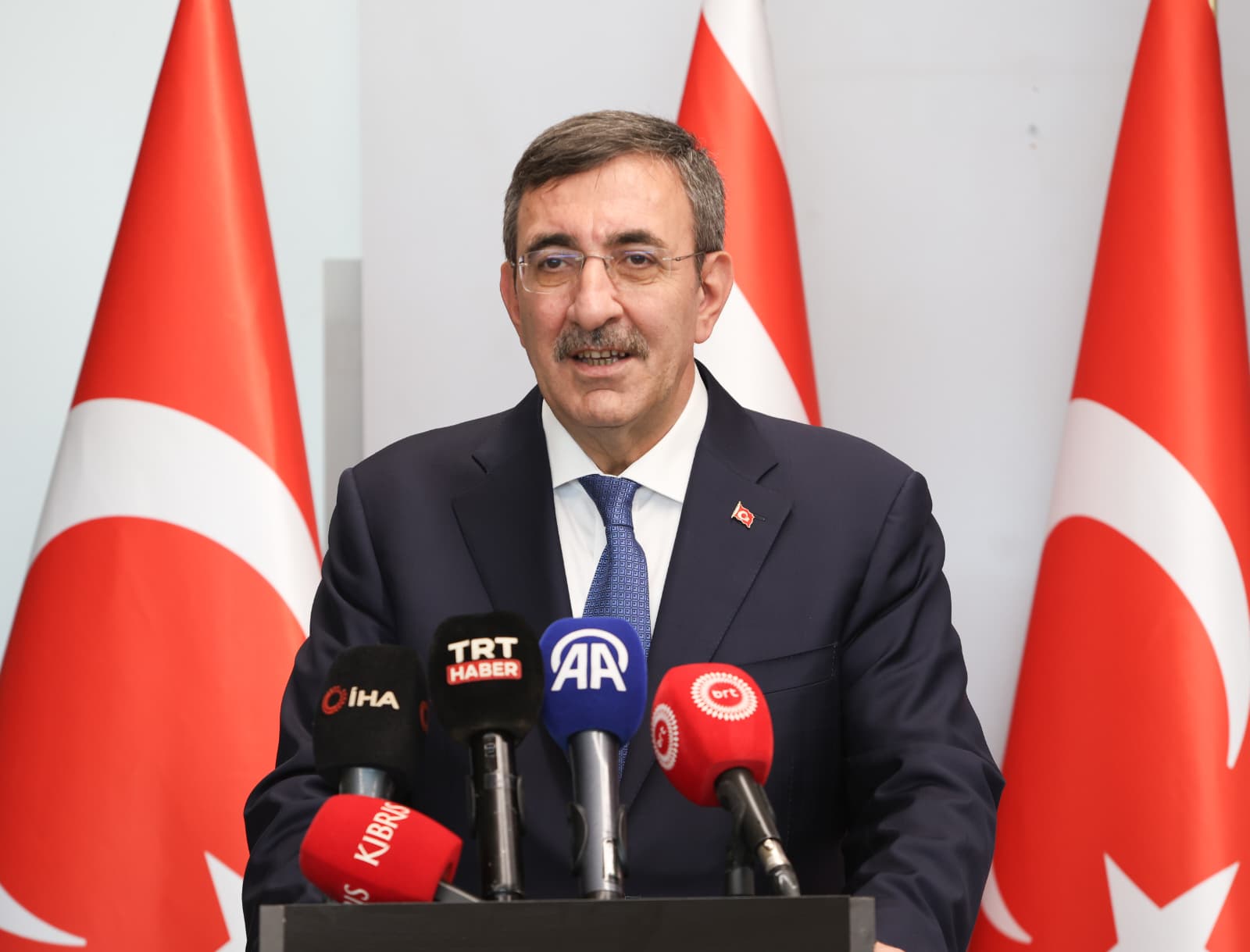
Turkish Vice President Cevdet Yilmaz on Friday quipped that “it seems we have upset some people” with his country’s plans to build a natural gas pipeline to link itself to Cyprus, as he arrived on the island for a two-day visit.
“I want to express that the voices raised from various circles, especially from the Greek Cypriot side, against these humanitarian and perfectly legal projects are proof of how right we are in what we are doing. It seems we have upset some people,” he said after arriving at Tymbou (Ercan) airport.
He added that “regardless of what anyone says, we will continue to support what is right, what benefits the TRNC, and what will increase the wellbeing of our Turkish Cypriot brothers and sisters”.
His comments come after the Republic of Cyprus’ permanent representative to the United Nations Maria Michael had penned a letter to UN Secretary-General Antonio Guterres protesting the agreement reached between Turkey and the Turkish Cypriot authorities regarding the pipeline’s construction.
“The signing of the purported ‘memorandum of understanding’ constitutes yet another deliberate and provocative action by Turkey, in violation of international law, including the relevant resolutions of the security council on Cyprus,” she wrote.
She added that “preparatory activities” for the pipeline’s construction “appear to have already commenced”, with Turkey having in July issued a navtex, a message used to transmit information to seaborne vessels, informing nearby ships that it intends to commence seismic surveys for the pipeline.
She described the gas pipeline agreement as “null and void, and, thus, devoid of any legal effect”, writing that “the illegal secessionist entity established in the occupied part of the Republic of Cyprus lacks international legal personality”.
Cable planned to stretch 101km and be ‘bidirectional’
A memorandum of understanding for the pipeline’s construction was signed by the Turkish and Turkish Cypriot authorities on July 10, with Yilmaz having said at the time that “this step taken in the energy sector will be a historic turning point in cooperation between the two countries”.
Meanwhile, Turkish Cypriot ‘prime minister’ Unal Ustel had said that “the project is not for today, but for future generations”, and that “it is a demonstration of our will to leave a stronger, more sustainable and more competitive country for our children”.
Turkish Energy Minister Alparslan Bayraktar had explained the technical aspects of the pipeline, saying that it will stretch from Anamur, in Turkey’s Mersin, to the Teknecik power station, located just outside Kyrenia.
Bayraktar also said that the project would in fact consist of two parallel pipelines, each 56cm in diameter, thus allowing the system to be “bidirectional”, meaning that natural gas will be able to be transported to Cyprus from Turkey, and to Turkey from Cyprus.
The pipelines will stretch a total of 101 kilometres, of which 97km will be under the Levantine Sea.
The pipeline has also faced criticism from the European Union, with the EU’s foreign policy chief Kaja Kallas having called on Turkey to “respect” the Republic of Cyprus’ sovereignty.





Click here to change your cookie preferences