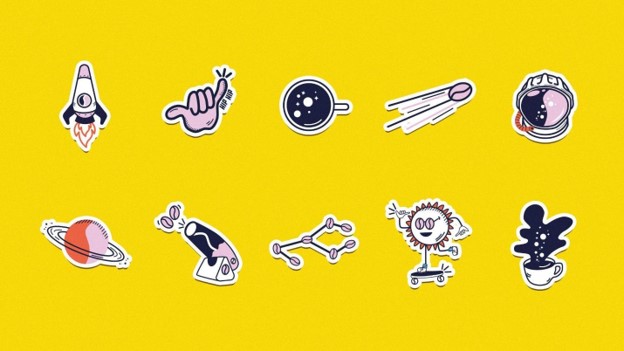
Launching merch can be exciting until you realize you have 200 keychains sitting in a box and only 17 people actually bought them.
For artists, especially those selling to a niche fandom or a small online audience, the goal of your first merch drop shouldn’t be to make as many products as possible.
Instead, focus on learning what exactly your audience actually wants to buy. A small merch drop gives you room to test a design, product type, price, and demand before spending more money on production.
Start with a small product line
One of the biggest mistakes artists make is treating their first merch drop like a full collection. The thing is, you don’t need five designs across six different products for the first time.
It’s best to start with one or two designs and a small number of product types. If you have an illustration your followers already love, or the one that got the most attention online, you can turn it into a sticker, keychain, or print instead of creating completely new artwork for every product.
This also makes your merch launch easier to understand. Your audience sees a small, intentional collection instead of a store full of unrelated products.
If you want to avoid having inventory no one would buy, consider a print-on-demand service like Artiststore. This allows artists to create products without paying upfront for stock, while production and fulfillment are handled when customers place orders.
Creating a small batch of merch will give you more control over packaging and fulfillment, while print-on-demand reduces the risk of ending up with unsold products.
Choose the product that fits the artwork
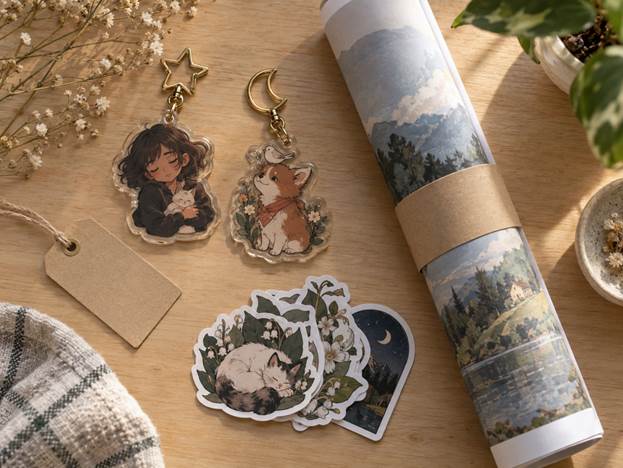
Not every illustration needs to become a T-shirt.
For instance, a detailed character illustration might be suitable as an acrylic standee, a small mascot could be made into a keychain, and a collection of small illustrations might be better for stickers or a postcard set.
When creating merchandise, think about how someone would actually use or display the product.
This matters because the same artwork might feel completely different depending on the product it’s made into. A design might look impressive on a large print, but it won’t be the same on a tiny charm.
Test the design before making everything
You don’t have to wait until launch day to find out whether people like your design or not.
Before you make the products, post sketches, cropped details, color variations, character expressions, or mockups. You can use polls to ask followers which version they would prefer to buy.
This can help you look for signals. If one character is getting more attention than the other, that’s a sign of demand. Another sign is if people keep asking whether a particular illustration will be available as a keychain.
Use preorders when demand is unclear
Preorders can be useful when you have an interested audience, but you don’t know how large the demand will be. Instead of producing 100 units and hoping they sell, you can announce the design, show the finished mockup, and give people a specific window to place orders.
The number of orders then gives you a much clearer production signal. You can also use a preorder target. For instance, announce that it would go into production once 20 orders are reached.
This creates a sense of a limited event without having to gamble on a large inventory. You still have to plan carefully and account for production time, shipping, packaging, and communication with customers.
But it’s always easier to plan around known orders than guessing.
Make the drop feel limited
Artists sometimes feel weird having only a small number of products, but to avoid overproducing, you can instead make it seem limited.
A limited merch drop can feel more exciting when the collection has a clear concept. So, give the drop a name, pick a theme, and choose a consistent color palette.
You could release a single character design as a limited acrylic standee or create three matching sticker designs around one illustration theme.
That limitation is part of the appeal and will give your audience a reason to pay attention instead of assuming the product will always be available.
Track what actually sells
After the drop, look at which designs sold first, those that sold the most, and those that were ignored. Also, look at which price points caused hesitation and what customers asked for after buying.
Your stickers might have sold out while your prints barely moved, or one character took most of the orders. You might have also gotten requests from your customers.
All these details prepare you for your second drop.
Small merch drops can grow from real demand
A successful merch drop doesn’t need a huge collection. It can start with one illustration, one product, and a small group of people who really want it.
It’s best to test the design, keep the first product line focused, and use pre-orders or low-quantity production. At the end of the day, pay attention to what people actually buy instead of what you assume they will buy.





Click here to change your cookie preferences