
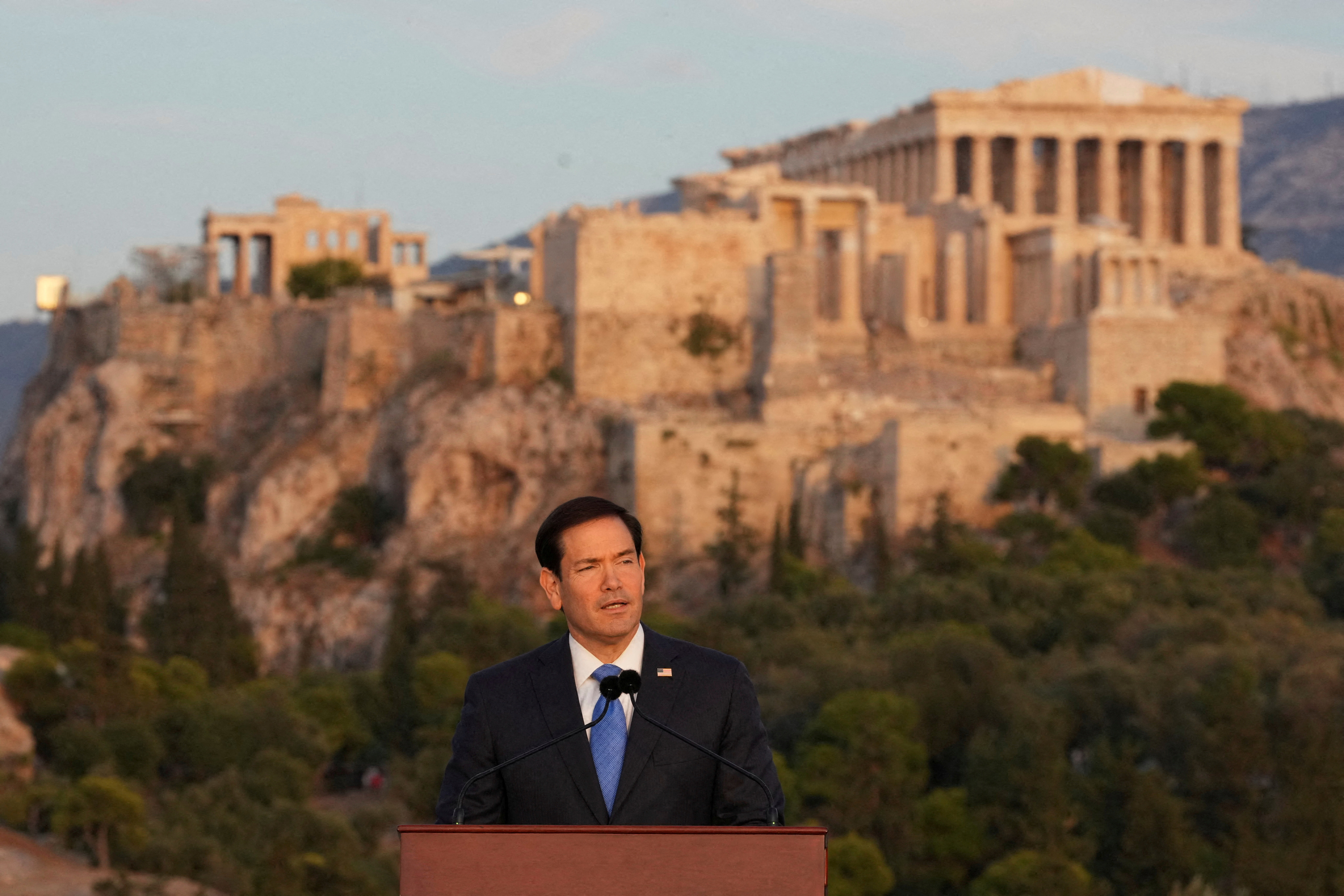
United States Secretary of State Marco Rubio on Thursday said his country will undertake “diplomatic efforts” to ensure that progress is made towards the construction of the Great Sea Interconnector project, which, if completed, will connect the energy grids of Cyprus, Greece, and Israel.
“If there is one thing which has become clear in recent months, it is that we need to diversify the way the world gets its energy. The war between Russia and Ukraine and what is happening in the Strait of Hormuz with Iran and in the Red Sea with the Houthis are reminders of that,” he told Greek newspaper Kathimerini.
He added that as such, “we ned to diversify supply chains”, and that “this is a very important priority and another example of how the interests of the United States and Greece overlap”.
“We are very committed to that. We understand that there are potential obstacles, some things which stand in the way. We intend to use our diplomatic efforts to remind all parties how important this is to us and why it is important, and I hope we can find solutions,” he said.
On this front, he said that “some of these issues are obviously not best resolved through the media”, and that “it is best to do this privately and quietly in the diplomatic arena”.
“This is very important, as we need to prioritise commitments from many countries,” he said.
Asked about the prospect of the US mediating between the states involved in the interconnector (GSI) project and Turkey, he said that “I always avoid discussing sensitive issues in the media because it makes it difficult to resolve them”.
“That being said, we are in constant contact with Turkey, which is a Nato member and has dealt with many other issues, for example hosting talks between Russia and Ukraine in the past. Our relationship with Turkey is a relationship in which we have invested, and perhaps that investment will help us in terms of these discussions,” he said.
Disputes better dealt with ‘within the confines of private conversations’
He then reiterated that “on issues like these, if you want to make statements, you can make statements, but if you want to reach a solution, it is often better to deal with them within the confines of direct private conversations”.
“That is how diplomacy works best,” he said.
Then asked whether the US may “intervene” to “prevent a serious escalation” in the Aegean sea or in Cyprus, he said that such an escalation should be “unthinkable”.
Greece and Turkey, he said, are “two allies and partners in Nato”, and as such, “it simply cannot happen”.
“It would not be good for anyone, not for Turkey, not for Greece, and not for the United States. I would say it is unthinkable for me, something that we could never allow to happen, and that I do not believe will happen,” he said.
He went on to speak about Greece’s deepening defence relationship with Israel, saying that “we see it positively”, but that “obviously the challenge … is not only in the relationship with Israel, but also in how one maintains good relations with other countries in the Middle East, which may not have such a positive relationship with Israel”.
Navtex for disputed waters expected to be issued soon
His comments come with it expected that in the coming weeks, the Greek government will issue a navtex, a message used to transmit information to seaborne vessels, to warn sailors of plans to conduct seabed surveys for the laying of cables between Cyprus and Crete as part of the interconnector project.
That navtex is expected to concern planned surveys in disputed waters which are claimed by both Greece and Turkey, and these conflicting claims have impeded attempts to carry out seabed surveys between Cyprus and Greece before.
In 2024, Turkish naval vessels were deployed after the Italian research vessel the Ievoli Reulme strayed into what Turkey believes to be its own waters.The naval vessels escorted the research ship away from Turkey, but not before Greece, too, dispatched a number of its own naval vessels, including the frigates the Nikiforos Fokas and the Aittitos, to the area.
The dispute about the ownership of the waters stems from the question of whether islands generate their own exclusive economic zone (EEZ) or not.
Greece and Cyprus, citing the United Nations convention on the law of the sea (Unclos), state that they do, while Turkey, which is not a signatory to Unclos, states they do not.
As such, according to Turkey’s position, beyond the 12 nautical miles of territorial waters to which Turkey believes both islands are entitled, the sea between Cyprus and Crete is Turkish.
By contrast, the position held by Greece and by the Republic of Cyprus is that, given that islands generate a full EEZ, the EEZs of Greece and Cyprus border one another south of Kastellorizo, Greece’s easternmost inhabited island.




Click here to change your cookie preferences