
Cyprus is preparing to take around 25 maritime companies to India next month, hoping to turn its growing ties with the Asian shipping industry into new contracts, investment and business partnerships.
The plans were discussed in Busan, South Korea, where Shipping Deputy Minister Marina Hadjimanolis met India’s Minister of Ports, Shipping and Waterways, Sarbananda Sonowal, as part of a wider round of meetings aimed at bringing the two countries’ maritime industries closer together.
At the centre of their talks was the Cyprus–India Maritime Business Forum, which will take place in Mumbai on November 23, 2026, during Hadjimanolis’ visit to India.
Sonowal confirmed that India was ready to welcome the Cypriot delegation and support the forum, with both sides keen to see businesses make the most of the opportunity.
According to the Indian government, around 25 leading Cypriot companies are expected to take part, looking for potential partners in shipping, ship management, maritime technology and related services.
The ministers also examined opportunities in shipbuilding, maritime investment and seafarer welfare. Sonowal made clear that India wanted the relationship to deliver more than diplomatic goodwill, saying he looked forward to working with Cyprus to “translate our Strategic Partnership into concrete and mutually beneficial maritime outcomes”.
There was another development of particular interest to shipowners. Cyprus backed India’s efforts to secure European Union recognition for eligible Indian ship-recycling yards, a move that could eventually give Cyprus-flagged vessels more options when they reach the end of their working lives.
Under EU rules, large vessels flying the flag of a member state can only be dismantled at facilities included on the European Commission’s approved list. Those yards must meet strict environmental and worker-safety standards, regardless of where they are located.
For shipowners, the choice of recycling facilities can make a considerable difference to costs and the arrangements involved in disposing of older vessels. If Indian yards meet the requirements and secure approval, Cyprus-flagged ships could gain access to another major ship-recycling market.
The November business mission is being organised by the Cyprus Chamber of Commerce and Industry (Keve) in cooperation with the Shipping Deputy Ministry. Hadjimanolis will travel to India from November 21 to 26, accompanied by Keve president Stavros Stavrou and representatives of the participating companies.
The programme is intended to bring Cypriot businesses face to face with potential Indian partners, particularly those working in shipping, maritime services, transport and logistics.
It also takes in opportunities arising from the proposed India–Middle East–Europe Economic Corridor (IMEC), a project in which Cyprus is seeking a greater role as a transport and logistics link between Asia and Europe.
The groundwork for the visit was laid in Limassol last month, when Cyprus and India held their first joint maritime committee meeting on September 29 under their 2017 merchant shipping agreement.
Officials examined everything from maritime education and training to shipping finance, vessel repairs, recycling and greener shipping technologies. The Indian delegation went on to meet the Cyprus Shipping Chamber, local shipping companies and port operators, with the employment and welfare of Indian seafarers another area of interest.
Those contacts have now been followed by the ministerial meeting in Busan, while the Mumbai forum will give companies themselves the chance to explore what business can be done.
South Korea has also been part of Hadjimanolis’ efforts to build stronger ties with Asia’s maritime industry, with another bilateral meeting opening the door to an update of Cyprus’ longstanding shipping agreement with the country.
Speaking at the opening of the 20th Korea Maritime Week in Busan on Wednesday, October 28, Hadjimanolis highlighted the close maritime relationship between the two countries before meeting South Korea’s Vice Minister of Oceans and Fisheries, Jaeheon Nam.
The Korean vice minister expressed his country’s willingness to develop closer cooperation and raised the need to bring their bilateral maritime agreement up to date.
Signed in Nicosia on December 2, 2008, and in force since July 10, 2009, the agreement dates back to a rather different shipping industry. Nearly 18 years later, shipowners are dealing with alternative fuels, increasingly complex environmental rules and technologies that are changing how vessels are built, managed and operated.
An updated agreement could give the two countries a more useful basis for working together on these issues, while creating room for practical cooperation between their shipping industries.
The talks came during a busy week in Busan, where shipping ministers, regulators and industry representatives had gathered for the World Maritime Day Parallel Event on October 26 and 27.
Hadjimanolis joined a high-level roundtable alongside representatives from South Korea, India and Norway, as well as International Maritime Organisation (IMO) Secretary-General Arsenio Dominguez, to examine how international shipping regulations can be put into practice.
The distinction matters for shipowners. Agreeing on international rules is one thing, but ensuring that governments have the legislation, expertise, infrastructure and resources to enforce them is quite another.
In a statement issued on October 28, the IMO stressed that national authorities need trained personnel, adequate infrastructure and closer cooperation with the industry if global maritime regulations are to work as intended.
Its first mandatory global audit cycle, covering 168 member states, approximately 94 per cent of its membership, has exposed shortcomings in how some countries implement and enforce maritime conventions.
For Cyprus, which operates one of Europe’s major shipping registers and has a substantial shipmanagement industry, the practical application of such rules carries considerable commercial weight.
That was also reflected in Hadjimanolis’ meeting with Norway’s maritime minister, Marianne Sivertsen Næss, on the sidelines of the gathering.
The two exchanged views on developments affecting international shipping and the negotiations under way at EU and IMO level, stressing the need for cooperation and for regulations that recognise the different circumstances facing maritime nations.
The question of cleaner shipping is especially important as owners weigh the cost of replacing older vessels and investing in new technologies, often without knowing precisely how future fuel rules will develop.
For Cyprus, those decisions are already beginning to show up in its shipping register.
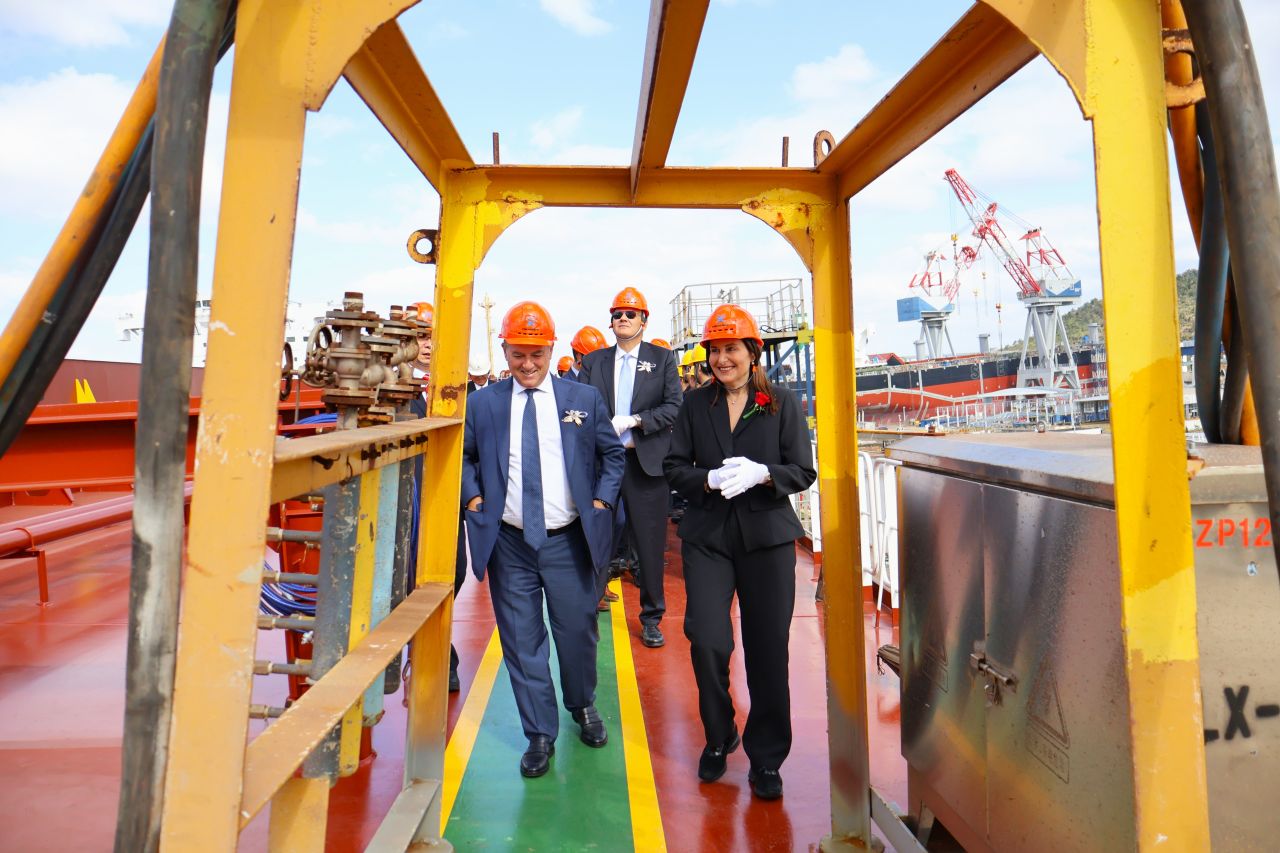
Earlier in her Asian tour, Hadjimanolis travelled to Zhoushan, China, for the naming ceremony of M/V Kypros Island, the latest addition to the fleet of Safe Bulkers, in the presence of the company’s chief executive, Polys Hadjioannou, and senior executives.
Built by Japan’s Tsuneishi Shipbuilding at its Chinese yard, the 81,200-deadweight-tonne Kamsarmax bulk carrier is the first methanol dual-fuel bulk carrier to join the Cyprus register.
The vessel can operate on either methanol or conventional marine fuel, giving its owner greater flexibility as the industry works towards cleaner operations.
It is also the first ship of its kind delivered to Safe Bulkers, which has invested in a wider fleet renewal programme. A second methanol-capable Kamsarmax is expected to follow in January 2027.
As detailed in the Kypros Island delivery, the vessel’s design includes improvements to hull efficiency and aerodynamic features intended to reduce fuel consumption.
Methanol is increasingly attracting interest as an alternative marine fuel, although the environmental gains depend heavily on how it is produced. For shipowners, the investment decision is therefore not simply about choosing a different fuel, but also about preparing vessels for an uncertain regulatory future.
Hadjimanolis thanked Hadjioannou for his longstanding confidence in the Cyprus flag, recognising Safe Bulkers’ continued investment in the country’s shipping register.
The delivery comes at a time when Cyprus is trying to attract more modern vessels and strengthen its appeal to international shipowners.
At a shipping reception in Tokyo on October 15, Hadjimanolis announced that the Cyprus Ship Registry had grown by 27 per cent since September 2023, reaching its highest level in 25 years.
She linked the increase to efforts to make the register more competitive, simplify procedures and improve the services available to shipowners, while promoting Cyprus as a base for international shipping business.
Her October tour of Japan, China and South Korea has therefore been about more than raising the profile of the Cyprus flag. From shipyards and vessel registrations to new maritime agreements and meetings with potential commercial partners, the government is seeking to turn its Asian relationships into business for the island’s shipping industry.




Click here to change your cookie preferences