
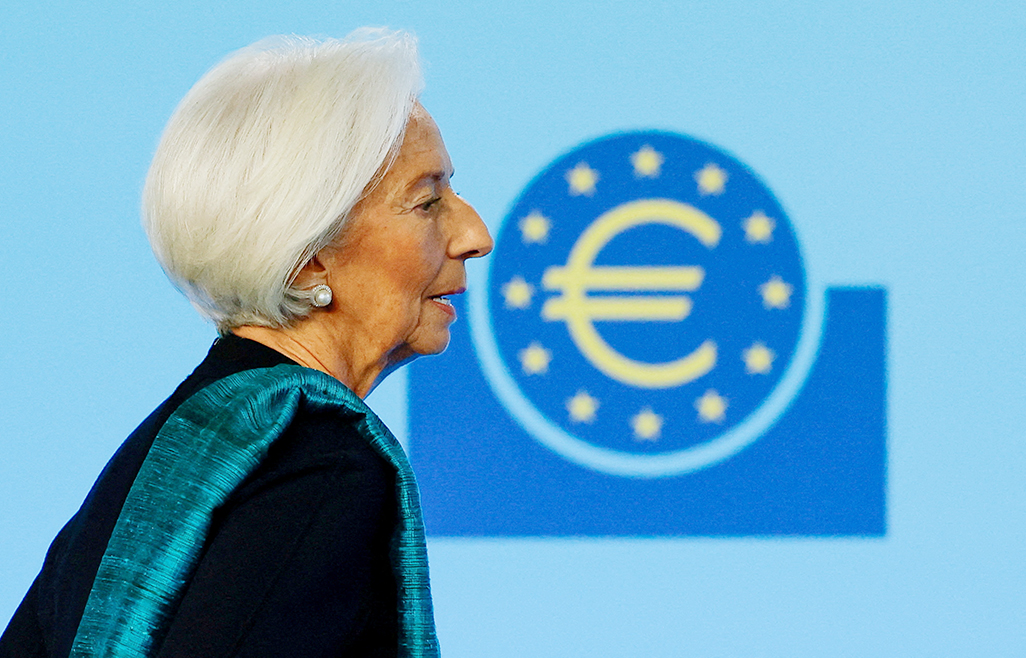
Christine Lagarde is stepping down as president of the European Central Bank (ECB) nine months earlier than expected, bringing forward a leadership contest at a time when renewed inflationary pressures and rising borrowing costs are causing fresh concern for businesses and households across Cyprus and the eurozone.
The ECB confirmed on Thursday, October 29, that Lagarde will leave her post on February 7, 2027, rather than complete her eight-year term, which was due to expire at the end of October next year.
In a video statement published on the bank’s social media, Lagarde personally confirmed her departure, explaining that she had informed fellow policymakers and ECB staff of her decision.
Reflecting on her seven years in Frankfurt, she described her time at the institution as “a great pride and a huge privilege”, thanking those who had helped fulfil its mission in Europe.
That mission, she explained, was to “be a rock, be solid, deliver price stability, financial stability”, before adding that she would leave with “a sense of good work done and an ECB that is fit for the future.”
According to the official announcement, Lagarde also informed European Council president António Costa of her decision earlier on Thursday, with the ECB’s Governing Council thanking her for her service and giving her a lengthy standing ovation.
Her departure comes at a particularly difficult time for the European economy, with renewed inflationary pressures, higher energy costs and growing concerns over borrowing conditions putting the ECB’s interest-rate decisions back in the spotlight.
For Cyprus, those decisions directly affect mortgage repayments, business financing and deposit returns, making the choice of Lagarde’s successor particularly relevant to the island’s banking sector and wider economy.
The announcement also comes on the same day as the ECB’s latest monetary policy meeting, with policymakers expected to keep the deposit rate unchanged at 2.5 per cent, despite growing speculation that further increases could follow before the end of the year.
Rising oil prices, linked to the continuing Middle East conflict and disruptions to energy supplies, have complicated the inflation outlook, leaving the ECB balancing the need to control prices against the risk of putting further pressure on economic growth.
Lagarde, who took over from Mario Draghi in November 2019, has already overseen one of the most demanding periods in the bank’s history.
Her presidency began shortly before the Covid-19 pandemic and subsequently saw the eurozone confront the economic consequences of Russia’s invasion of Ukraine, soaring inflation, the energy crisis and an aggressive series of interest-rate increases.
As the Financial Times reports, her seven years at the ECB have been dominated by exceptional economic and geopolitical crises, including the pandemic, war in Europe, a major inflation shock and trade tensions with the United States.
The newspaper also recalled that Lagarde, now 70, had previously admitted believing she would serve for five years rather than eight when she accepted the position following discussions with French president Emmanuel Macron.
Her early exit follows months of speculation about her future, with the World Economic Forum emerging as a possible next destination. According to the Financial Times, she has been in discussions about taking over as its chair, although no appointment has been confirmed.
Lagarde will become only the second ECB president to leave before completing a full term, following the bank’s first president, Wim Duisenberg, who departed after five years.
Attention is now turning to who will replace her, with former Dutch central bank governor Klaas Knot and former Bank of Spain governor Pablo Hernandez de Cos among the leading names being discussed.
The Financial Times reports that the Dutch government is backing Knot, while Spain supports Hernandez de Cos, who currently serves as general manager of the Bank for International Settlements.
Their potential appointments come at a time when the ECB is preparing for a broader change in its senior leadership.
Executive Board member Isabel Schnabel is leaving on January 3, 2027, a year before the end of her term, to take up a senior position at the International Monetary Fund, while ECB chief economist Philip Lane’s term expires in May.
The three departures mean European leaders will have to settle several important appointments within a relatively short period, raising questions about the future balance of views within the ECB’s six-member Executive Board.
The timing is politically significant, too. By leaving in February, Lagarde gives European leaders an opportunity to agree on a successor before France’s presidential election in spring 2027.
Costa has confirmed that the process of choosing a new president will begin immediately, with the European Council responsible for making the final appointment.
Under the EU’s appointment rules, any candidate must secure the support of at least 16 of the eurozone’s 21 member countries, representing no less than 65 per cent of the currency area’s population.
The process also involves consultation with the European Parliament and the ECB’s Governing Council before the European Council makes its decision.
Cyprus will have a say through its participation in the eurozone, while Central Bank of Cyprus (CBC) governor Christodoulos Patsalides sits on the ECB’s Governing Council, which is responsible for setting monetary policy across the currency bloc.
A change of president does not automatically mean a change in interest rates, since monetary policy decisions are taken collectively. Nevertheless, the next ECB chief will inherit an institution facing difficult choices over inflation, economic growth and the cost of credit, with the latest rise in energy prices making those decisions all the more complicated.





Click here to change your cookie preferences