
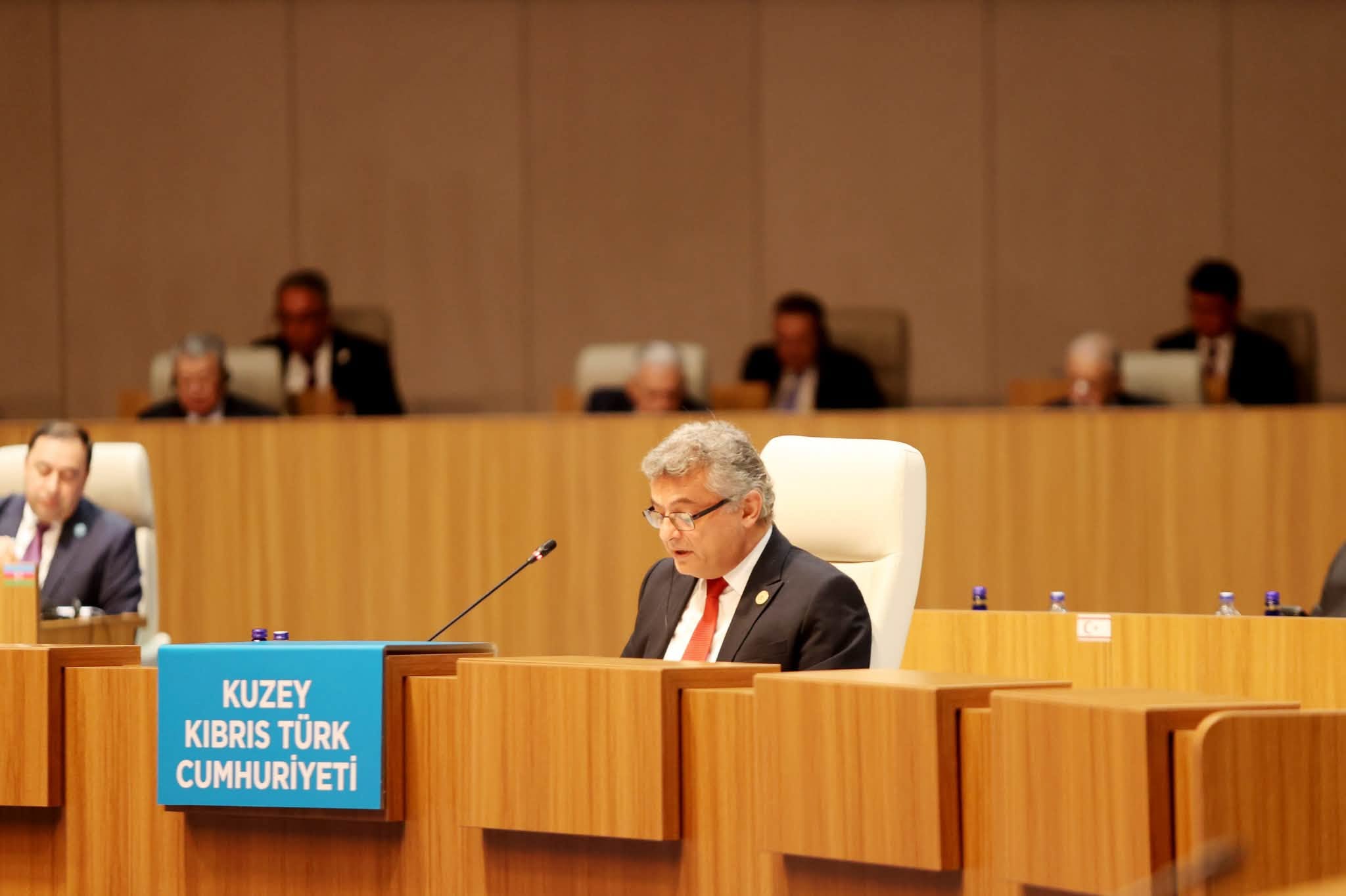
Turkish Cypriot leader Tufan Erhurman on Friday told the leaders of member states of the Organisation of Turkic States there are “no obstacles” to them establishing close relations with the Turkish Cypriots, as he addressed the organisation’s summit in Ankara.
He said that the Turkish Cypriot people have “for many years” been subject to “an unjust isolation which has limited their direct contacts with the international community, their economic and social development, and their integration with the world”.
“However, a nation’s ability to engage with the international community in the fields of culture, art, sports, science, education, and economics is a fundamental issue of human rights which must be considered beyond political agreements,” he said.
To this end, he pointed out that “the Turkish Cypriot people, through their will for a solution demonstrated in 2004 and their constructive stance in subsequent negotiation processes, have repeatedly shown their desire for integration with the world and for a just and lasting solution on the island”.
“Despite this, attempts are being made to prevent our young people from participating in international sports competitions, to prevent cultural events from being held in our country, and to prevent our people from having direct contact with the world,” he said.
He added that “such initiatives negatively impact efforts to build mutual trust and create a favourable environment for a solution on the island”.

Developments ‘aligned with EU goals’
On this front, he made reference to a letter he had received from United Nations Secretary-General Antonio Guterres in response to concerns he had raised regarding efforts undertaken by the Greek Cypriot side to bring about the cancellation of a children’s football camp organised by FC Barcelona and a music festival in Kyrenia.
He said that Guterres had described those initiatives as “discouraging”, and that the secretary-general had “emphasised that initiatives hindering the establishment of trust and which lead to the cancellation of international events run contrary to joint efforts”.
Additionally, he referred to a second letter on the same matter he received from the European Commission, which, he said, “reaffirmed the European Union’s 2004 goal of ending the isolation of the Turkish Cypriot people”.
He added that the letter had also “said that initiatives which contribute to the socioeconomic development of the Turkish Cypriots, especially young people, and enable them to establish close relations with the European Union are consistent with the EU’s goals”.
“The common message of these two letters is clear. There is a strong political and legal basis for developing contact, dialogue, and cooperation with the Turkish Cypriot people in all areas, and this basis is confirmed and supported by the UN and the EU. Steps taken in this context will contribute to the creation of an environment of mutual trust and to efforts for a solution,” he said.
As such, he added, “I want it to be known that there are no obstacles to establishing close relation with the Turkish Cypriots in the fields of science, academia, culture, technology, and diplomacy”.
“We can develop joint research programmes between our universities, bring our youth together in academic and cultural exchange projects, and forge stronger ties in the field of sports,” he said.
‘The reintegration of the Turkish Cypriot people’
He added that “by developing shared cultural spaces such as exhibitions, concerts, opera, and performing arts, we can enhance the cultural dialogue among our artists”, and that “by bringing together our entrepreneurs, businesspeople, and researchers, we can create new opportunities in the fields of trade, investment, the digital transformation, and innovation”.
On this front, he said that “the Turkish Republic of Northern Cyprus, with its higher education resources, young workforce, tourism potential, and strategic location in the eastern Mediterranean, has the capacity to make significant contributions to these collaborations far exceeding its population and land areas”.
“In this context, we are ready to act with the goal of being an economic, scientific, and cultural bridge between the Turkic world and the eastern Mediterranean,” he said.
He then added that “the fundamental goal of all these efforts is to strengthen peace, stability, and cooperation on the island of Cyprus and in the region”.
“Our approach is clear. The reintegration of the Turkish Cypriot people into the world and the search for a solution in Cyprus are not mutually exclusive, by rather processes which reinforce one another,” he said.
To this end, he said that he will “continue to work for a fair and lasting solution on the island in close consultation with the Republic of Turkey”.
“We want the eastern Mediterranean to become a region where mutual respect, inclusive cooperation, and common prosperity, not tensions and exclusionary policies, prevail,” he said.
The day’s summit was, however, somewhat overshadowed by the absence of Azerbaijani President Ilham Aliyev, who elected not to travel to Ankara amid deteriorating relations between his government and Turkey, once his country’s closest ally.
On the surface of the matter is a rift which emerged following Azerbaijan’s decision to ban the wearing of headscarves at public schools in the country – a move which infuriated Turkish President Recep Tayyip Erdogan to the extent that he criticised Baku during his speech to the UN general assembly last month.
Click here to change your cookie preferences