
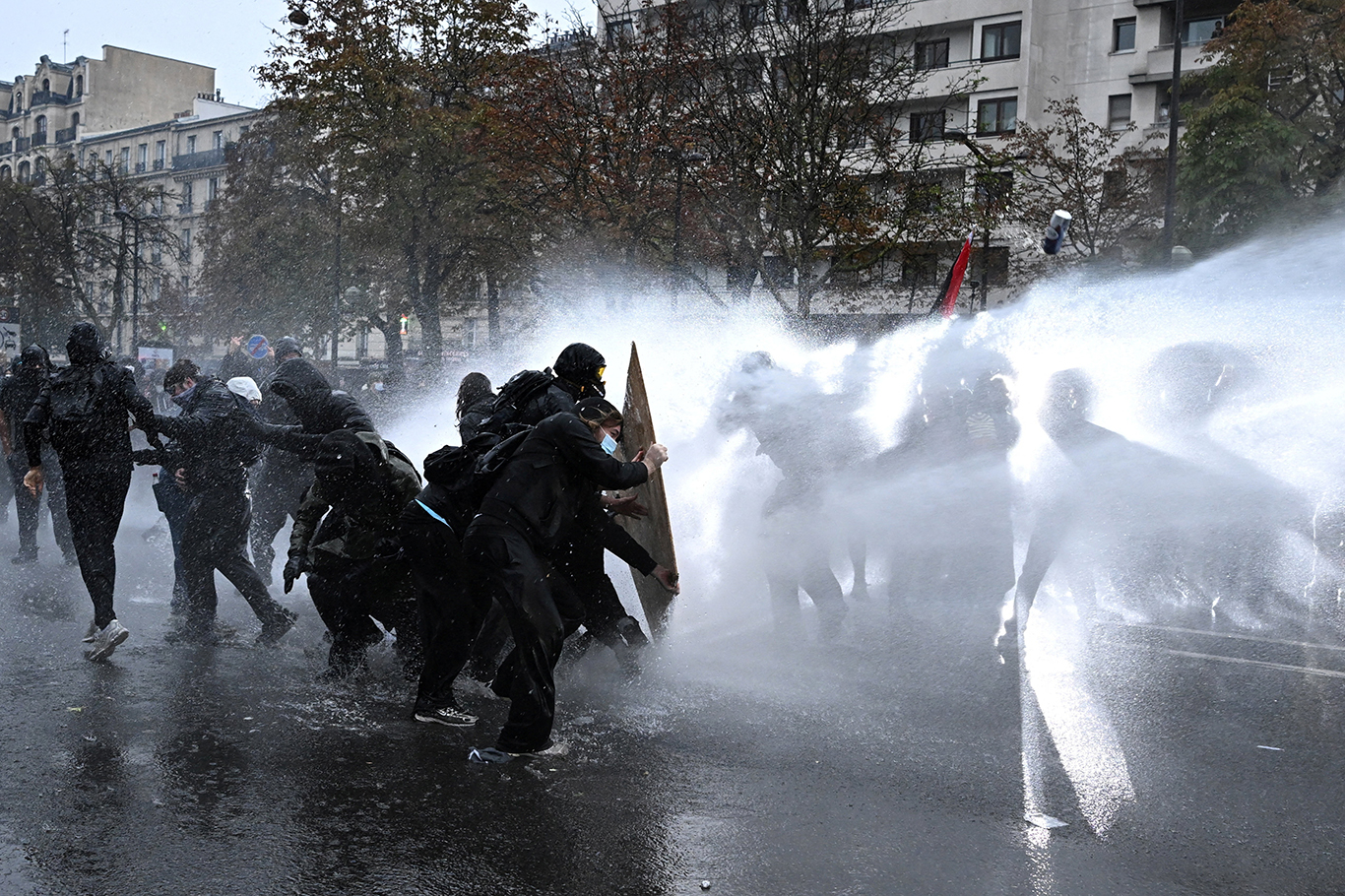
The riots in France reflect the systemic exhaustion of a neoliberal governing model that has dominated European statecraft for a generation
For three decades, European policymakers operated under a comforting illusion: sovereign debt crises were peripheral disruptions confined to the southern periphery – Greece, Ireland, Portugal and Cyprus.
The euro crisis of 2010-2014 was diagnosed as the moral failing of profligate states rather than a structural flaw of the currency union. Those early shocks were absorbed because the troubled economies represented a modest share of euro-area output, because Germany’s export engine anchored continental solvency, and because global disinflation permitted the European Central Bank to backstop sovereign balance sheets and suppress bond spreads without stoking domestic price pressures.
That institutional buffer has now dissolved. The debt crisis has moved directly into Europe’s administrative and political core: France. This dislocation is neither an exogenous shock nor a temporary administrative failure; it reflects the systemic exhaustion of a neoliberal governing model that has dominated European statecraft for a generation. Emmanuel Macron’s technocratic cabal promised that minor microeconomic adjustments, labour deregulation and supply-side business tax credits would magically spark a 3 per cent to 4 per cent real economic boom to outgrow their compounding liabilities.
That growth never materialised. Standard market-liberalising reforms failed to generate sustainable productivity gains. Instead, they starved public infrastructure, widened inequality and eroded human capital. Consequently, France remains mired in structural stagnation: average annual growth fell to 1.0 per cent between 2009 and 2025, down from 2.3 per cent over the preceding 15 years. France now sits atop a terrifying mountain of debt exceeding €3.4 trillion, making it Europe’s largest absolute debtor. When sovereign claims permanently outpace an economy’s productive capacity, debt servicing stops being an accounting abstraction and starts cannibalising public capital and domestic welfare.
The mathematics of bond market cannibalisation
The primary transmission mechanism of this crisis is the sovereign debt rollover cycle, through which mobile global capital exercises an effective structural veto over domestic policy choices. Governments do not retire maturing liabilities from current tax receipts; they issue replacement paper at prevailing secondary-market yields. With France refinancing hundreds of billions of euros annually, benchmark ten-year borrowing costs have risen from historical lows of 1 per cent to 2 per cent to between 5 per cent and 6 per cent, turning routine debt maintenance into direct fiscal cannibalisation. Annual interest payments now rival the national defence budget, locking the state into an extractive dynamic.
Compounding this domestic exhaustion is the vulnerability inherent in external geopolitical exposure. The war in Ukraine severed Western Europe from cheap Russian pipeline gas – a critical subsidy that historically cushioned high domestic tax wedges and institutional wage rigidities in continental manufacturing. Concurrently, disruptions across Middle Eastern maritime lanes elevated freight insurance and transit volatility. These supply-side shocks entrenched core Eurozone inflation at 3 per cent to 4 per cent, eroding real purchasing power and suppressing consumption.
In an embedded liberal regime, sovereign governments deploy compensatory shock absorbers – currency devaluations, targeted credit policies, or central bank monetisation – to cushion domestic society against such external volatility. But by locking itself into a rigid currency union without a corresponding European fiscal democracy, the French state voluntarily surrendered these mechanisms. It cannot devalue to restore price competitiveness, nor can the French Treasury command monetary policy. The state stands exposed to the discipline of secondary bond markets, which systematically discount sovereign paper issued by polities with uncooperative electorates.
The authoritarian turn and the revolt of the street
Resolving this crisis demands a coherent social compact, structural tax reform and diplomatic pragmatism. Instead, the French National Assembly remains paralysed across three irreconcilable blocs. The left-wing New Popular Front rejects any retrenchment of public services and demands that capital absorb the cost of fiscal stabilisation – an agenda capital markets immediately penalise through bond selloffs. The presidential centre has lost popular legitimacy and holds no legislative majority to govern. Meanwhile, the nationalist right under Marine Le Pen advances an arithmetic contradiction, offering unfunded pledges that fail to address the underlying drivers of inequality.
None of these factions can reform the system, and the executive governs by decree. Macron’s incessant deployment of Article 49.3 of the French Constitution bypasses parliamentary votes on national budgets and pension retrenchment.
Recurring cycles of urban unrest, agrarian highway blockades, and transport strikes paralysing France reflect the predictable democratic backlash against this disembedding of the market. For generations, the French social compact rested on an explicit covenant: citizens accepted heavy fiscal extractions and extensive state regulation in exchange for a robust social safety net, universal public services and retirement security.
This popular resistance sets a rigid, non-negotiable floor for sovereign spending. Bond markets demand credible multi-year deficit retrenchment; yet any attempt to compress domestic entitlements provokes immediate mass mobilisation. Conversely, expanding the tax burden falls on a middle class already pressed to its margins, fuelling anti-system politics. The French state is caught in a vice: the fiscal discipline enforced by global financial markets and the democratic demands of domestic society have become mutually exclusive.
The path forward: diplomacy, public investment and solidarity
The assumption that administrative decree can indefinitely substitute for democratic consensus has shattered. France is the European Union’s agricultural heartland, its second-largest economy, and a nuclear power holding a permanent seat on the UN Security Council. It cannot be subjected to external fiscal diktats crafted by technocrats in Brussels or Frankfurt without fracturing the European project itself. When an economic framework requires constitutional bypasses and civil coercion to service its debts, the dysfunction lies within the governing system, not the street. Stabilising the Republic requires dismantling the structural drivers of this decline across three interconnected fronts:
First, European leaders must break with foreign policy orthodoxy to pursue strategic autonomy and diplomatic de-escalation. Restoring continental stability and curbing industrial cost inflation requires a negotiated settlement in Ukraine that normalises long-term Eurasian trade and restores predictable energy flows.
Second, Paris and Brussels must replace self-defeating fiscal retrenchment with coordinated capital allocation. Rather than enforcing austerity, the European Union must coordinate large-scale public investments in human capital, energy transition infrastructure, and digital capacity – underwritten by common European debt instruments and funded by targeted levies on economic rents and concentrated corporate wealth.
Finally, the Élysée must restore democratic governance by ending executive rule by decree, respecting parliamentary prerogatives and renegotiating a durable domestic compact with organised labour and civic institutions.
Only synchronised diplomatic realism, targeted productive investment and domestic democratic renewal can avert sovereign insolvency and restore stability to the European core.



Click here to change your cookie preferences