
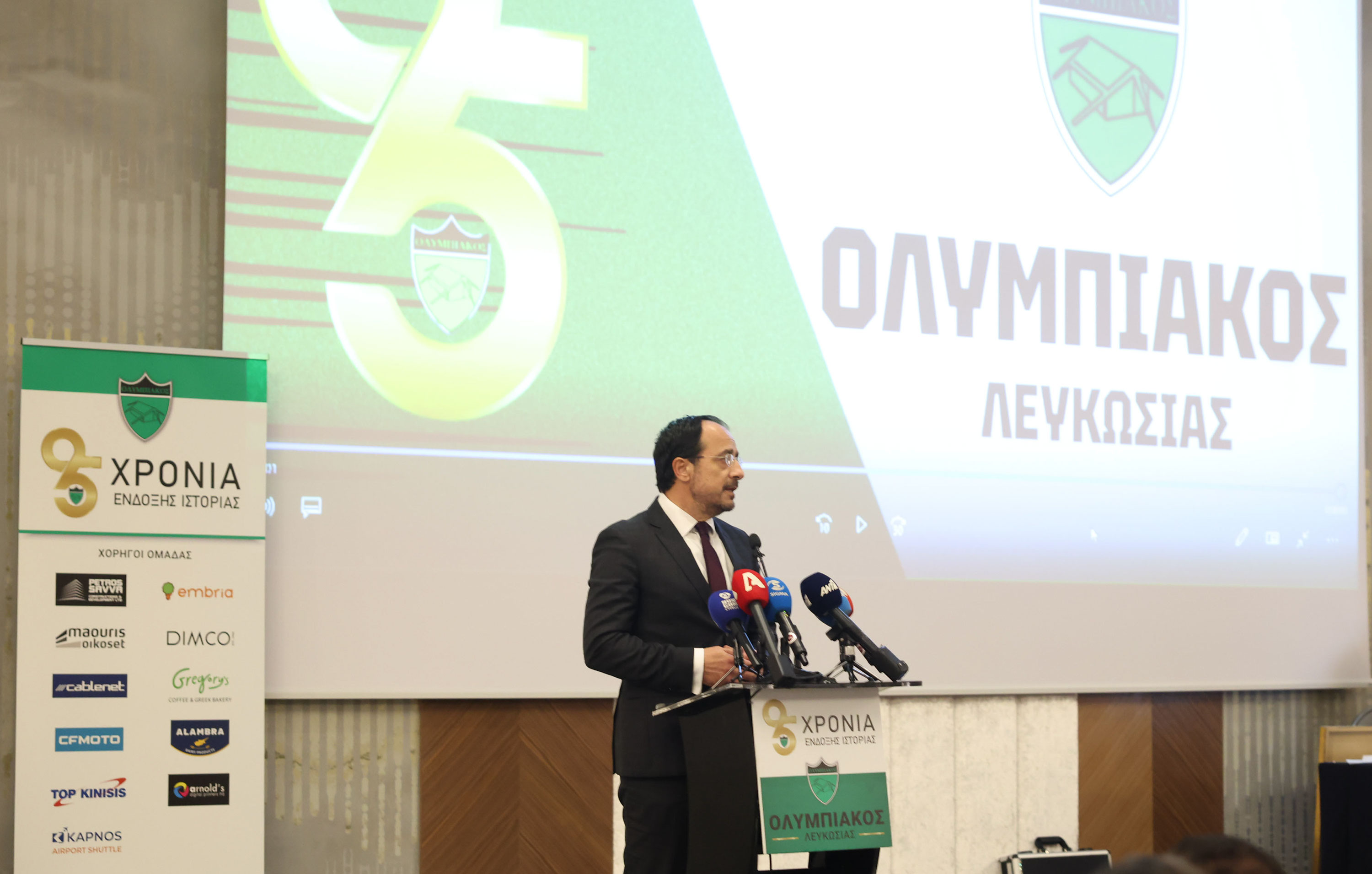
Attending an event to celebrate the 95th anniversary of football club Olympiakos Nicosia, President Nikos Christodoulides donated €95,000 as a birthday gift. The only justification he offered for this indefensible squandering of the taxpayer’s money was “to honour one of the most historic sports clubs of Cyprus, not only with a vital role in the country’s sport, but also with a national and social role.”
Football clubs receive money from the state, so on what grounds would an additional payment of €95,000 be justified? Is the taxpayer funding the president’s re-election drive?
A week earlier, the president was the guest of honour at the 75th anniversary of another sports club – Olympias Neapolis – and had this to say: “I had come here with the intention of announcing a state donation of €15,000, but seeing so many children, the donation will be increased to €30,000, exactly because we support the very important work done, especially by the academies, with young children, and for us it is an investment in the future of our country.”
This was the president in the role of generous benefactor – the rich uncle from abroad – moved to increase his contribution by the sight of many children. Everyone can be generous with other people’s money, and it is astonishing how the president can increase the state’s donation on a whim, doubling the amount budgeted. If he was playing the big spender with his own money, it would have been commendable, but it is the taxpayer’s money he is spending on a whim.
These are small amounts that will not break the bank, but it is indicative of the president’s mentality which seems oblivious to the fact that state spending adds up, even in small doses. And as we get closer to the presidential election, we suspect it will keep rising, despite Christodoulides incessantly boasting about his government’s responsible fiscal policy. He uses this boast whenever he announces a government spending spree.
Before the Olympiada event, he told journalists that it was the “responsible fiscal policy of the government which allows the strengthening of the disposable income of households and the investments in health, education, housing and the welfare state.” And he did not rule out additional measures – presumably more tax cuts – which are supposed to help households cope with high prices but instead fuel inflation, which according to the central bank governor, in September climbed to 5.2 per cent.
The mindless spending, in very uncertain economic times for the world, cannot be justified even if there is a budget surplus. The Fiscal Council of Cyprus, in its interim report for 2026, warned that “the two biggest spending categories – the state payroll and social benefits – continue to rise at high rates and dictate corrective measures.” None are on the government agenda, the president still increasing benefits for different social groups (not to mention the marked increase of the public payroll in 2027, when, apart from the annual pay rises, it would be boosted by the high inflation rate via CoLA) and talking about more measures.
The danger posed by election campaign spending was not lost on the Fiscal Council, which in the above-mentioned report said: “The maintenance of fiscal discipline acquires particular importance also in periods of increased electoral pressure.” It was a diplomatically put warning, as everyone knows that increased state spending (vote-buying is a cruder term for it) is standard practice for a president seeking re-election and Christodoulides has shown he fully subscribes to this approach.
This is a shame, because in a time of rising inflation, regional instability and uncertainty in the world energy markets, the government needs to exercise fiscal caution even if it has budget surpluses, as the economy could easily take a turn for the worse. This caution can only be imposed by the president, who now needs to elevate the fiscal responsibility he always talks about from words to action.

Click here to change your cookie preferences