
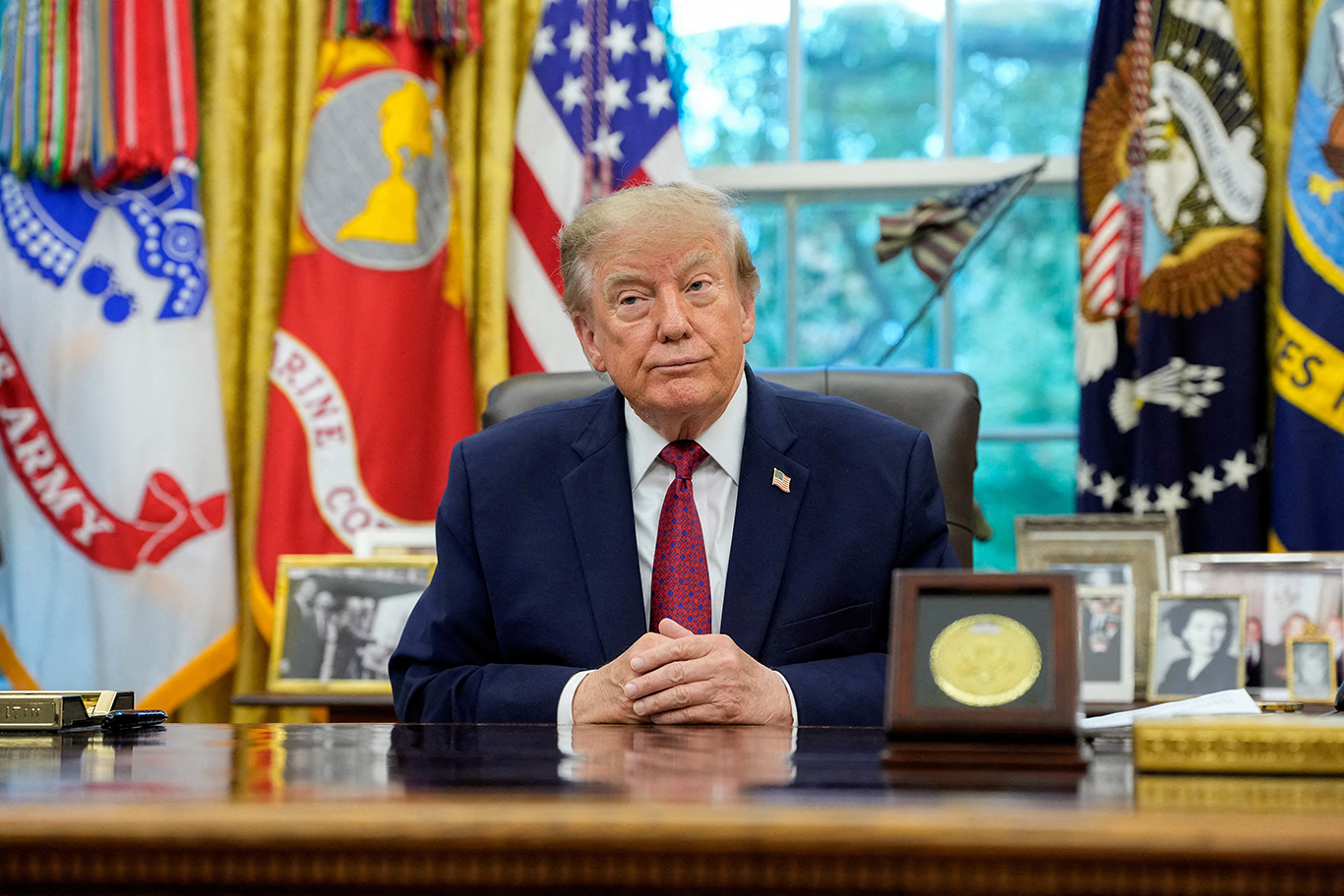
A weakened Trump could become more assertive abroad
Donald Trump was not on the ballot in Tuesday’s US congressional midterm elections. But he urged his supporters to vote as though he were. And they did.
Nearly two years after his return to the White House, the elections became a referendum on his presidency. His policies. His methods. His promises. And, increasingly, his exercise of presidential power.
In his 1980 presidential debate with Jimmy Carter, Ronald Reagan asked Americans a question that has echoed through successive elections: “Are you better off than you were four years ago?”
Forty-six years later, the question still resonates. This time, voters judged the first 22 months of Trump’s second presidency.
For many, the answer came down to their wallets. Groceries, housing, healthcare, petrol and, yes, the price of eggs. Eggs had become a symbol of the cost-of-living crisis. He had promised to make life more affordable. Had he delivered?
But while Americans voted largely on domestic concerns, the consequences reach far beyond their shores.
The American verdict
The election turned into a political tsunami for Trump and the Republicans. Democrats swept both chambers of Congress, making gains even in traditional Republican strongholds, including Texas, Kansas and South Carolina.
The result went well beyond the customary midterm losses suffered by the party in the White House. Exit polls revealed widespread dissatisfaction over living costs, the Iran war and the direction of the country. They also showed strong public demand for Congress to exercise greater checks on presidential power.
Economic growth does not necessarily translate into financial security for ordinary households. Nor does it tell us how prosperity is distributed.
Trump argued that Republicans would have fared better had he himself been on the ballot. He acknowledged that the Iran war contributed to their losses but insisted he would make the same decision again.
Vice President JD Vance went further. He blamed the defeat primarily on the war, citing disaffected Trump voters who wanted lower living costs, an end to the fighting and a change in America’s relationship with Israel. That last point is particularly telling.
Trump also signalled a willingness to work with Democrats, while reminding them of his veto power. Whether this leads to compromise or confrontation remains to be seen.
A presidency unlike others
Trump remains president until January 2029. The Constitution bars him from seeking another term. He may be considered a lame duck in American political parlance. But perhaps a wounded lion is a more fitting metaphor. And a wounded lion can be dangerous.
His political influence extends beyond the presidency through MAGA (Make America Great Again), the movement that has transformed the Republican Party in his image.
Trump’s presidency has an expiry date. Trumpism may not.
Trump’s willingness to challenge conventions, confront institutions and use economic pressure as an instrument of diplomacy has changed the way Washington conducts foreign affairs.
Yet unconventional methods should not be mistaken for an absence of strategy.
American objectives remain remarkably consistent: preserving global primacy, preventing the rise of a dominant peer rival, maintaining military and technological superiority, and using economic power to advance national interests.
What distinguishes Trump is often less the destination than the route he takes. And that route can be decidedly unpredictable.
Weakened at home, emboldened abroad?
Here lies perhaps the most consequential paradox of these elections.
A president weakened at home may become more assertive abroad.
From January 3, 2027, Democratic control of Congress will bring greater scrutiny, investigations and legislative obstacles. The Senate can block presidential appointments, including nominations to the Supreme Court. Both chambers wield considerable power over spending and legislation. Trump may respond by relying more heavily on executive authority, testing its legal limits.
But he retains his veto.
And congressional opposition does not extinguish presidential power abroad. He retains considerable freedom in diplomacy, negotiations and military affairs, subject to constitutional and statutory constraints.
Trump may seek achievements less dependent on Congress: a deal with Putin over Ukraine, an understanding with China or a breakthrough in the Middle East. Equally, he may intensify pressure on allies and adversaries. Or seek common ground with Democrats on foreign policy.
He has often used unpredictability as leverage. But how can Putin, Xi Jinping or America’s allies know whether a threat is a negotiating tactic or a statement of intent?
Such methods can produce results. They can also invite dangerous miscalculation.
The world does not vote
When America sneezes, the world catches a cold. The old saying still holds, though the world is less dependent on Washington than before.
Europe faces the continuing challenge of strengthening its security while navigating an increasingly transactional Washington.
Ukraine must safeguard its interests amid diverging American and European approaches to ending the war.
Russia and China will watch for opportunities while weighing the risks of an unpredictable Trump.
In the Middle East, traditionally bipartisan US support for Israel may face greater congressional scrutiny, particularly over the Iran war, though a fundamental policy shift is hardly conceivable.
Foreign policy increasingly shapes domestic economic life. Tariffs affect prices. Wars affect energy markets. Sanctions affect trade and investment. Decisions taken thousands of miles away reach into the wallets of American voters.
For weak states, including Cyprus, the lesson is familiar. Strategic partnerships matter. American engagement matters. But personal assurances cannot replace institutions, binding commitments or a coherent national strategy.
The midterms have altered the balance of power in Washington and set the stage for the political struggle towards 2028. They have also reaffirmed the constitutional principle of checks and balances.
Americans have delivered their verdict. The rest of the world must now reckon with its consequences.
The question is no longer simply how much power Trump has lost.
It is how he intends to use the power he retains.



Click here to change your cookie preferences