
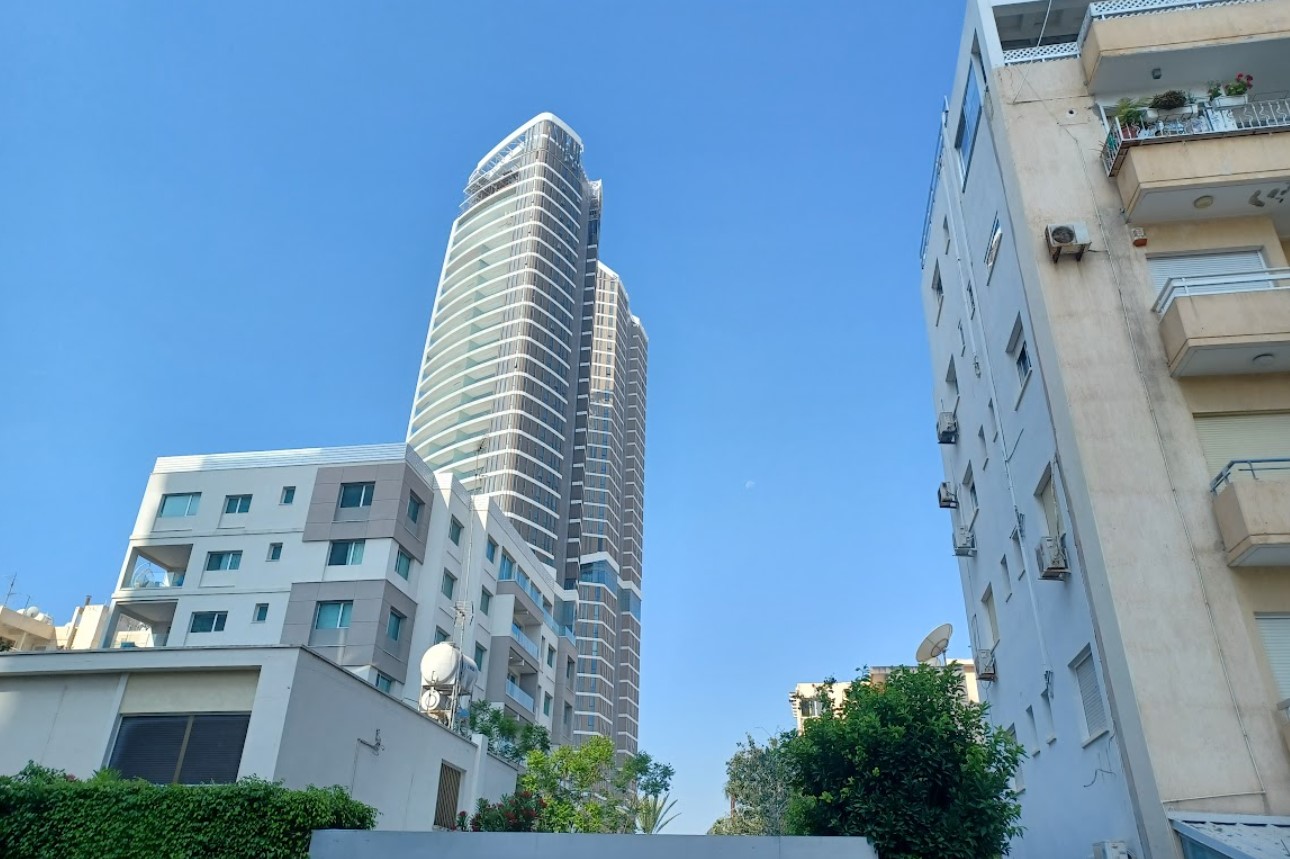
Limassol continues to dominate Cyprus’ property landscape, holding the highest rental values on the island and showing little sign of easing despite new construction activity, as recent market data confirm.
The city’s average asking rent reached €3,057 per month this summer, more than double the €1,277 recorded in Larnaca, showing both its economic strength and the pressure created by an increasingly tight housing pipeline.
Yet despite the visible pace of development, the limited supply of homes available for long-term rent remains the main obstacle to any meaningful market correction, leaving many residents struggling to secure a home at a sustainable price.
This shortage becomes even clearer when looking at availability trends. Apartment listings fell sharply from 3,257 in January to 1,390 in July, with Limassol alone accounting for 1,013 units during that period.
Even Nicosia, despite having a larger overall population, had only 191 available units, underlining the scale of Limassol’s imbalance.
At the same time, national rental averages continue to climb. Earlier in the year, Cyprus’ average apartment rent reached €1,803, while Limassol’s citywide average had already risen to €2,742, confirming a widening gap between districts.
Within the city itself, rents remain elevated across all categories. One-bedroom units now average €1,651, two-bedrooms €2,574, and three-bedrooms €3,812, levels that would have been unimaginable only a few years ago.
Similarly, high-end coastal homes have surged well beyond €5,000 per month, while four-bedroom properties average €7,224 and five-bedroom homes reach €7,750, demonstrating just how stretched the upper end of the market has become.
Although construction sites and cranes are visible across the city, relatively few new units are actually entering the long-term rental market.
Many developments are sold directly to investors, while others shift toward short-stay or mixed-use models, further limiting the stock available to permanent residents.
Even during recent months, when most cities saw rental increases, Limassol posted only a modest -1.9 per cent seasonal adjustment, estimating that the city’s pressures remain structural rather than cyclical.
As a result, Limassol continues to set the pace across every major rental category, consistently widening the gap with other districts.
To counter this imbalance, policymakers have turned to supply-expansion mechanisms designed to push more affordable rental stock into the market. One of the most prominent initiatives is the affordable-rental housing scheme, which functions similarly to build-to-rent models by offering developers additional building density in exchange for delivering units at below-market rents.
Alongside this, municipal partnerships and the Cyprus Land Development Organisation (Koag) are moving ahead with new affordable-housing blocks in Limassol and Nicosia.
In Limassol alone, around 600 apartments are planned across Agios Nikolaos and Agios Ioannis, with rents set 25–30 per cent below market levels, ensuring that the new supply directly supports residents rather than speculative demand.
Moreover, demand for state-supported schemes has been strong. By August, 525 young-couple applications had been submitted, with 152 approved for grants totalling €5.4 million, while the “Renovate-to-Rent” scheme recorded 43 applications, 28 of which were approved, amounting to €727,000 in subsidies.
Koag’s broader pipeline includes more than 135 units for sale and 36 for rent scheduled for delivery in 2025, followed by 96 units for sale and 156 for rent in 2026, with further phases under review.
Additional planning incentives, including 25–45 per cent bonus building density, are also intended to ensure that increased development translates into genuine long-term housing rather than purely investor-driven stock.
Despite these efforts, the central challenge remains unchanged. Limassol needs significantly more long-term housing than it currently produces.
Without a sustained and tangible increase in units that are actually available to residents, rents will remain high and choices limited, regardless of ongoing construction.
The mechanisms are now in place, yet the pace and consistency of delivery will determine whether the market can finally begin to stabilise. Until then, Limassol is expected to retain its position as Cyprus’ most expensive city.




Click here to change your cookie preferences