
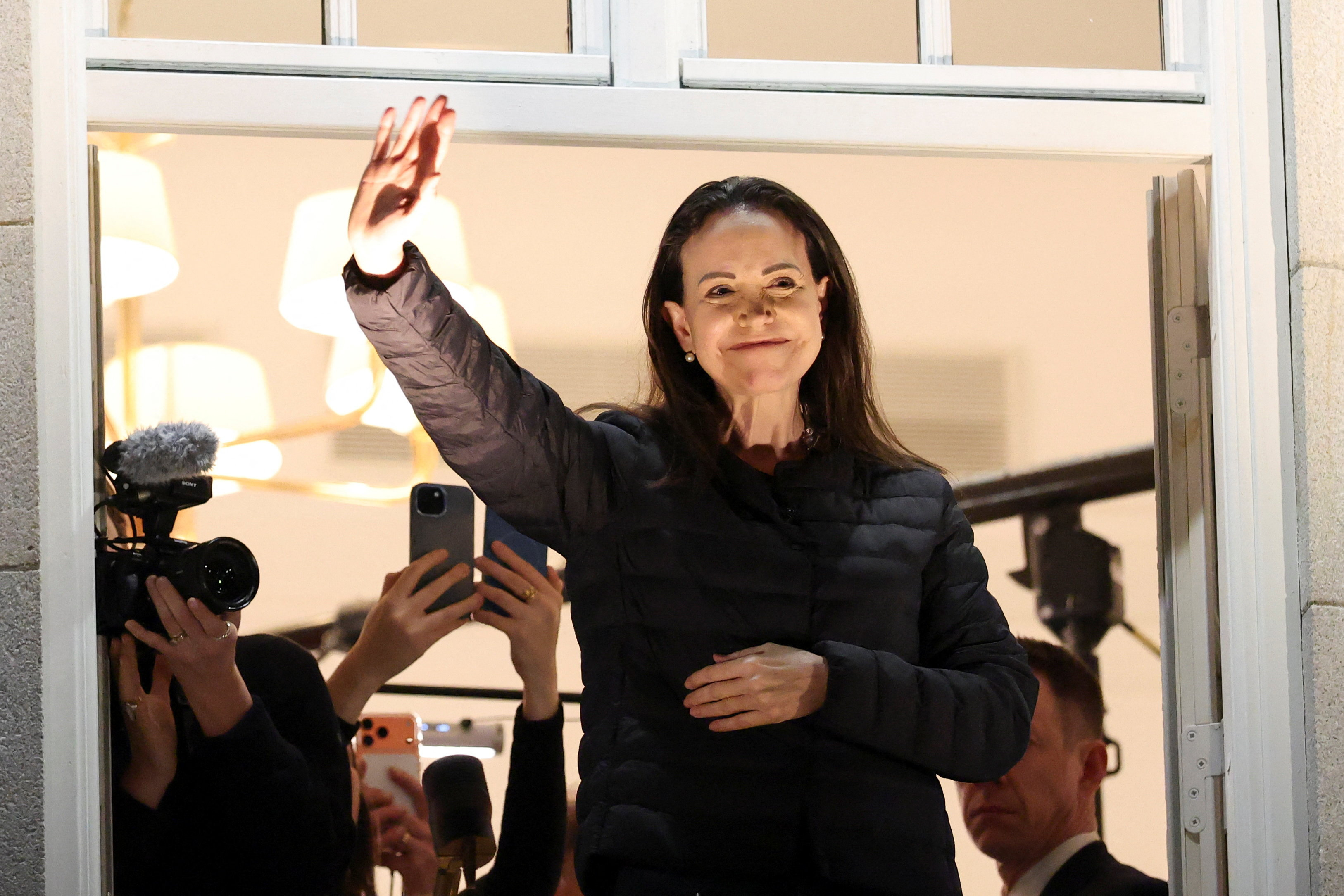
Nobel Peace Prize laureate Maria Corina Machado appeared in Oslo early on Thursday, climbing barriers outside her hotel to hug well-wishers after the Venezuelan opposition figure failed to reach the Norwegian capital in time to receive her award at a ceremony held hours earlier.
The 58-year-old engineer had secretly left Venezuela for Oslo in defiance of a decade-long travel ban imposed by authorities in her home country and after spending more than a year in hiding.
Machado greeted dozens of people from the balcony of Oslo’s Grand Hotel, where Nobel laureates traditionally stay, waving and singing the national anthem along with the crowd, which waved Venezuelan flags and filmed her with their mobile phones.
Later, Machado came down to the street and climbed over crowd barriers to hug and shake hands with people who had gathered in the cold for the chance to see her.
“After all these months in which she has been in hiding and her life has been in danger, I think seeing her together with the entire Venezuelan diaspora is a pleasure and a reassurance that she is safe, and it is also a way for the Venezuelan cause to stay alive and a way to put more pressure on the regime,” said Diana Luna, a Mexican-German woman in the crowd.
Machado’s daughter, Ana Corina Sosa Machado, earlier accepted the Nobel Prize in her name and delivered a speech by her mother in which she said democracies must be prepared to fight for freedom in order to survive.
In her speech, Machado said that the prize held profound significance, not only for her country but for the world.
“It reminds the world that democracy is essential to peace,” she said via her daughter, whose voice cracked when she spoke of her mother. “And more than anything, what we Venezuelans can offer the world is the lesson forged through this long and difficult journey: that to have a democracy, we must be willing to fight for freedom.”
LAUREATE LEFT VENEZUELA BY BOAT
Machado left Venezuela by boat on Tuesday and travelled to the Caribbean island of Curacao, from where she departed on a private plane for Norway, according to a person familiar with the matter.
The source, who had been briefed by Machado’s camp, said her escape from the Venezuelan coast was handled by her security staff. The White House did not immediately respond to a request for comment on Machado’s travel to Curacao, which was first reported by the Wall Street Journal.
A large portrait of a smiling Machado hung in the Oslo City Hall to represent her at the ceremony. The audience cheered and clapped when Norwegian Nobel Committee head Joergen Watne Frydnes said during his speech that Machado would be coming to Oslo.
Evoking previous laureates Nelson Mandela and Lech Walesa, he said fighters for democracy were expected “to pursue their aims with a moral purity their opponents never display”.
“This is unrealistic. It is unfair,” he said.
“No democracy operates in ideal circumstances. Activist leaders must confront and resolve dilemmas that we onlookers are free to ignore. People living under the dictatorship often have to choose between the difficult and the impossible.”
‘A CHOICE THAT MUST BE RENEWED EACH DAY’
In 2024, Machado was barred from running in the presidential election, despite having won the opposition’s primary by a landslide. She went into hiding in August 2024 after authorities expanded arrests of opposition figures following the disputed vote.
The electoral authority and top court declared President Nicolas Maduro the winner, but international observers and the opposition say its candidate handily won and the opposition has published ballot box-level tallies as evidence of its victory.
“Freedom is a choice that must be renewed each day, measured by our willingness and our courage to defend it. For this reason, the cause of Venezuela transcends our borders,” she said in her prepared speech.
“A people who choose freedom contribute not only to themselves, but to humanity.”
‘FRAGILE’ DEMOCRATIC INSTITUTIONS
In her speech, Machado said Venezuelans did not realise in time that their country was sliding into what she described as a dictatorship.
Referring to the late president Hugo Chavez, who was elected in 1999 and held power until his death in 2013, Machado said: “By the time we recognised how fragile our institutions had become, a man who had once led a military coup to overthrow democracy, was elected president. Many thought that charisma could substitute the rule of law.”
“From 1999 onward, the regime dismantled our democracy.”
Maduro, in power since 2013, says U.S. President Donald Trump is trying to overthrow him to gain access to Venezuela’s vast oil reserves and that Venezuelan citizens and armed forces will resist any such attempt.
DEDICATED TO TRUMP
When Machado won the Nobel Peace Prize in October, she dedicated it in part to Trump, who has said he himself deserved the honour.
She has aligned herself with hawks close to Trump who argue that Maduro has links to criminal gangs that pose a direct threat to U.S. national security, despite doubts raised by the U.S. intelligence community.
The Trump administration has ordered more than 20 military strikes in recent months against alleged drug-trafficking vessels in the Caribbean and off Latin America’s Pacific coast.
Human rights groups, some Democrats and several Latin American countries have condemned the attacks as unlawful extrajudicial killings of civilians.




Click here to change your cookie preferences