
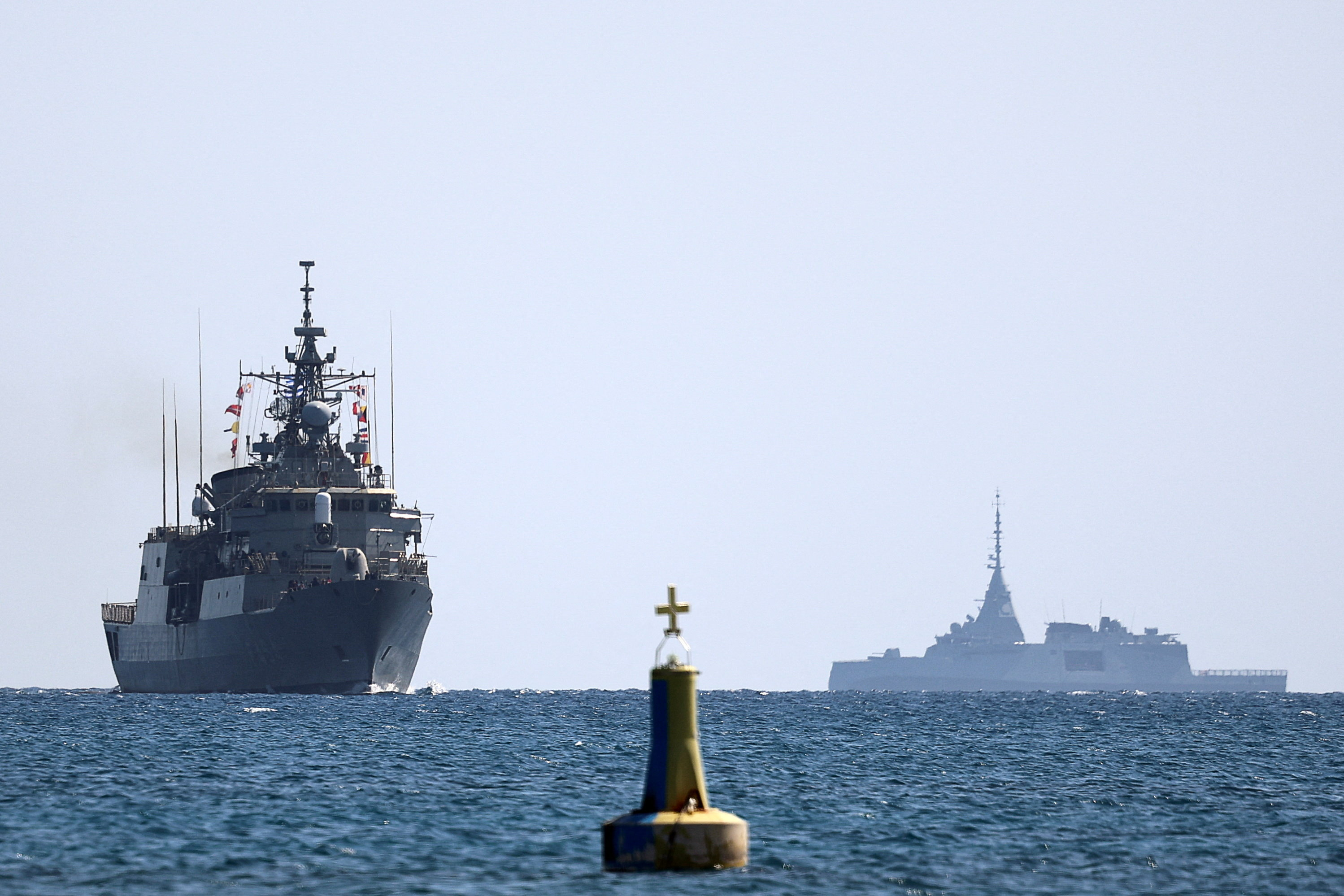
The Greek naval Belharra class frigates, the Kimon and Psara, arrived in the port of Limassol on Wednesday.
The two vessels entered the republic’s maritime zone shortly after dawn before reaching the Limassol port at 11.15am, according to defence sources.
Their deployment follows a series of military and diplomatic moves by Athens aimed at bolstering Cyprus’s security after drone strikes and rising threats linked to the conflict in the Middle East.
Speaking in Nicosia on Tuesday after meeting Greek defence minister Nikos Dendias, President Nikos Christodoulides said Cyprus and Greece “stand united” and would “always be part of the solution” during the current crisis.
He described Greece’s response as both “substantial and symbolic”, adding that it was helping to shape a broader European response.
“Greece declares itself present once again,” Christodoulides affirmed.
“A move of particular importance which also paves the way for the European Union. Your immediate response is followed by other European states.”
Dendias, accompanied by the Hellenic national defence chief of staff, General Dimitrios Choupis, met Christodoulides and defence minister Vasilis Palmas at the presidential palace to assess developments after missiles were exchanged by the United States, Israel and Iran.
The talks came a day after four Greek F-16 fighter jets and a C-130 military transport aircraft arrived in Cyprus, while the two frigates were already en route.
The Greek vessels were dispatched following a drone strike attributed to Hezbollah that hit the area of the British base at Akrotiri.
Greece has stressed that the deployments are defensive in nature and aimed at protecting Cyprus and its population.
“Greece will always stand by the Republic of Cyprus,” Dendias said, adding that Athens would provide “any help it can, within its powers and capabilities, to Cyprus”.
He underlined that neither Greece nor Cyprus had participated in military operations against Iran and warned that the targeting of uninvolved parties must be avoided.
Palmas described Greece as Cyprus’s most important supporter and partner, saying the two defence ministries were in close coordination and daily consultation.
He reiterated that Cyprus “did not participate, is not participating and will not be part of any military operation”, stressing the Republic’s commitment to international law, strategic alliances and the peaceful resolution of disputes.
France has confirmed it will deploy anti-missile and anti-drone systems to the island, along with a frigate, while President Emmanuel Macron has ordered the aircraft carrier Charles de Gaulle to the eastern Mediterranean.
Christodoulides has also requested the deployment of a German frigate during a call with Chancellor Friedrich Merz, with Berlin expected to take a final decision soon.
The Greek frigates Psara and Kimon are equipped with the Centavros combat system, designed to detect and neutralise drone threats.
The system was previously used to intercept drones launched by the Iran-backed Houthi movement in the Red Sea in 2024 and has since been integrated with Israel’s Barak MX air defence system, acquired by Cyprus in 2025.
Greek air assets remain active on the island, with four F-16 fighter jets stationed at the Andreas Papandreou airbase in Paphos and reportedly involved in the protection of Cypriot airspace.
A Greek C-130 transport aircraft has also been deployed to support logistics and coordination.





Click here to change your cookie preferences