
A different kind of burnout results when home stops feeling like home and the isolation effect kicks in
Working remotely is still not as common in Cyprus as in the rest of Europe. Only 22 per cent of employees worked from home in 2024, the lowest rate in the EU. However, for them, the change has dramatically impacted not only the work process, but also the way their home life is lived.
Remote and hybrid work have been growing at a rapid pace worldwide since the pandemic. However, the downside is that people find it mentally challenging to shut off their minds from work if the physical boundary between work and home has been blurred. This in turn, leads to an increase in chronic stress and eventually burnout.
The change is subtle. People do not start their workday at the office door or end it with their commute home. Instead, work exists in the same places, both physically and mentally, as rest, family time and sleep.
Occupational and organisational psychologist Maria Charalambous says this shift is not simply logistical; it is cognitive. “When home becomes a primary workspace, the psychological boundaries between professional and personal life start to blur,” she says.
When the physical boundaries are not clear, the difference between work and personal life can start to fade without being immediately obvious. The home, which was once a place of rest, slowly takes on new psychological associations.
“When that separation disappears, it becomes harder for the brain to clearly enter ‘work mode’ and at the end of the day shift to ‘rest mode’,” Charalambous says. “Over time this can increase cognitive load and make detachment from work more difficult”.
In Cyprus, where many people do not have the luxury of a separate home office, this continuous overlap can be difficult to avoid.
“Living in condensed or multigenerational homes can increase stress levels, particularly when privacy is limited,” Charalambous adds. “At the same time, when work takes place in shared family spaces, it becomes harder to mentally detach. The individual is physically present at home but psychologically still at work.”
This constant psychological proximity to work also changes the nature of burnout. Whereas burnout is usually linked to long hours and massive workloads, remote work gives rise to different risks.
“What has changed with remote work is not necessarily the existence of burnout but its pathway,” Charalambous says. “More precisely, remote environments put individuals at risk of overworking. Without clear time boundaries, many people start earlier, finish later, and take fewer real breaks.”
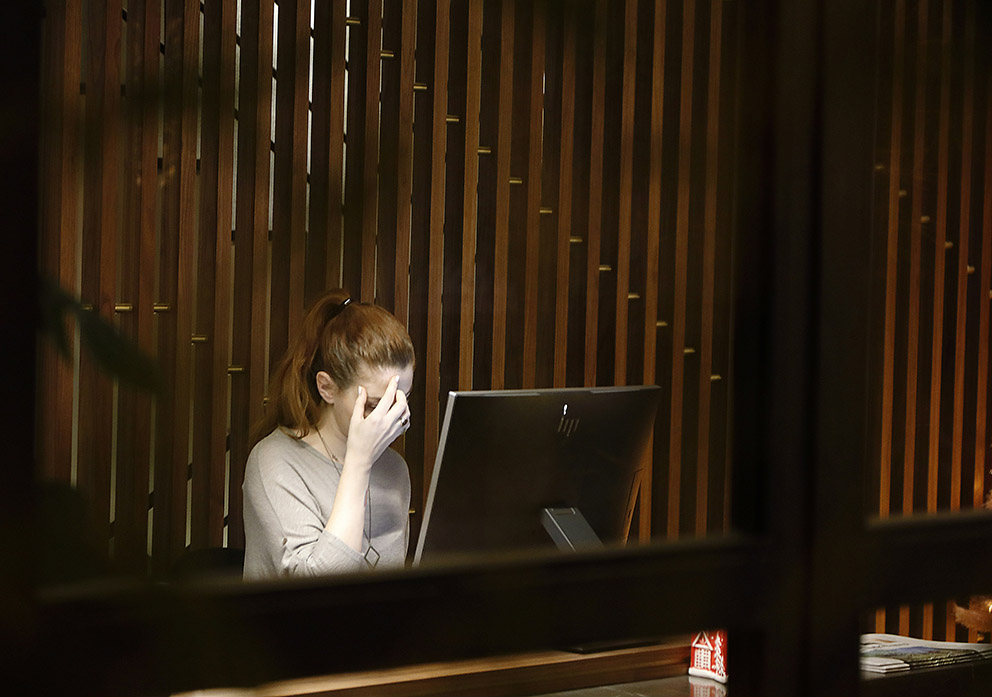
In the absence of a traditional workday, work can progressively expand into the time that was once set aside for rest. “The absence of commuting can lead to ‘time creep’, where work gradually expands into personal time,” she explains. “If this continues without adequate recovery, then burnout is very much expected to increase”.
For some employees, the pressure is sometimes internal. “The risk is particularly high for highly conscientious and committed employees, who may feel the need to prove that they are productive when working remotely,” she says. “It can also affect individuals who do not feel trusted by their employers and therefore experience an increased need to prove that they are indeed working.”
In Cyprus, where remote work is still developing, psychological structures have not always been able to keep up with the change. “In many cases, remote work is implemented and managed logistically but not psychologically,” Charalambous says. “There is a room for improvement in training managers to lead remotely, evaluate performance based on outcomes rather than hours and recognise early signs of isolation or burnout”.
Aside from managing workload, remote work comes with another less obvious downside: slowly losing those everyday social connections. When you are not chatting with colleagues face to face, it’s easy for a sense of isolation to sneak up on you. “Over time, loneliness can affect both wellbeing and performance,” Charalambous says.
Research across Europe suggests these experiences are becoming increasingly common as remote work becomes part of everyday life. Studies from the European Agency for Safety and Health at Work reveal that people working from home are more likely to put in extra hours during their free time and have a harder time mentally switching off than those who work in an office.
If you can’t mentally disconnect from your job, it’s easy to get stressed and tired. Experts believe that being able to switch off is key to avoiding burnout. If you don’t set boundaries between work and home life, your brain will always associate your home with work rather than relaxation.
As remote and hybrid work become more common in Cyprus, both employers and employees are still figuring out ways to adjust. For employees, building small daily habits can go a long way in bringing back those boundaries. For instance, settling on a clear finishing time and sticking to it helps the brain transition out of work mode. Other rituals such as changing clothes after work, shutting down the laptop fully, or taking a short walk to simulate the typical ‘commute’.
As the workplace continues to evolve, the challenge for many is no longer learning how to work from home but learning how to be at home again.





Click here to change your cookie preferences