
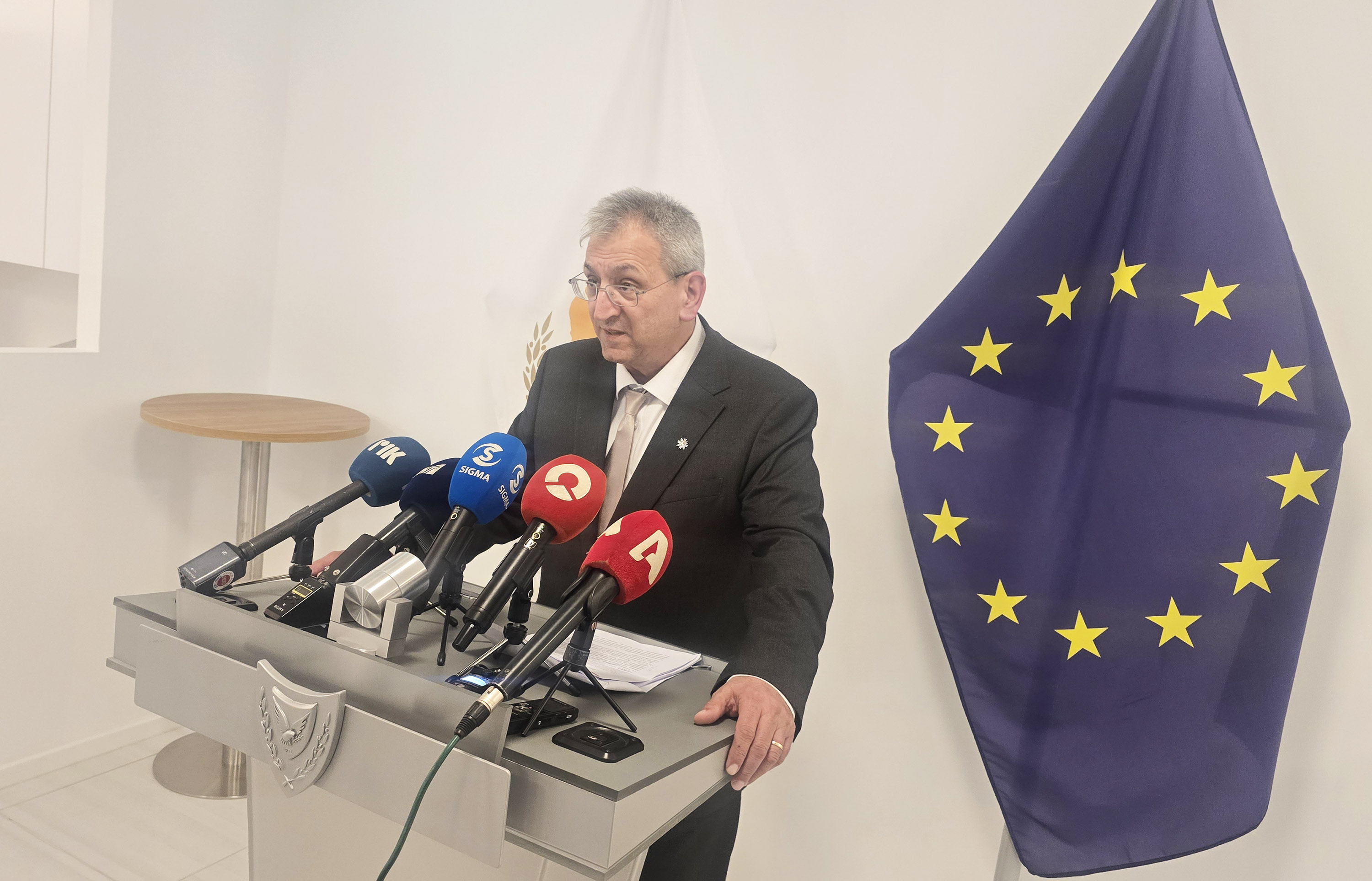
Labour Minister Marinos Moushiouttas announced on Monday that the government is moving to address the Social Insurance Fund’s sustainability through high-level talks with the Finance Ministry, including on issues related to the fund’s investment strategies and the settlement of outstanding state debt.
The Labour Advisory Body, chaired by the minister, examined the transposition into national law of a European directive aimed at strengthening the principle of equal pay between men and women for the same or equivalent work, as well as an amending bill concerning the establishment and revision of administrative fines.
“Two important issues concerning the immediate rights of workers and the strengthening of the framework of social protection were discussed,” Moushiouttas said.
Regarding the first issue, he explained that consultations continued on incorporating Directive 2023/970 into national law, describing it as a milestone for reinforcing the principle of equal pay between men and women for the same or equivalent work.
“The government is committed to the timely and substantive integration of the directive into the Cypriot legal system,” he said.
He noted that the deadline for transposition of the directive is June 7, 2026.
Moreover, the minister stated that, following the current meeting, the intention is for the final bill to be prepared within the next few weeks, after which it will be submitted to the Cabinet and subsequently to the House of Representatives.
Moushiouttas said, however, that due to the House being closed because of parliamentary elections, the new House will examine the bill in early June.
“Our request to the new House is that if possible it examines it between June and mid-July and if not we will go to September,” he said.
He added that if the House is unable to review the bill in June, an extension will be requested from the European Commission for the directive’s transposition deadline due to the elections.
He also said that during the meeting, “one or two differences of opinion” were expressed by social partners, and the ministry will decide “what the final form of the bill will be”.
Turning to the second issue, which “had unanimity”, Moushiouttas said it concerned a bill amending Article 85A of the social insurance law, relating to the establishment and revision of administrative fines.
He explained that under the proposed amendment, the total increase of an administrative fine imposed will not exceed double the amount of the initially imposed fine.
He added that under current legislation, if an administrative fine is not paid within a certain timeframe, a daily surcharge is applied, noting that “we have reached a point where debts of 2 to 2.5 million with surcharges now reach the amount of 42 million”.
“We believe that as in other legislation a regulation could be made on this issue so that it can reach up to double and stop,” he said.
He explained that this would apply retroactively and is already implemented in other laws.
The minister also stressed that the current system leads to penalties that are disproportionate to the offence, such as undeclared work, as the final fine “is not final” and continues to increase.
“The intention is for it to go to the Council of Ministers and the House as soon as possible,” he stated.
On the issue of pensions, he clarified that it was not discussed during the meeting, “because discussions are taking place these days with the competent Ministry of Finance”.
“Decisions on the investment policy of the Social Insurance Fund and the repayment of the state’s debt to the Social Insurance Fund directly concern the Finance Ministry,” he said.
He pointed out that consultations are ongoing with technocrats and the Finance Minister, saying that a meeting at technocratic level will take place today or tomorrow and “subsequently we will examine them at political level”.
He further stated that by the next meeting, scheduled for April 20, “we will be able to present our unified government position to the partners for discussion at the Labour Advisory Body”.
He also indicated that discussions on the second pillar of the pension system should begin in parallel at the technical committee level, adding that “we will go to the technical committee, as a ministry, with various options”.
“We will want to hear the positions of the partners so that this element can also progress and a common position can be shaped or co-shaped that reflects what the second pillar will look like,” he said.
Regarding the first pillar, which concerns pension reform, he said that trade unions raised two to three questions and that responses will be provided by the Labour Ministry by April 20.
He mentioned that the subsequent meeting originally scheduled for April 27 will be postponed by one week at the request of social partners due to May Day events and planned assemblies by employers’ organisations.
He added that the next meetings of the body will take place on April 20 and May 4 instead of April 27.
Moushiouttas said that by those meetings “we will have quite a lot of news to share, as some issues will become an open book for discussion and exchange of views”.
“The milestone we had set was to be able to submit the bill to the new House resulting from the elections before it closes in July for the summer holidays,” he added.
The minister also stated that following the completion of parliamentary elections, he intends to hold a series of meetings with parliamentary parties of the new House “to brief them on this bill that we will have already submitted so that it is not the first time they hear about this issue, which is large and complex”.
“When the discussion begins in September or October before the competent committee or committees, they will know what is before them,” Moushiouttas concluded.





Click here to change your cookie preferences