
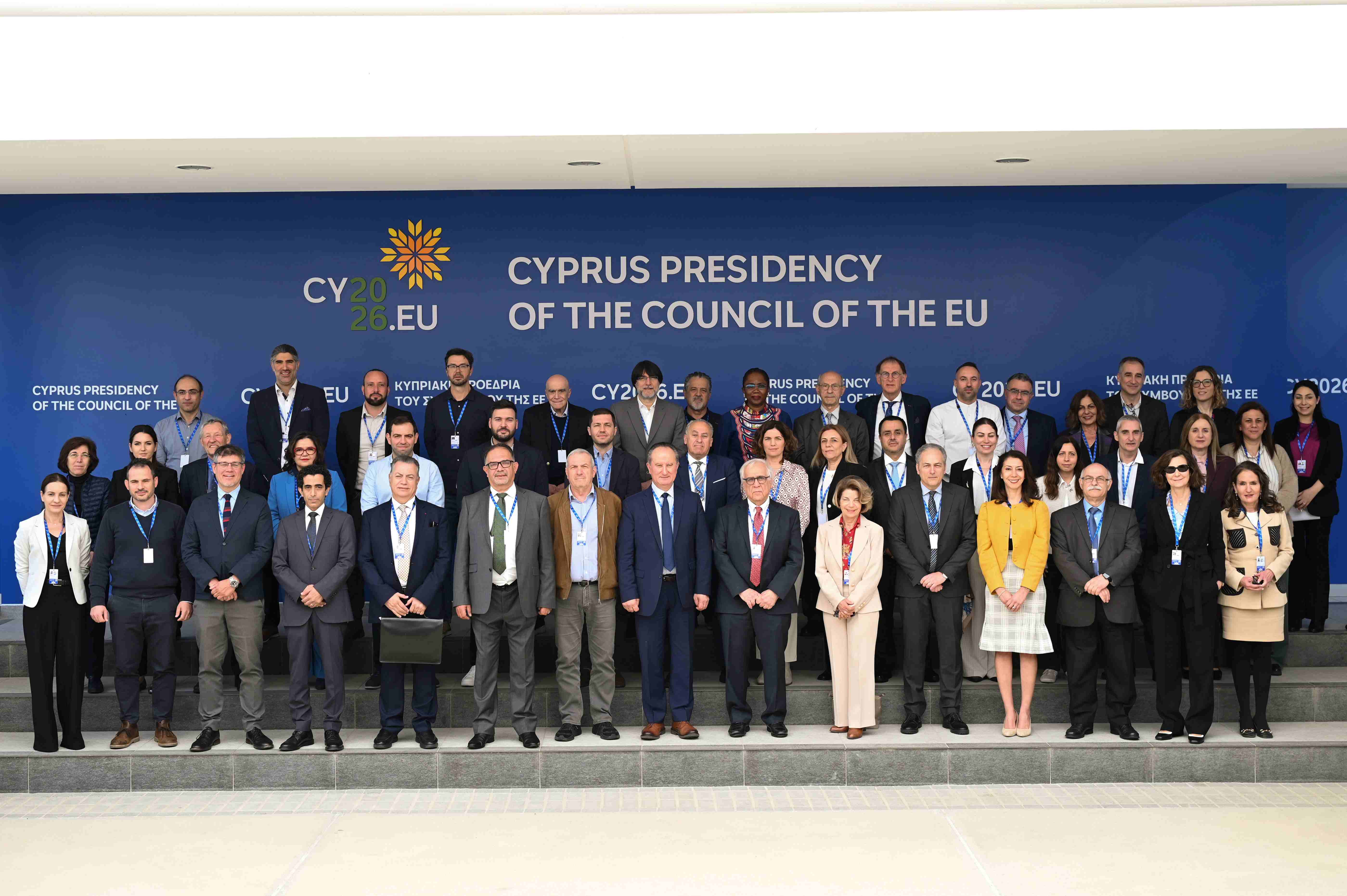
A powerful call for coordinated climate action, grounded in science, innovation, and regional cooperation, was delivered from Nicosia during the international conference “Climate Action in the Eastern Mediterranean and Middle East Regional Cooperation Empowered by Science and Innovation”.
The event took place on April 8 and 9, 2026, at the Filoxenia Conference Centre, within the framework of the Cyprus Presidency of the Council of the EU.
It was organised by the Cyprus Institute and the Deputy Ministry of Research, Innovation and Digital Policy.
Representatives of governments, international organisations, policymakers, and scientists underscored the urgent need for collective action in one of the world’s most climate-vulnerable regions, with participants from 18 countries contributing to the programme.
The conference featured addresses by President Nikos Christodoulides, European Commissioner for the Mediterranean Dubravka Suica, Prince Hassan bin Talal of Jordan, Agriculture Minister Maria Panayiotou, and Deputy Minister Nikodemos Damianou.
In addition, Energy Minister Michalis Damianou and European Commissioner for Fisheries and Oceans Costas Kadis outlined policy responses and strategic actions by their respective ministries and the European Union on the climate crisis.
A central outcome of the event was the adoption of the Nicosia Call for Action 2026, a framework setting out key priorities for regional cooperation, resilience, and sustainability.
Participants stressed that the Mediterranean’s strategic position as a bridge between Europe, North Africa, and the Middle East makes balanced and inclusive cooperation essential for its future.
They highlighted that climate change, environmental degradation, economic inequality, migration pressures, and security risks are deeply interconnected challenges requiring coordinated, long-term responses.
At the same time, sustainable consumption patterns and the responsible use of natural resources were identified as critical components of any effective strategy.
Particular emphasis was placed on science diplomacy as a vital tool for addressing climate challenges, even in complex geopolitical environments.
The conference also underscored the importance of collaboration across key sectors such as energy, water, food, health, urban development, and cultural heritage.
The Nicosia Call for Action 2026 places strong emphasis on empowering citizens and societies, with investment in education, youth, and women seen as fundamental to building resilient communities.
In this context, the importance of ensuring a socially just transition was strongly highlighted.
The document further calls for enhanced cooperation in science and innovation to accelerate the energy transition, advance the circular economy, and reduce dependence on fossil fuels.
It also stresses the need to develop shared scientific infrastructure and data systems to support evidence-based policymaking.
Moreover, the call highlights the importance of effective and participatory governance, increased investment, and improved policy coordination.
It identifies the development of robust partnerships and flagship cross-border projects as essential to achieving these objectives at a regional level.
Overall, the Nicosia Call for Action 2026 delivers a clear message that the Eastern Mediterranean and the Middle East must evolve into a region defined by enhanced cooperation and shared responsibility.
Addressing the climate crisis, it concludes, requires collective action to ensure resilience, prosperity, and long-term stability for future generations.





Click here to change your cookie preferences