
Cyprus strengthens global presence in digital trust debate
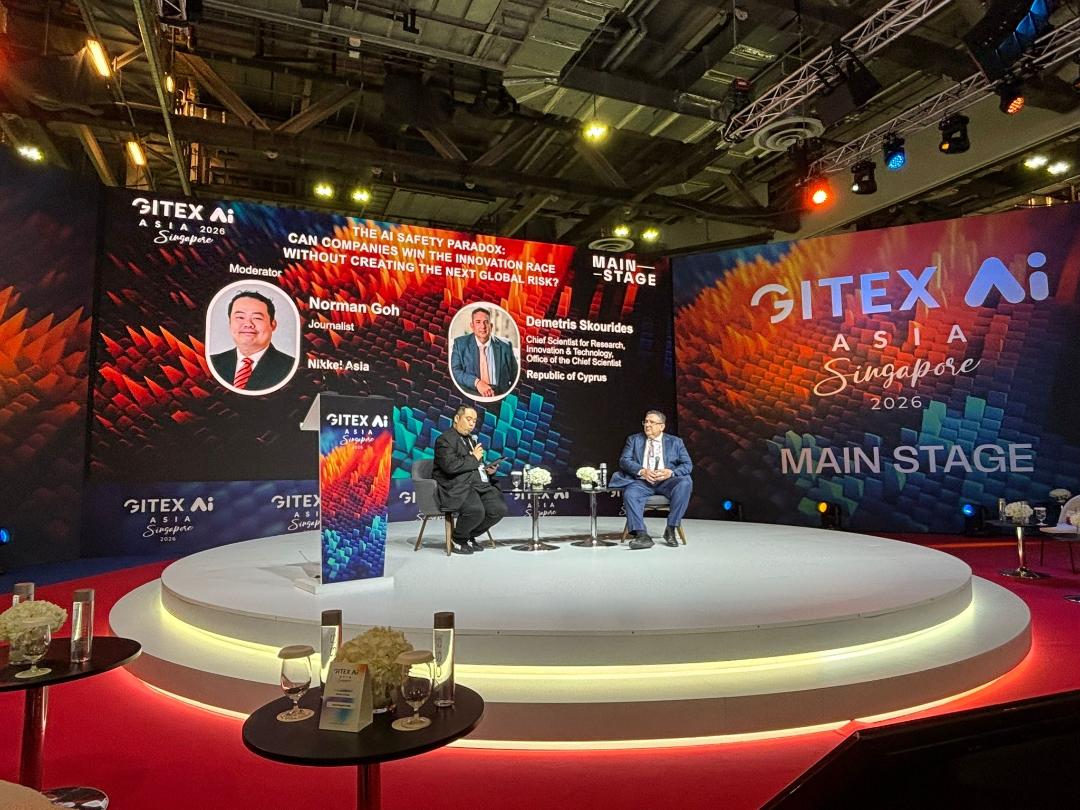
Cyprus’ Chief Scientist Demetris Skourides was recognised among the “Top 50 What’s Next Champion” thought leaders at GITEX ASIA 2026 in Singapore, where he contributed to high-level discussions on ethical artificial intelligence and digital trust.
Skourides, serving as Chief Scientist for Research, Innovation and Technology of the Republic of Cyprus, represented the country as an emerging hub for deep-tech innovation during the event held at Marina Bay Sands.
According to an announcement released on Thursday, his participation highlighted Cyprus’ growing role in global dialogue on AI governance, digital identity and cybersecurity challenges.
At the event, he took part in two fireside discussions addressing the dual challenges of rapid AI deployment and the erosion of digital identity.
In the first session, titled “The AI Safety Paradox Can Companies Win the Innovation Race Without Creating the Next Global Risk,” Skourides joined journalist Norman Goh of Nikkei Asia to explore the complexities of scaling artificial intelligence systems.
He explained that as organisations transition towards Industry 5.0, AI systems are increasingly evolving into autonomous agents influencing human behaviour and critical infrastructure.
Within this context, he emphasised the importance of the EU AI Act and complementary regulatory frameworks in ensuring that innovation remains aligned with safety, accountability and trust.
He further examined the growing gap between rapid AI commercialisation and ethical oversight, noting that regulatory tools such as the EU AI Act and international standards including ISO IEC 42001 can support compliance while reducing deployment risks.
Skourides also stressed the need for adaptive national digital strategies capable of responding to emerging threats such as the misuse of biometric technologies and systemic risks in financial ecosystems.
The discussion extended to the balance between technological advancement and societal responsibility, particularly across sectors including manufacturing, healthcare and the public sector.
He highlighted the importance of raising public awareness around synthetic media, synthetic identities and fraudulent digital personas, which are becoming increasingly sophisticated.
Reflecting on ongoing risks, Skourides pointed to persistent gaps in digital literacy and public awareness, which continue to expose individuals and organisations to cyber threats.
He also underlined the lack of open infrastructure and reliance on closed systems, which can lead to vendor lock-in and reduced flexibility.
In addition, he stressed the absence of globally standardised frameworks for responsible AI, alongside a growing shortage of skilled professionals in both cybersecurity and artificial intelligence.

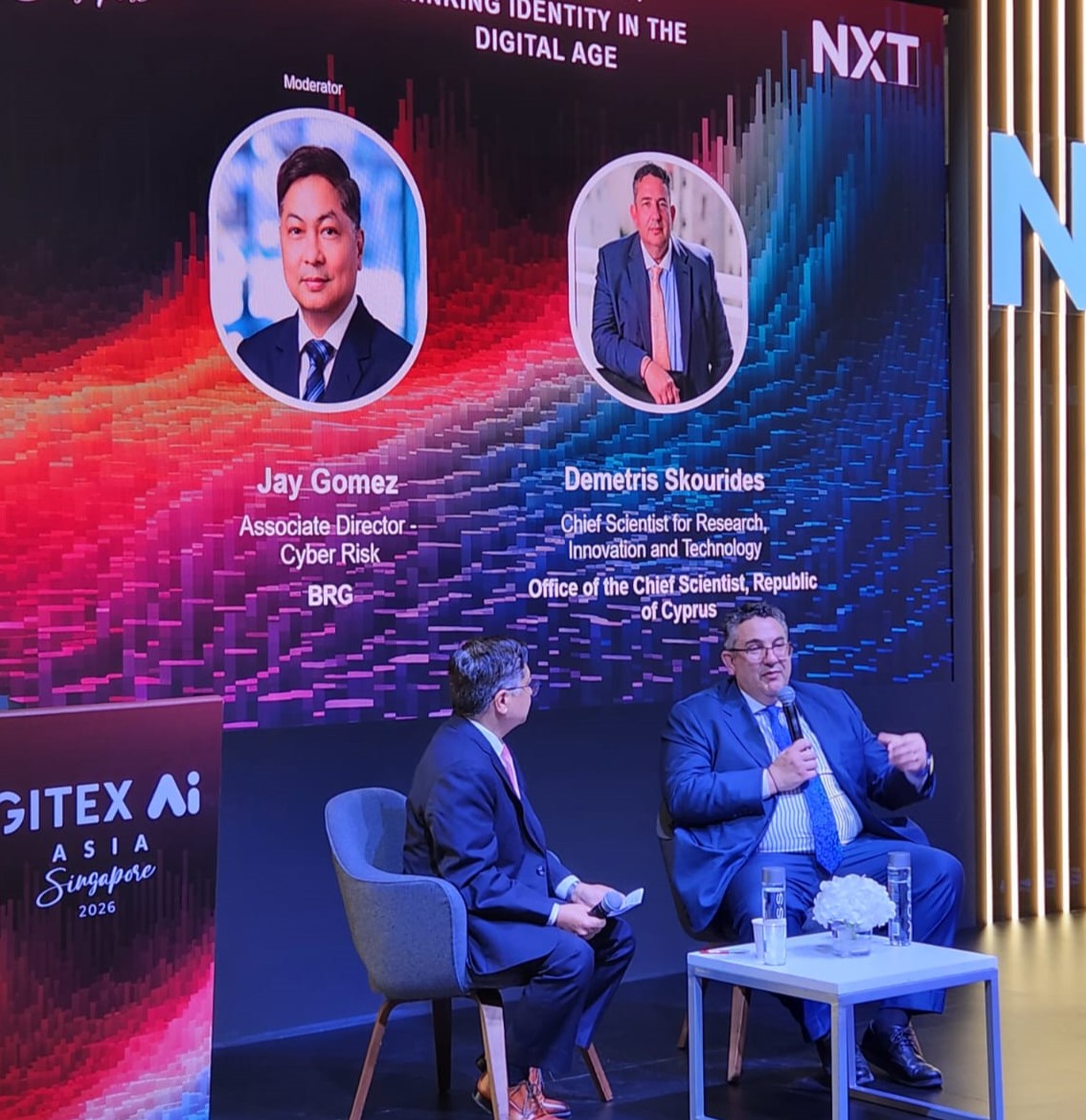
In the second session, titled “Who Do You Trust Rethinking Identity in the Digital Age,” Skourides joined Jay Gomez, associate director in cyber advisory at BRG, to discuss the evolving concept of trust in a digitally interconnected world.
The discussion focused on the rapid advancement of deepfake technologies, capable of convincingly impersonating individuals, as well as the emergence of autonomous AI agents conducting digital transactions.
Skourides outlined the transition towards decentralised digital identity systems, emphasising the need for robust mechanisms to verify human identity in increasingly complex environments.
He addressed the rise of synthetic identity fraud and cross-border cyber risks, highlighting the importance of coordinated international responses.
He also explored how blockchain-based architectures and decentralised frameworks can help restore control of personal data to individuals and reduce reliance on centralised systems.
Positioning Europe’s eIDAS 2.0 digital identity wallet as a global benchmark, Skourides described it as a model for sovereign digital trust in the modern economy.
He explained that eIDAS 2.0 represents a fundamental transformation in digital identity architecture, enabling citizens to securely use their digital identities across the European Union.
He further elaborated on the role of zero-knowledge proofs in preserving privacy, allowing individuals to verify credentials without revealing underlying personal data.
Drawing comparisons, he referred to Singapore’s Singpass system as a global benchmark, noting differences between centralised and decentralised identity models.
He explained that while Singpass operates as a centralised trust system focused on service delivery, the European model prioritises individual sovereignty over personal data.
During his visit, Skourides held meetings with a wide range of international stakeholders across government, cybersecurity and innovation ecosystems, reinforcing Cyprus’ engagement in global cooperation.
These discussions formed part of a broader dialogue on AI governance, cybersecurity collaboration and digital trust frameworks.
He also participated in a workshop hosted by the Global Council for Responsible AI, focusing on the transition from generative AI to regenerative AI and presenting the GRACIE governance framework.
The framework aims to bridge the EU AI Act with emerging regulatory approaches across the Asia-Pacific region, supporting alignment between regions.
Skourides concluded his participation with a strategic meeting with Plug and Play APAC managing partner Jupe Tan, focusing on facilitating visits of Cypriot startups to Singapore and Indonesia.
These discussions aimed to strengthen international collaboration and market access opportunities for Cyprus-based innovation companies.
His visit also included an interview with research analyst Stephanie Constantinou, examining the role of smaller nations in shaping global AI governance frameworks.
The announcement further mentioned that “Skourides’ presence at GITEX ASIA reinforces Cyprus’ strategic positioning within the global technology and innovation landscape”.
“By actively contributing to high-level discussions on AI governance, digital identity, and trust frameworks, Cyprus is emerging not merely as a participant, but as a credible voice aligned with European regulatory leadership and global best practices,” it added.
Moreover, the announcement stated that “this engagement strengthens Cyprus’ role as a bridge between Europe and high-growth markets across Asia and the GCC, opening pathways for investment, research collaboration, and cross-border innovation”.
“At a time when digital trust, AI regulation, and data sovereignty are becoming foundational pillars of the global economy, Cyprus is positioning itself as a jurisdiction capable of supporting secure, compliant, and scalable digital ecosystems,” it added.
“Through a structured approach to technology and innovation diplomacy, the office of the chief scientist continues to translate national strategy into global action, enhancing Cyprus’ attractiveness as a destination for technology investment, talent, and innovation-driven businesses,” it continued.
“This forward-facing approach directly supports the country’s long-term vision to become a regional hub for research, innovation, and advanced technologies, while ensuring its integration into the evolving global digital economy,” the announcement concluded.




Click here to change your cookie preferences