
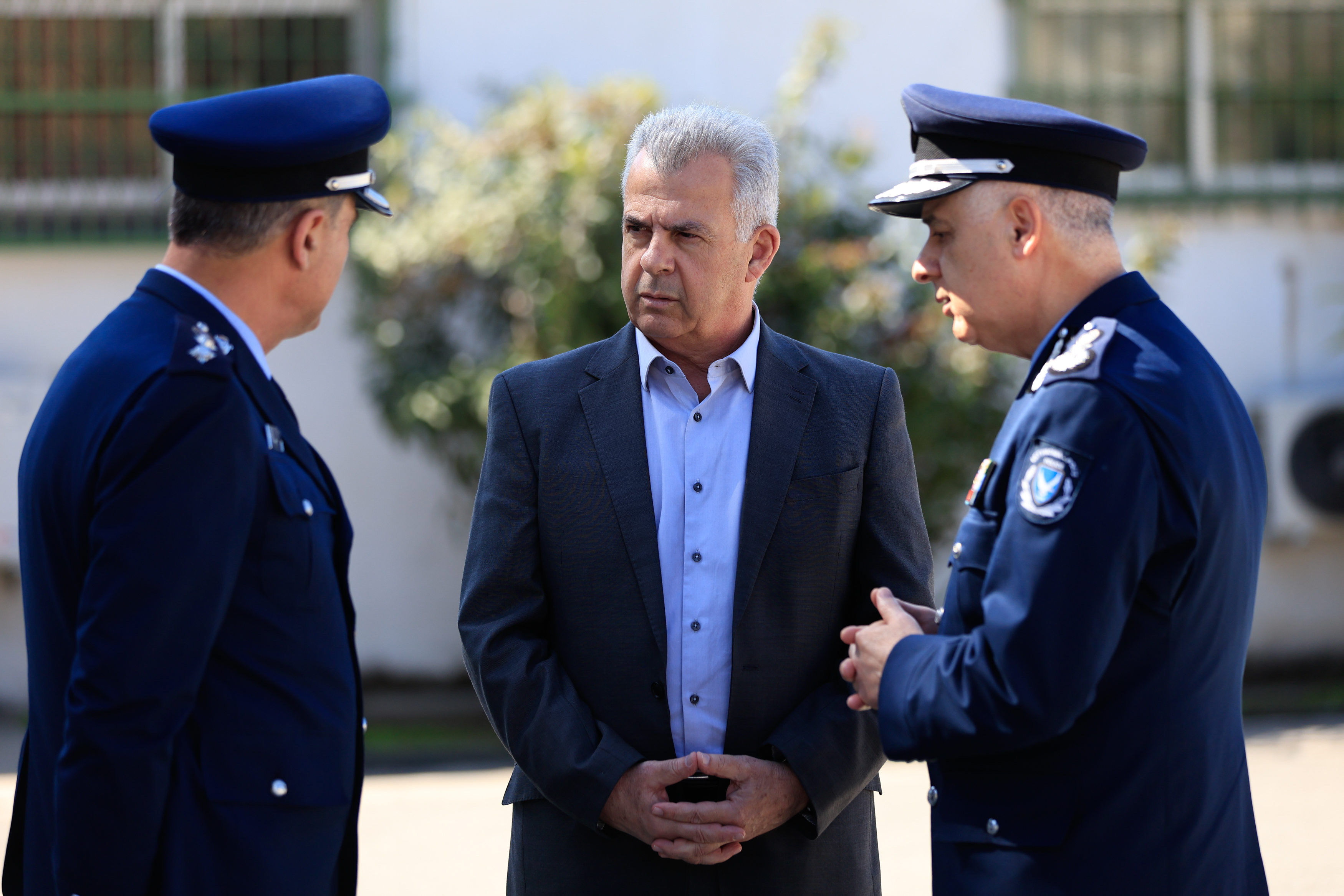
Justice Minister Costas Fitiris has said he takes responsibility for assurances given to the President regarding the handling of the Rizoelia farmers’ protest, while also expressing dissatisfaction with aspects of the police response during the incident.
Speaking to reporters on Tuesday, Fitiris said he had conveyed assurances that the road at Rizoelia would remain open and that the informal council of heads of state would not be disrupted.
“I assured the President and I am responsible; I never shifted responsibility. I am to blame as a minister,” he admitted.
The incident related to the livestock farmers’ protest last Thursday, when road closures at the Rizoelia roundabout led to traffic disruption during ongoing demonstrations over animal culling measures regarding foot-and-mouth disease protocol.
Fitiris said the assurances he passed on were based on information received from organisers and authorities at the time.
“The assurance came first of all from the organisers that it would not be closed,” he said, adding that there was an expectation of limited action rather than full closure.
He said the outcome did not align with those expectations and would be reviewed.
“I was unhappy with it, but I consider it an isolated incident and that’s why we’re evaluating the measures,” he said.
He added that the priority for government and security planning is to ensure continuity during major events.
“The requirement is that things run smoothly and that when we have events like the Council, it is not affected at all,” he said.
“Since it was affected, we need to take stock of how and so on so that it doesn’t happen again.”
Fitiris said he did not assess the incident as reflective of overall police performance, referring instead to wider operational activity.
“If I exclude the incident in Rizoelia, the security measures taken by the police in all areas were excellent,” he said, adding that foreign delegations had expressed positive feedback.
“This incident in Rizoelia, which did indeed displease me, we will examine,” he assured.
On his working relationship with police chief Themistos Arnaoutis, Fitiris said differences of opinion exist but do not amount to institutional tension.
“We are not going through a crisis, there may be different perceptions, as is normal”, he stressed.
He said cooperation between officials at different levels is required.
“It is the duty of everyone who is in a position to find ways to cooperate with both superiors and subordinates,” he said.
He also referred to the legal framework governing his role in relation to the police, saying he can issue instructions in the public interest but not take over operational duties.
“I understand my office, I’m not going to play the policeman here”, he retorted.
He said that where operational difficulties arise, they must be examined.
“Since there are cases where matters are not running smoothly, I have a duty to ask why,” he said.
Fitiris also referred to wider policing workload pressures, including deployments to areas outside core policing duties.
He cited the example of resources being assigned to farm inspections during animal disease controls, saying this had affected patrol availability.
“The police were burdened with too many tasks that are not theirs,” he said.
He added that operational demands had stretched staffing levels, with officers reassigned across multiple responsibilities.
He said the objective is to ensure police resources remain focused on core duties.
“My goal is for duties that are not the police’s responsibility to be reassigned more appropriately” he said.





Click here to change your cookie preferences