
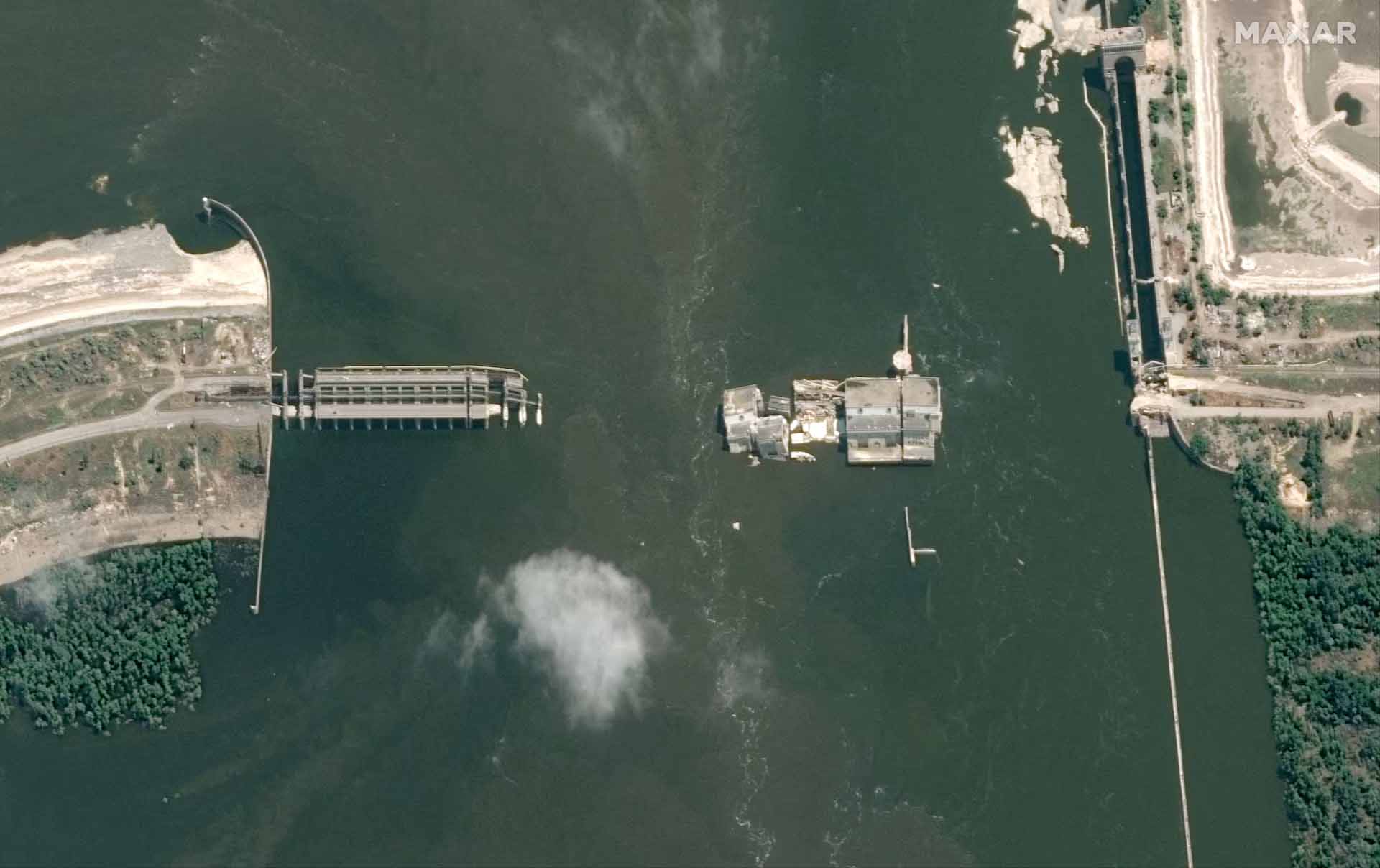
On June 6, 2023, the Nova Kakhovka Dam on Ukraine’s Dnipro River was destroyed. The explosion cut the primary freshwater supply for upstream communities while flooding downstream areas with contaminated water and unexploded ordnance. Active warfare continued around the disaster zone. Within hours, Chemonics International was coordinating with a variety of local and international partners, including Ukraine’s State Emergency Services, to procure water pumps and establish a call center to receive humanitarian needs directly from affected residents.
The response took shape quickly. Twenty-one mobile water treatment plants went into service, collectively reaching 45,000 people daily. Twenty-nine pumps removed floodwater from structures. A volunteer-staffed call center fielded 7,500 emergency calls. Fuel procurement and delivery was routinely completed within hours of requests. What made that timeline possible wasn’t speed as an organizational trait — it was the existing infrastructure: supply chains already operating across 90-plus countries, relationships with Ukrainian authorities already established, logistics networks already in place before the crisis hit.
A rapid response to an acute crisis is one capability. Most of Chemonics’ work in conflict-affected states is agile, adaptive, and focused on building the peace, stability, and institutional capacity that communities need over the long term.
Programming for social cohesion
In central Mali, Chemonics designed a tailored response to reduce the frequency and severity of disputes in communities with limited conflict resolution mechanisms. The approach combines conflict-sensitive programming with unconditional cash transfers designed to strengthen household-level social cohesion. Cash transfers in fragile-state contexts serve a different purpose than emergency relief. They reduce the economic vulnerability that makes households susceptible to recruitment and coercion, while building the community bonds that violence strains.
Building social capital at both individual and institutional levels is essential for strengthening the local mechanisms that communities use to prevent and resolve disputes before they escalate into violence. Formal systems exist for many of these functions in theory. Building them in practice — in communities that have experienced sustained instability — requires sustained presence and a design that works with existing social structures rather than around them.
When conflict crosses borders
Some fragile environments don’t respect national boundaries, and neither do the dynamics driving conflict within them. Along the borderlands of Ethiopia, Kenya, Uganda, South Sudan, and Somalia, pastoralist communities in the Karamoja, Moyale, and Mandera clusters move across state lines, share grazing routes, and face livelihood shocks that national-level development programs aren’t designed to reach. Chemonics’ cross-border resilience programming worked at this regional scale — empowering local communities, civil society organizations, private sector actors, and subnational governments to design and implement responses to conflict, livelihood instability, and environmental stress.
The design reflected a practical judgment about what external organizations can and can’t accomplish. Development programs that arrive with predetermined solutions and a project lifecycle can address specific gaps. They rarely build the trust and institutional capacity that outlasts the funding. Chemonics’ stabilization approach centers local leadership for a specific reason: the communities in Karamoja, Moyale, and Mandera have a more durable stake in the region’s stability.
Governance where it’s hardest to build
In Iraq, Chemonics’ programs spanned both immediate stabilization and long-term governance. One program addressed the underlying economic drivers of instability through community-based development — improving competitiveness for small and medium enterprises, facilitating job creation in conflict-affected areas, and building the inclusive community leadership structures that economic recovery requires. That work extended across sectors, with Chemonics also working alongside Iraqi government entities to improve the quality and transparency of public services in water, sanitation, and solid waste management, working at the national, provincial, and district levels to rebuild the citizen-government trust that conflict erodes.
The work in Syria ran alongside it. In Syria, displacement and sustained conflict left large numbers of youth with interrupted education and without pathways to employment. Chemonics programs provided psychosocial support, reintegration services, vocational training, access to quality, inclusive education, and strengthened service delivery capacity for education authorities and local organizations. The design addressed two risks simultaneously: the immediate education gap and the longer-term vulnerability of young adults without skills or social reintegration who become susceptible to the same forces that displaced them.
What operating in these environments requires
Chemonics’ work in humanitarian assistance operates across an integrated set of capabilities: stabilization and early recovery support, procurement and logistics for emergency supplies, governance and public services rebuilding, disaster risk reduction, and analysis to equip decision makers before and after crises. Those capabilities are built on supply chains and relationships spanning more than 90 countries and 50 years of multisectoral experience — infrastructure that supports both immediate response and the longer-term transition from humanitarian relief to sustainable development.
The through-line across these programs — Ukraine, Mali, East Africa, Iraq, Syria — is the combination of operational capacity with contextual knowledge. Moving water treatment plants to a flooded Ukrainian city required logistics. Designing a cash transfer program that strengthened rather than disrupted existing community structures required deep understanding of how those structures work. Both are necessary. Chemonics’ tailored support to communities is built on the premise that operational strength without contextual sophistication produces waste, and contextual knowledge without operational capability produces inaction. The work requires both, in every environment where it operates.
DISCLAIMER – “Views Expressed Disclaimer – The information provided in this content is intended for general informational purposes only and should not be considered financial, investment, legal, tax, or health advice, nor relied upon as a substitute for professional guidance tailored to your personal circumstances. The opinions expressed are solely those of the author and do not necessarily represent the views of any other individual, organization, agency, employer, or company, including NEO CYMED PUBLISHING LIMITED (operating under the name Cyprus-Mail).





Click here to change your cookie preferences