
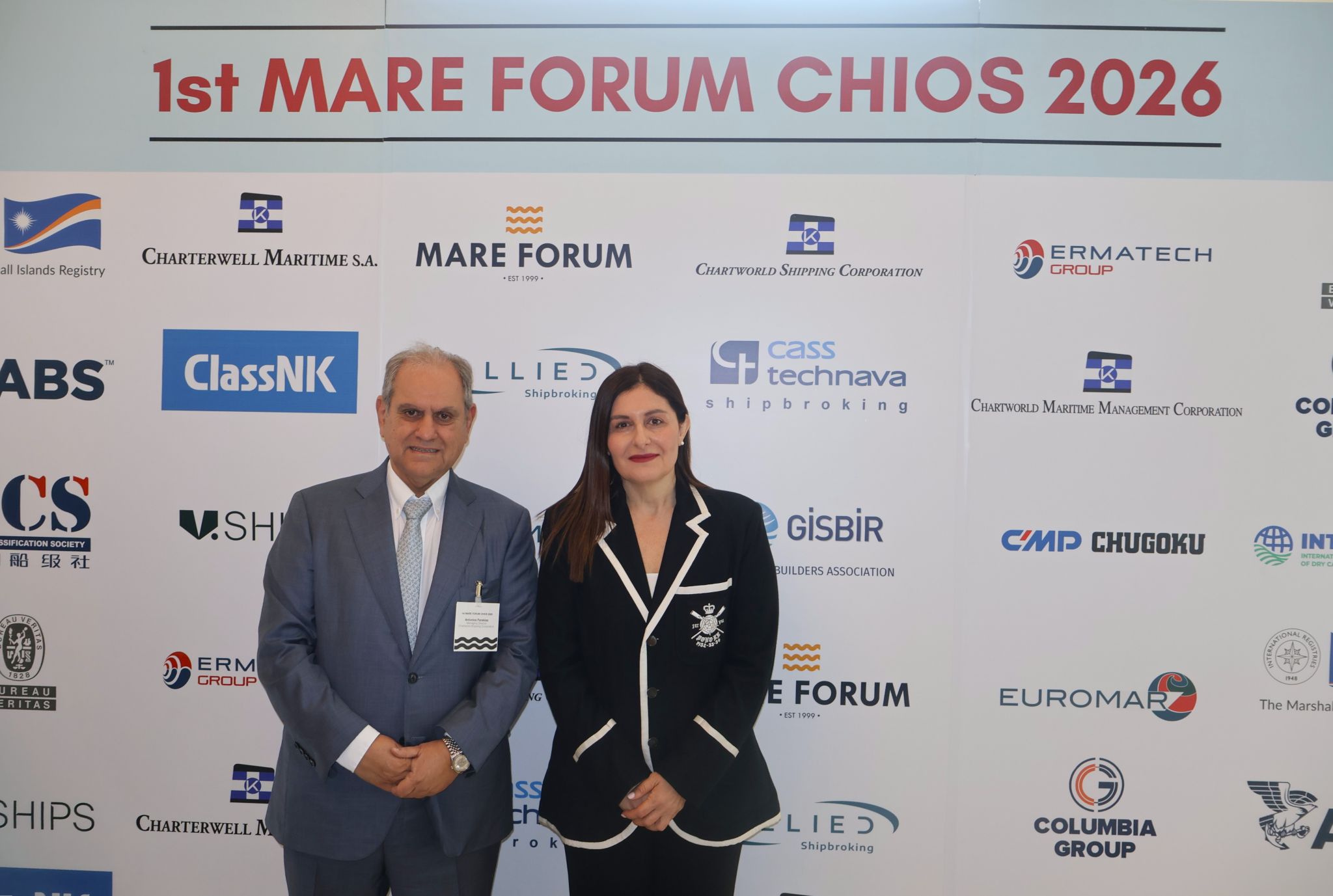
Chartworld Shipping Company managing director Antonis Faraklas has warned that geopolitical instability has made international shipping increasingly difficult to predict, saying fleet diversification has become a key survival strategy for companies exposed to volatile market cycles.
Speaking at the 1st Mare Forum Chios, Faraklas said developments such as the war in Ukraine and tensions in the Middle East were reshaping freight markets at a pace that leaves little room for reliable forecasting.
With 46 years of experience in the shipping industry, he said Chartworld has managed a fleet of more than 70 vessels over time, operating across several segments, including containerships, reefers and bulk carriers.
Faraklas said this spread across different markets has helped the company absorb shocks, as each segment tends to move in a different direction and at a different time.
“Diversification is always positive, because each market moves differently and at a different time,” he said.
He noted that market conditions can shift unexpectedly, pointing to tankers as an example of a segment currently performing strongly, although this has not always been the case.
“Today, for example, the tanker market is extremely strong, while in other periods the opposite may be the case,” he said.
Faraklas added that investment decisions made only a few years ago, including ship orders placed in 2019, are now viewed very differently under current market conditions.
He also referred to the pandemic period, saying initial expectations that the containership market would deteriorate were quickly overturned.
“Before COVID, the containership market was sluggish and everyone expected it to get worse. In the end, the opposite happened,” he said, noting that the industry’s ability to adapt remains crucial.
However, Faraklas said the most important change concerns the shorter and less predictable nature of shipping cycles.
“We used to say that a cycle lasts about five years. Today, this is not true, mainly because of geopolitics,” he said.
He added that “anyone who claims to know where the market will be in six months simply doesn’t know”.
According to Faraklas, the war in Ukraine was one such example, as few expected it to last for several years, while developments in the Middle East have also had a direct impact on maritime transport and freight rates.
“Geopolitical developments can change the market from one day to the next,” he said, adding that shipping decisions are increasingly affected by political statements and developments that can quickly alter market balances.
Faraklas said fleet diversification acts as a safety net for shipping companies, helping them withstand downturns in one segment while benefiting from opportunities in another.
At the same time, he said diversification must be supported by strong technical expertise, as managing different types of vessels requires specialised knowledge and an effective organisational structure.





Click here to change your cookie preferences