
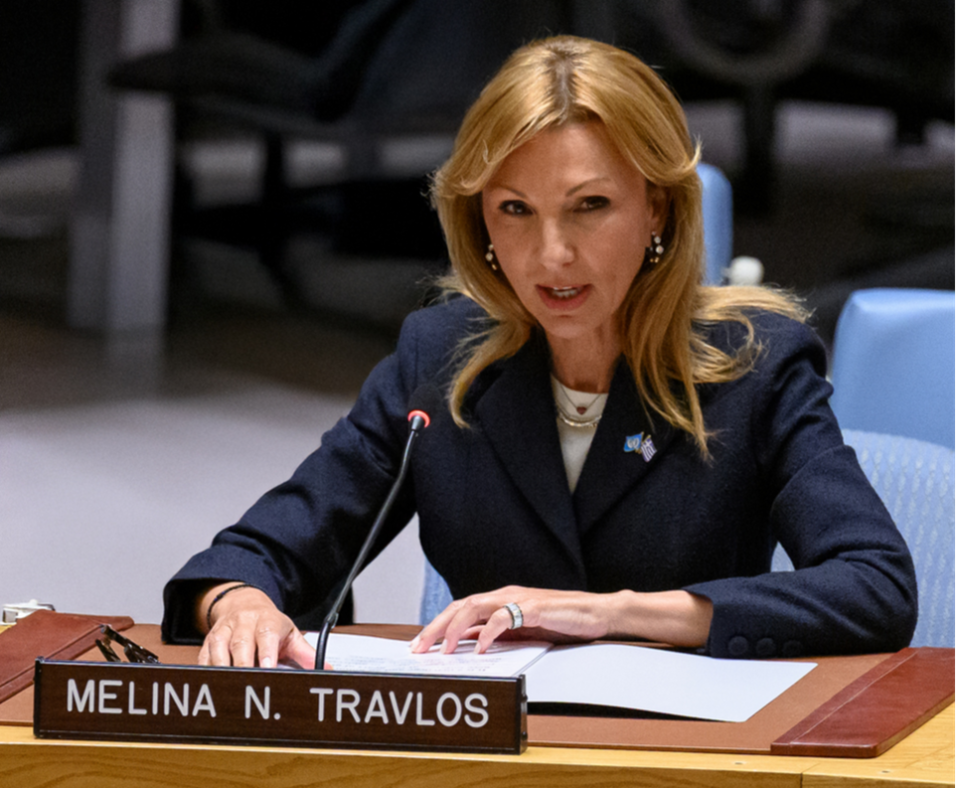
Greek shipping remains a stabilising force at a time of geopolitical upheaval, Union of Greek Shipowners president Melina Travlos said, warning that attacks on merchant vessels and seafarers have become part of a new and dangerous reality for global trade.
In a statement ahead of Posidonia, Travlos said shipping continues to “move the world”, keeping “economies functioning, societies supplied and people connected” despite a period marked by “geopolitical realignments, uncertainty and multiple crises”.
She said Posidonia brings the international maritime community to Greece, “home to the world’s leading shipping nation”, at a moment when the strategic importance of the sector has become even clearer.
Shipping, she said, “does not merely transport goods and energy”, but “safeguards the very functioning of the modern world”.
Travlos said the industry is now operating under growing geopolitical pressure, with threats to freedom of navigation and attacks on commercial ships no longer seen as isolated incidents.
“They have become a new reality, testing maritime routes, supply chains, energy security and global economic stability,” she said.
The safe and uninterrupted operation of maritime transport, she added, is “a prerequisite for humanity’s welfare”, as ships carry “food, medicines, energy, raw materials and essential goods” at a scale and efficiency unmatched by any other system of transport.
For that reason, Travlos said maritime security must be treated as “a global public good and a collective responsibility”.
“The protection of human life at sea, of merchant vessels and freedom of navigation must be a non-negotiable duty of the international community,” she said.
Turning to Greece’s role, Travlos said Greek shipping continues to show “strength, reliability and resilience” in this more difficult environment, representing “almost 20 per cent of global capacity and more than 60 per cent of the EU-controlled fleet”.
But she said the sector’s leadership is “not only measured in numbers”.
“It is reflected in the consistently principled and institutional stance of the Union of Greek Shipowners on all critical issues concerning our sector and international maritime policy,” Travlos said.
“It is reflected in our foresight, our investments and our ability to respond with consistency, composure and determination to constantly changing global conditions,” she added.
Travlos also placed Greek shipping at the centre of the industry’s green transition, saying it has “one of the youngest fleets worldwide and the largest alternative-fuel-capable fleet globally”.
“Our investments in new build vessels, innovative technologies, digitalisation and emission-reducing solutions are continuous and substantial,” she said.
However, she warned that the shift towards decarbonisation must be rooted in realism, rather than ambition alone.
“The transition towards decarbonisation requires realism, technological maturity and global alignment,” Travlos said.
“It must not compromise the safety of crews and vessels, nor the viability of shipping and global supply chains,” she added.
A sustainable transition, she said, must be “safe, practical and implementable, fair for all parties and operationally effective worldwide”.
Travlos said the recent discussions at IMO MEPC 84 give the international community “a second chance to restore consensus” and work towards “a realistic, fit-for-purpose and workable global framework for the reduction of greenhouse gas emissions from ships”.
However, she said the success of such an effort depends on “safe, available, economically viable and scalable alternative fuels worldwide”.
Despite the pressure facing the industry, Travlos said shipping has repeatedly shown that it can respond with “resilience, prudence and resolve, even through the most turbulent waters”.
“And it will continue to do so,” she said.
“Because shipping is a force of vital continuity for the world. In times of crisis, it keeps the routes of cooperation open. In times of uncertainty, it provides stability. In times of transition, it ensures that progress can continue,” Travlos added.
Greek shipping, she said, will continue to lead “with purpose and vision”.
“With its seamanship, resilience and unity, it will continue to connect the world with consistency, vision and a sense of responsibility for generations to come,” Travlos concluded.





Click here to change your cookie preferences