
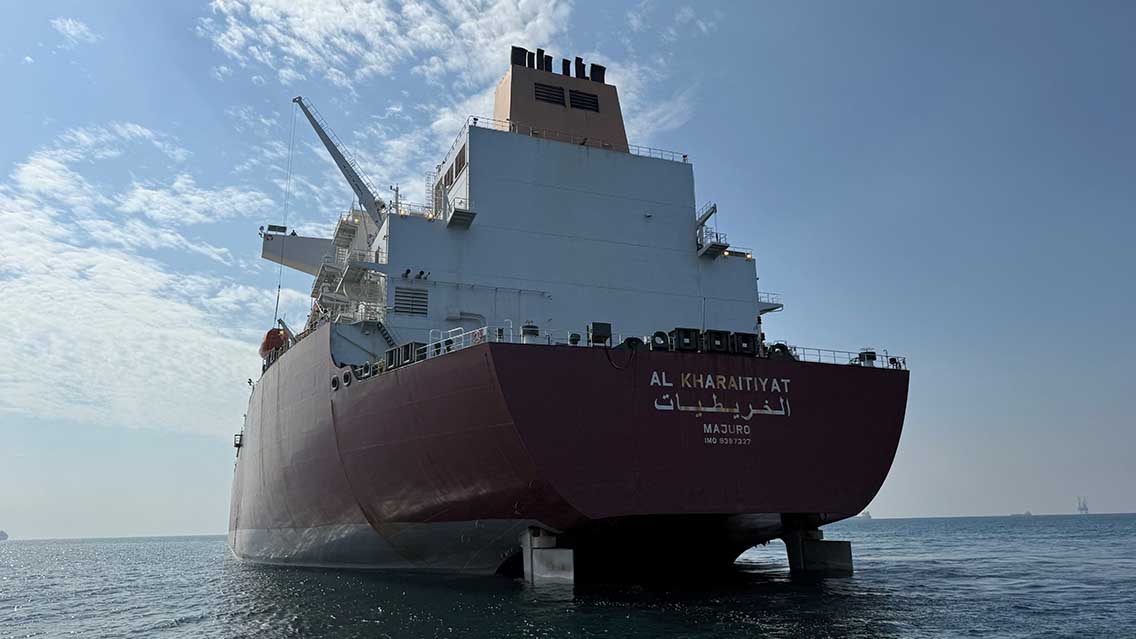
Greek refineries are its dominant supplier, providing about 53 per cent of Cyprus’ refined petroleum products imports in 2025
The US-Iran ceasefire remains in place, but President Trump’s repeated warnings keep oil prices high, over $110/b. The much-heralded Trump-Xi summit in Beijing was more of a show than substance and did not produce any breakthroughs.
China said that finding a solution to the conflict is beneficial to both the US and Iran, but Xi gave no indication that he will help the US reopen the Strait of Hormuz. Trump, more optimistically, said the US and China share common goals for ending the Iran war. But at the same time warned that he will not be much more patient with Iran, sending prices back up.
We are in mid-May and there are still no indications when the war will end, or the Strait of Hormuz will open, or when oil supply will get back to normal. If anything, Trump’s statement earlier in the week, that “we don’t have to rush anything…we have a blockade which allows them no money,” implies a prolonged closure.
What is clear, though, the longer this takes the nearer the world gets to real shortages in fuel supply, especially jet fuel. Not only is about 14 mb/d (thousand barrels per day) currently blocked and prevented from reaching markets, but this includes about 20 per cent of global seaborne supply of jet fuel, 15-20 per cent of petrol and 10 per cent of diesel. According to the IEA, by early May more than 1 billion barrels cumulative supply from Gulf producers had already been lost. This was partly offset by the release of strategic reserves and increased production outside the Gulf, about 4 mb/d, and crude already on ships before the war, another 4 mb/d, leaving a net deficit of about 6 mb/d.
But these supplies are not inexhaustible and are depleting fast. The IEA assumes that flows through the strait will gradually resume from June. If this does not happen it will affect refinery feedstock availability as global oil inventories deplete at a record pace, with the likelihood that oil supply shortages start becoming serious.
In any case, the IEA warned that the oil market will be “severely undersupplied” through to September even if the conflict ends by early June. Further “price volatility appears likely ahead of the peak summer demand period.”
Cyprus sources most of its oil fuels from Greek refineries. Before the war this amounted to 53 per cent of Cyprus’ fuel demand.
Greek refineries
Greek refineries have been adapting well to the crisis, with new oil trade flows emerging to compensate for lost Gulf imports. They are highly export-oriented and quite sophisticated. They can switch crude grades more easily than many of their European competitors. That flexibility becomes extremely valuable during a supply shock, as is happening now. The main danger comes if the war becomes prolonged and global recession follows.
As a result of the war Greek refineries lost over 20 per cent of their crude oil supplies, but, so far, they have been able to replace these through increased imports from Kazakhstan, Libya, the US and Norway. Greece also released 2 million barrels of its 20 million barrels strategic reserves.
The strategic advantage of Greek refineries have is that they are not dependent on any single crude source or region. They can process a wide crude range and they are logistically well-positioned. This allows them to remain operational longer in crises. But the switch to increased imports away from the Gulf brings more complex logistics and higher costs.
There are also risks associated with increased dependence on Libya, given its inherent instability and the fact that it cannot scale indefinitely. Kazakhstan announced a significant reduction in exports in June because of maintenance. It is also indirectly exposed to Russia transit risk. US crude is not always ideal refinery yield mix.
There are also additional constraints impacting the crude mix Greek refineries import. They cannot run too much light crude from Libya and the US, as it can cause product yield imbalances. Similarly, loss of Iraqi and Saudi crude impacts diesel yields. Such constraints make crude refining less efficient and crude products more expensive.
If Hormuz remains blocked beyond May, the first six to eight weeks are manageable with no crude or fuel shortages, only increasing prices. The real danger starts if Hormuz remains closed into August. Then replacement crude is no longer just “available at a higher price” but becomes allocated to the highest bidder, likely to cause fuel supply disruptions. That is the critical transition point where we may experience refinery throughput cuts, export prioritisation and fuel supply shortages. If Hormuz remains closed beyond August, disruption could become severe and prolonged.
In summary, Greek refineries are protected until mid-July, but fuel prices will carry on rising. They begin to feel strain if the strait remains closed until mid-August, with physical shortages becoming possible if disruption persists beyond that,
The most likely scenario is that Hormuz opens before mid-July, but if the US and Israel start bombing Iranian infrastructure again, the extreme scenario may arrive earlier.
What does all this mean for Cyprus
Cyprus is one of the most energy import-dependent countries in Europe, making it vulnerable to market conditions beyond its control. Greek refineries are its dominant supplier, providing about 53 per cent of Cyprus’ refined petroleum products imports in 2025. Apart from Greece, Cyprus depends on the open Mediterranean market, and not on a diversified set of suppliers. Currently at mid-May, Cyprus reference prices were about €1.56/litre petrol 95, €1.85/litre diesel and €0.30/kWh for electricity.
If Hormuz opens by the end of May petrol prices are likely to carry on rising to a peak summer price of €1.65–€1.80/litre and diesel to €2.00–€2.20/litre, with electricity going up by 5-10 per cent in June, and decline slowly after that.
If it remains closed to mid-July petrol could rise to €1.85–€2.00/litre, diesel to €2.50–€2.75/litre, with electricity going up by 15-25 per cent in July. Jet fuel tightness could send prices 40-70 per cent up, impacting flights and tourism. There could also be a small-to-moderate supply risk.
Real supply risks, 25-50 per cent, will emerge if the strait remains closed into August and beyond. Cyprus’ small import dependent system could become seriously vulnerable, with high risk of diesel shortages. Jet fuel is also likely to experience supply stress, impacting flights and tourism. Petrol could rise to €1.95–€2.20/litre, diesel to €2.75–€3.10/litre, jet fuel by 60-100 per cent, and electricity by 25-40 per cent in September.
Because of the size of its market and its geography, Cyprus’ resilience depends less on global oil availability and more on securing priority access within the Mediterranean oil trading system.
However, it is important to stress here that the most likely scenario is that Hormuz will open by June, with Cyprus experiencing higher prices but no fuel shortages.





Click here to change your cookie preferences