
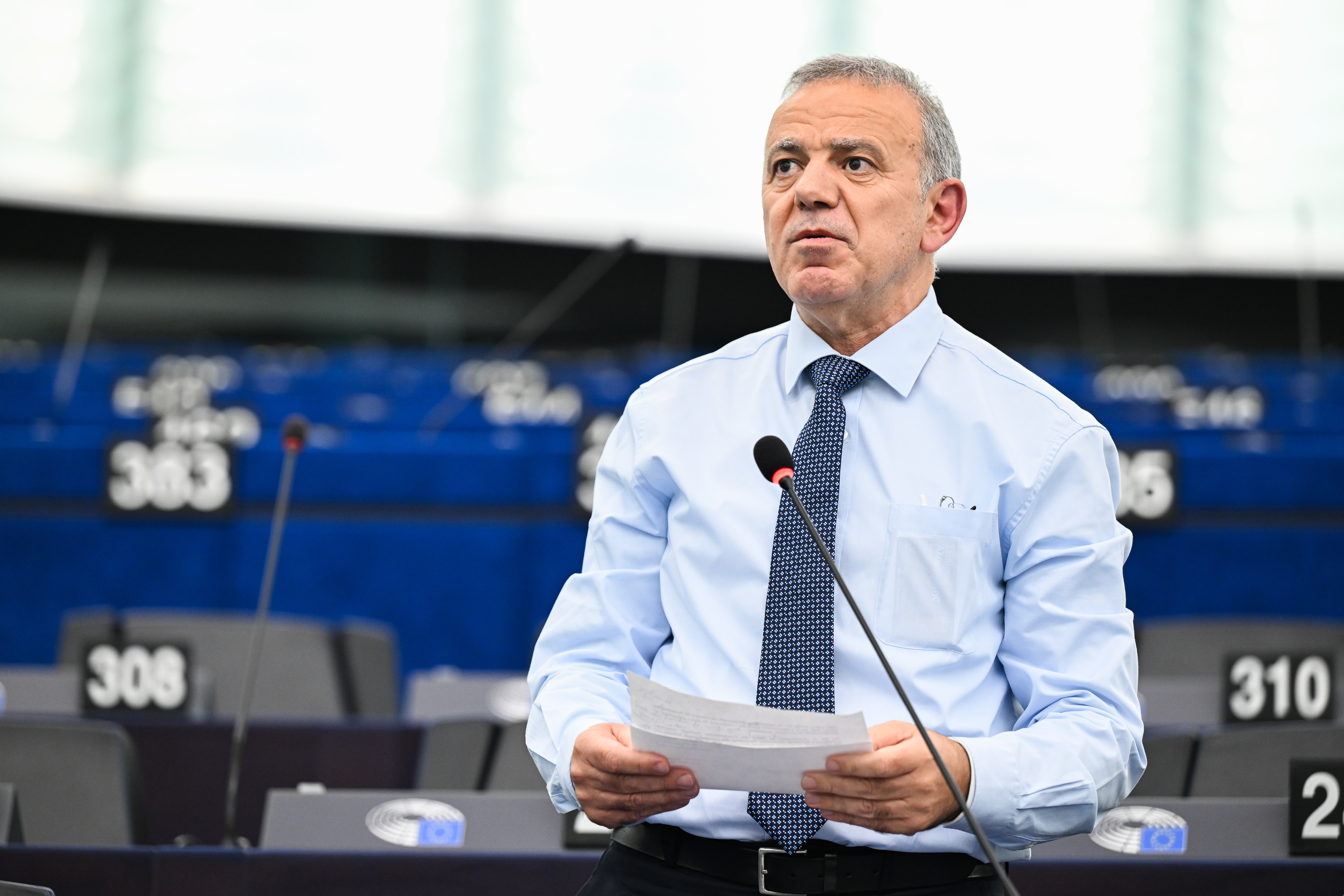
Cypriot member of the European Parliament Costas Mavrides, of Diko, called on the European Union to impose sanctions on Turkey should the country’s parliament pass the planned “maritime jurisdiction law”.
Should it pass, the law will codify the country’s maritime claims in the Aegean and Mediterranean seas in line with the “Blue Homeland” doctrine, known as the “Mavi Vatan” in Turkish.
“The Erdogan regime in Turkey is planning to give institutional status to the so-called ‘Blue Homeland’ doctrine, and this will be the beginning of a new invasion of the Aegean and of the eastern Mediterranean,” he told a plenary session in the Strasbourg chamber late on Monday night.
He added that the Blue Homeland doctrine “constitutes a blatant violation of the United Nations convention on the law of the sea [Unclos], which we, as the European Union, have already ratified”, and that it “is essentially directed against the European Union itself, and not simply against Greece or Cyprus”.
“We, the European Union, and the European Parliament especially, strongly condemned it in 2019,” he said, though it is unclear exactly to what he was referring in this regard, with the term “blue homeland” never having been used in any European Parliament resolution.
He then said that “unfortunately, however, history teaches us the following: as in the 1974 Turkish invasion of Cyprus, when the perpetrator, in our case Turkey, is not punished for a crime, it repeats it and consolidates and expands”.
“The decision is therefore directed against the entire European Union. The question before us is this: will we react in practice? Will we impose sanctions on Turkish expansionism? If we do not move forward, however, we should know that Islamofascism is advancing against the entire European Union itself,” he said.
His comments come after President Nikos Christodoulides had said on Monday evening that he expects for there to be a “European” response should Turkey’s parliament pass the bill.
“It affects Cyprus, it affects Greece, it also other European states, but it also affects the United States, which has interests in this particular region,” Christodoulides said, adding that those interests are “based on international law” and “on [Unclos]”.
He said that he had discussed the matter with Greek Prime Minister Kyriakos Mitsotakis when he visited Athens last week, and that the issue had also been raised “with European leaders”.
Turkey’s defence ministry had said last Friday that the bill “will define responsibilities in our maritime jurisdiction areas and address shortcomings in our domestic legal framework”, and that the finishing touches are being put to the bill.
Last Thursday, Turkish public broadcaster TRT had reported that sources from the country’s ruling AK Party had informed it that “under the regulation, the exclusive economic zone (EEZ) and continental shelf boundaries, which constitute Turkey’s maritime borders, will be codified into law” with the bill.
“The draft also addresses the legal status of the islands, islets, and rocks in the Aegean Sea, which occasionally cause tension between Turkey and Greece and are referred to as ‘grey zones’. The description and status of these geographical formations will be included into the ‘Blue Homeland law’,” it said.
It also stressed that the bill will be drafted “in accordance with the principles of international maritime law”.
Greece and Turkey have long disputed their maritime boundaries, with the disagreement stemming from the question of whether islands generate their own EEZ or not.
In line with Unclos’ definition, Greece’s position is that its islands each generate an EEZ, while Turkey’s position is that they do not, and that as such, its own EEZ stretches halfway across the Aegean towards the Greek mainland.
The maritime claims of Turkey and the Republic of Cyprus clash for the same reason, with the Republic of Cyprus placing its own western boundary further west than where Turkey believes it to be.
The bill is expected to be brought before the Turkish parliament in early June, after the Eid al-Adha holiday.




Click here to change your cookie preferences