
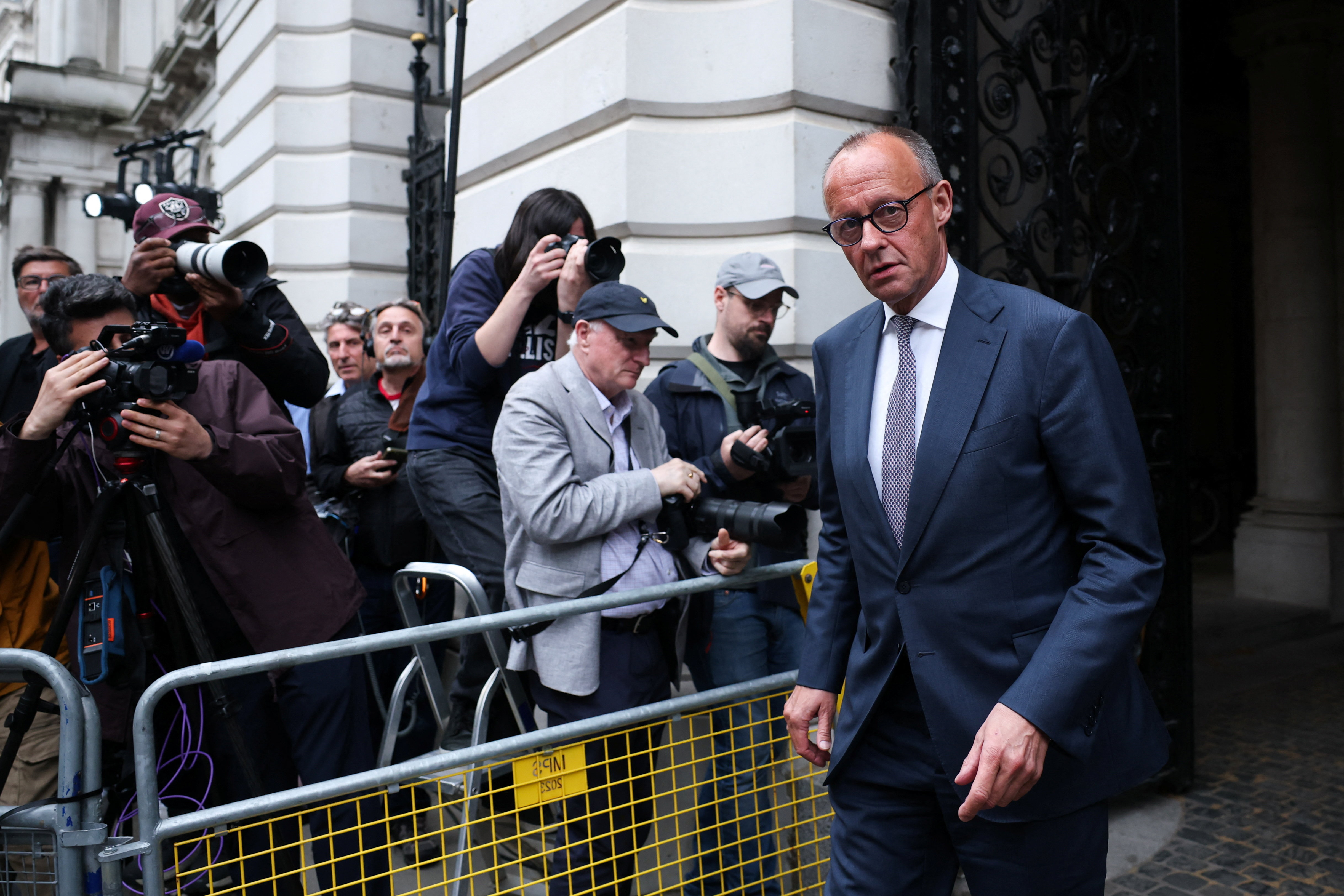
The leaders of Germany and France have agreed to scrap a landmark project to develop and build a new-generation fighter jet, two German officials said on Monday, bowing to industrial rivalries over Europe’s most ambitious defence programme.
German Chancellor Friedrich Merz and French President Emmanuel Macron discussed the troubled project on the sidelines of the EU-Western Balkans summit in Montenegro last week and concluded there was no prospect of breaking months of deadlock between arms firms involved in the plan, the officials said.
Merz has therefore advised Macron not to pursue the construction of a joint fighter aircraft any further, they said.
The decision to end the core pillar of Europe’s largest defence project comes at a time when Western military officials have warned of a growing threat from Russia and the United States is stepping up pressure for Europe to re-arm itself.
There was no immediate word from France, where Macron launched the project with former German Chancellor Angela Merkel in 2017. His office did not respond to a request for comment but French industry sources conceded the most visible core of the project – involving a crewed fighter jet – was over.
Failure to reach an agreement on the €100-billion ($116 billion) project, which also includes Spain,underscores the struggles Europe has faced in rebuilding its military capacity after decades of underinvestment.
“It’s hardly ideal signalling either to Washington or to Moscow,” said Douglas Barrie, senior fellow for military aerospace at think tank IISS.
FACE-SAVING SOLUTION
The project, which centres on a core fighter jet supported by drones and linked by a classified “combat cloud”, had been in doubt for months as the two sides have wrangled over specifications and control.
A European source briefed on the matter said the two sides were moving towards a face-saving solution in which the systems outside the core fighter, such as the “combat cloud” of highly secure links, would continue to be developed under the same name: Future Combat Air System or FCAS.
The compromise is mainly symbolic since FCAS is a generic name for such systems and not unique to this plan, but officials have been seeking a formula allowing Macron to relinquish the core fighter without having to declare the whole project dead.
Macron and Merz had tried for months to salvage the project and overcome differences between the main industry partners, European aerospace group Airbus AIR.PA, which represents Germany and Spain, and France’s Dassault Aviation AM.PA.
As well as disputes over control of the nect phase of development and access to intellectual property, the two sides had widely differing requirements for the aircraft.
The breakdown over the core fighter echoes France’s decision to withdraw from the Eurofighter in the 1980s and follows years of increasingly public bickering between Dassault and Airbus.
“SCAF has been on life support for three years,” said UK-based defence analyst Francis Tusa, referring to the project’s French acronym.
Merz has openly questioned whether developing a manned sixth-generation fighter jet still made sense for his country’s air force, and said Germany did not need a nuclear-capable jet that could land on an aircraft carrier.





Click here to change your cookie preferences