
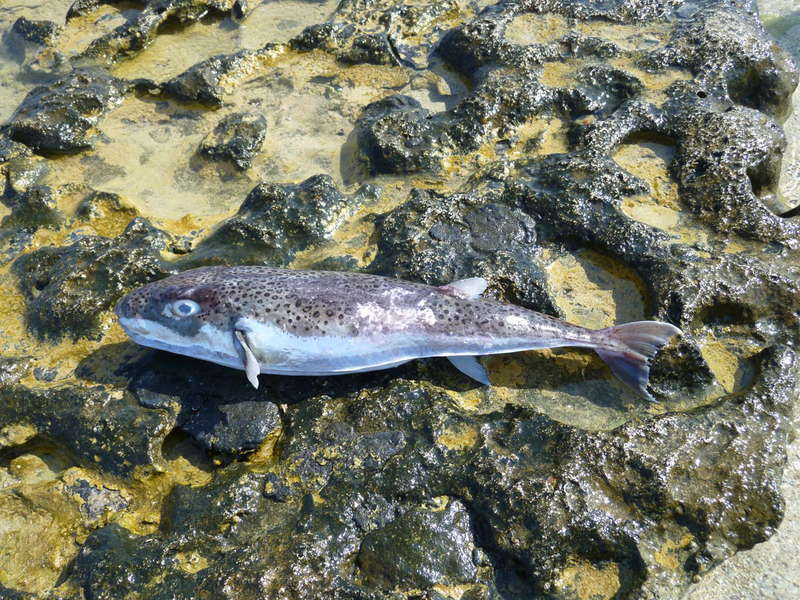
The invasive silver-cheeked toadfish poses no threat to bathers or swimmers, the fisheries department assured on Monday following recent reports and social media discussion suggesting the species could be dangerous to people in the water.
Officials stressed there is no evidence of unprovoked attacks on humans and said concerns over swimmer safety have been exaggerated.
The department told the Cyprus Mail that the fish is dangerous only if consumed and urged the public to remain calm.
“The fish poses no threat to bathers or swimmers. It is only poisonous when consumed,” officials said.
The comments come days after renewed attention on the species, scientifically known as Lagocephalus sceleratus and locally referred to as lagokefalos, prompted concern among beachgoers across the Levant.
Environmental organisation iSea also sought to dispel fears, describing claims of attacks on bathers as unsupported by available evidence.
“There are no recorded incidents of attacks,” communications manager Anastasia Charitou said.
She explained that reported encounters in Cyprus and Greece involved situations where people approached, touched or fed fish that had become trapped in shallow waters.
Speaking to Sigma, biologist and oceanographer Evagoras Isaias likewise rejected concerns about attacks on swimmers, saying there have been no recorded incidents in Cyprus and that reports elsewhere were linked to human interaction with the fish.
“The fish defends itself only when disturbed,” he said, adding that videos circulating on social media often showed people approaching or feeding the species before provoking a reaction.
“Under no circumstances can you swim and be attacked by a lagokefalos,” Charitou said, adding that even snorkellers are unlikely to experience aggressive behaviour.
The silver-cheeked toadfish is an invasive species that entered the Mediterranean through the Suez Canal and has become firmly established in Cypriot waters over the past two decades.
It is considered one of the most successful invasive fish species in the region due to its rapid growth and ability to adapt to a wide range of habitats and food sources.
Isaias said the species has been present in Cypriot waters for around 20 years, with its presence scientifically documented since 2006.
He described it as a highly adaptable and opportunistic predator capable of consuming a wide range of marine organisms, a characteristic that has contributed to its successful spread across the Levant.
The species is capable of reaching more than one metre in length and contains tetrodotoxin, a powerful neurotoxin concentrated mainly in its liver.
Consumption can lead to paralysis, respiratory failure and death, as there is currently no antidote for the toxin.
For that reason, the sale and marketing of the fish is prohibited throughout the European Union.
While authorities have repeatedly warned against consuming the species, they have also emphasised that it presents a very different challenge to fishermen than to the general public.
The fish is widely regarded as one of the biggest problems facing Cyprus’ coastal fishing sector because of the damage it causes to nets, fishing gear and catches.
Its strong beak-like teeth allow it to tear through equipment and prey on fish trapped in nets.
Earlier this month, the fisheries department announced that more than 103 tonnes of the species had been removed from Cypriot waters through a government funded eradication programme launched in 2024.
Around 150 professional fishermen are participating in the scheme, which pays €4.73 per kilogramme collected.
Despite those efforts, fisheries officials acknowledge that completely eliminating the species is unlikely.
Environmental groups have urged the public to focus on the real challenges posed by invasive species, including their impact on biodiversity, fisheries and marine ecosystems, rather than fears of attacks on swimmers.
“There is no reason for a bather to take precautions against lagokefalos attacks,” Charitou said.




Click here to change your cookie preferences